NZD/USD: Dollar weakness brings 0.5640 into focus despite soft New Zealand jobs data
- NZD/USD buyers eye 0.5640 resistance, with 0.5580 remaining the key support.
- Weak New Zealand employment figures dampen expectations for further RBNZ tightening.
- Post-election Dollar weakness and falling Treasury yields offer support to the pair.

The New Zealand Dollar remains under pressure following the RBNZ’s surprise decision to hold interest rates last week, despite markets having heavily priced in a hike. The latest labor market figures have added another challenge for the currency.
Employment fell 0.1% q/q, against expectations for a 0.4% increase, while unemployment rose to 5.7% from 5.6%. The weaker figures suggest continued spare capacity in the labor market, reducing pressure on the RBNZ to raise rates at its next meeting.
However, the report does not eliminate the possibility of further tightening. The RBNZ’s October decision was narrowly split, with four members favoring a hold and three supporting a hike. The central bank maintained that tighter policy would likely be necessary, depending on the economic outlook.
For NZD/USD, weakness on the US side of the equation is providing an offset. The Dollar retreated after Democrats won control of both chambers of Congress, as investors assessed the implications of political gridlock and potentially constrained government spending.
The US 10-year Treasury yield remains below 5%, offering some support to NZD/USD despite New Zealand’s weaker domestic backdrop. Nevertheless, a sustained recovery in the pair would require Dollar weakness to persist; the election result alone does not guarantee that outcome.
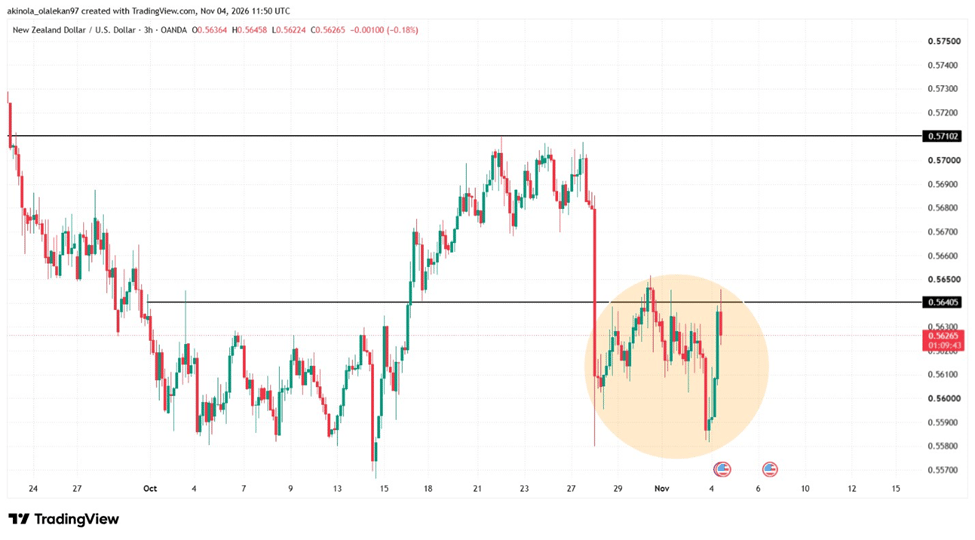
The technical focus remains on the 0.5580–0.5640 range. Buyers need a sustained break above 0.5640 to suggest that Dollar weakness is outweighing the pressures on the Kiwi. Such a move could strengthen the case for a broader recovery.
Sellers could retain support from the softer employment outlook and reduced expectations for RBNZ tightening. Another rejection at 0.5640 would leave the range intact, while a sustained break below 0.5580 would strengthen the bearish case.
Until either boundary gives way, the pair remains caught between weak New Zealand fundamentals and a softer US Dollar.
Author

Olalekan Akinola
Independent Analyst
Olalekan Akinola is a financial-markets analyst and writer with five years of experience covering forex, commodities, and global macroeconomic developments.