Natural Gas reaches a 337-report bullish COT extreme as grain positioning turns increasingly bearish

Natural Gas stands out with a 337-report bullish extreme
Natural Gas produced the clearest signal in this week’s Commitments of Traders review.
The market has reached a 337-report bullish COT extreme. In practical terms, the current positioning is more stretched on the bullish side than at any point covered by the previous 336 weekly reports.
I would not treat that as a timing call. COT extremes can remain in place for some time before price reacts, and they can become even more stretched. But a lookback of this size tells me that the positioning backdrop is historically unusual and deserves attention on a medium-term horizon.
My interpretation is therefore constructive rather than immediate: the COT structure supports the possibility that Natural Gas can continue higher, but the signal should be used as positioning context rather than as a precise entry trigger.
Wheat shows a bearish weekly shift as Commercials move net short
The grain markets are telling a very different story.
In wheat, Commercial net positioning changed by a larger-than-average amount and produced a bearish COT change signal. On the one-year chart, the shift is especially notable because Commercials, who had been net long throughout that period, moved net short.
That does not mean Commercials are simply making a directional bet against wheat. They are physical-market hedgers, and their positions reflect underlying business exposure. Even so, a rapid weekly adjustment of this size can be informative because it shows that their exposure changed materially.
There is also an important practical limitation. The COT report describes positions as of Tuesday but is released on Friday. By the time the signal becomes public, part of the price reaction may already have occurred. That lag is one reason I use COT primarily for context rather than precise timing.
Corn is developing a clear bearish positioning stress
Corn reinforces the bearish grain theme.
Over roughly the past two months, traders have shifted their positions rapidly. On a ten-year chart, the speed of that change resembles earlier periods when bearish stress built quickly before the market weakened.
I would still avoid calling an exact top. COT analysis does not identify turning points with that level of precision. What it does show clearly is that positioning stress has moved to the bearish side.
Earlier bearish extremes in February and again in May were followed by declines. Those episodes are useful historical context, but they are not a forecast that the present signal must resolve in the same way. The current move could extend before price responds.
The soybean complex adds a sector-wide bearish signal
The soybean complex is also showing a bearish extreme.
Here I am not looking at a single contract in isolation. The broader reading combines soybeans, soybean oil and soybean meal, and the sector is currently stretched on the bearish side.
That matters because several grain-related markets are now pointing in broadly the same direction. Wheat has produced a bearish weekly change signal, corn is showing a rapid build-up of bearish positioning stress, and the soybean complex is already at an extreme.
The alignment does not guarantee lower prices across every contract or on the same timetable, but it gives the bearish grain story more weight than any one signal would have on its own.
COT is a compass for positioning, not an entry system
This week provides a useful contrast in how I use COT data.
Natural Gas is showing a rare bullish extreme, while grains are developing a cluster of bearish signals. The value is not in forcing all of those readings into a short-term forecast. It is in identifying where positioning has become historically unusual and where market participants are changing exposure quickly.
I think of COT analysis as a compass. It can tell us the general direction of positioning pressure, but it is not designed to pinpoint exact entries and exits.
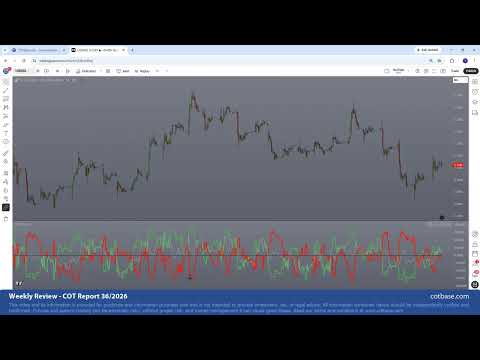
I walk through the Natural Gas extreme, the grain signals and the underlying charts in this week’s full COT review:
This content was partially created by an AI tool.
Author

Thomas Lukacs
COTBase.com
Thomas Lukacs is the founder and CEO of COTbase.com.