Market forces, missed opportunities
The one silver lining about high prices for fossil fuels is that they discourage consumption. Obviously, that’s not a good thing in terms of affordability in the near term, but it may be good news for those who see climate change as a real and present danger. Here we have an opportunity for a far-sighted leader to use the occasion to accelerate our move away from fossil fuels to other green energy alternatives.
Did I say, “far-sighted leader?” No such luck with Donald Trump at the helm. When we should be committing to increased production of wind and solar energy sources and encouraging the development of greater efficiencies for batteries and electric vehicles, Trump seems to be doing all he can to make matters worse. Not only have many of the incentives that had been spurring these activities been discontinued under Trump’s grossly misnamed “Big Beautiful Bill,” but according to Chemical and Engineering News, as of October 2025, the Department of Energy had halted $7.5 billion of funding for 223 energy projects. in many cases, those projects were well underway, effectively wasting much of the money that had already been spent. I’ve seen nothing since suggesting any indication that this orientation has been rescinded.
As an economist — and one who generally favors a free-market orientation — I admit to some reservations about the apparent reliance on federal funding by this industry. That said, in this instance, the national security considerations tend to override. I wish, however, that private lenders would step in where the government is stepping back; but that doesn’t seem to be happening. Instead, the direction of the government appears to have spilled over to the private sector, with $22 billion of clean-energy projects canceled just in the first half of 2025.
In light of the myriad executive orders that have added considerably to the uncertainty that businesses have faced under this Trump administration — think of the dramatic increase in tariffs, the impact of widespread fear of deportation in communities of immigrants on our labor markets, and the prospect of higher prices and world-wide economic stagnation due to a poorly planned and executed war with Iran — the reluctance of private lenders to step into the fray may be understandable.
Meanwhile, much of the rest of the world is thinking more clearly, stepping up where America is retreating. I’m no expert on these developments, so I used AI to generate a list detailing how many countries across the world have adapted to the new calculus of energy markets.
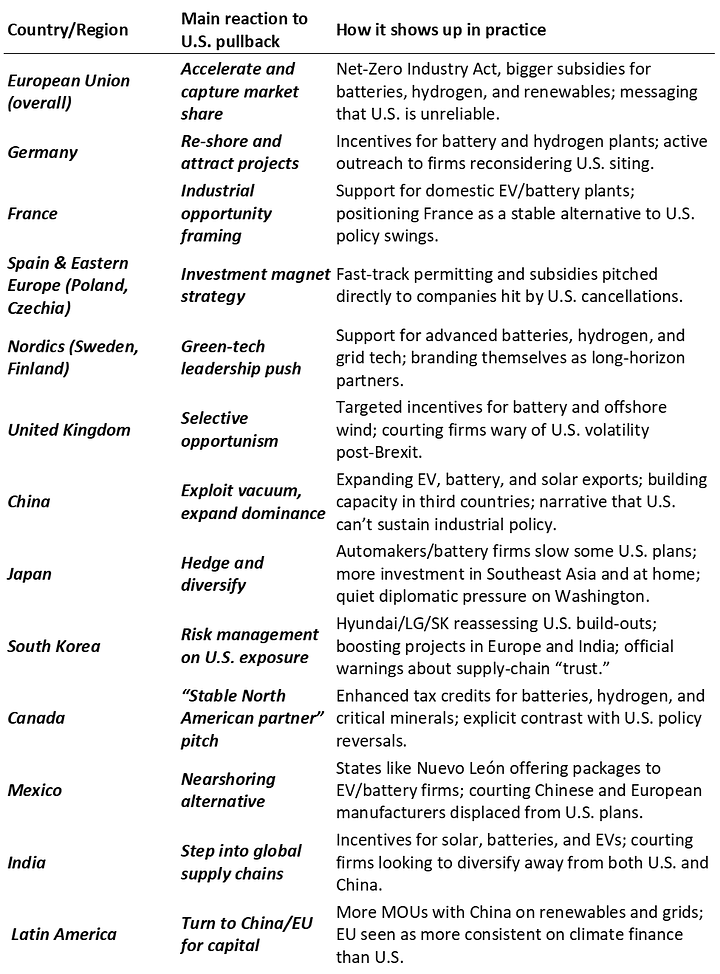
We’ve got an idiot in the White House blindly pursuing a policy of “drill baby drill,” an Energy Department that has abandoned critical thinking and instead serves the president as a rubber stamp, and a Congress unwilling or unable to exercise appropriate oversight or control. Meanwhile, all the countries listed above are eating our lunch — and we’re serving it to them on a silver platter. We’re ceding the markets, the jobs, and the technical advances that, under other circumstances, would have naturally been ours for the taking. Yet another self-inflicted wound courtesy of the Trump Administration.
Author
_Profile.jpg)
Ira Kawaller
Derivatives Litigation Services, LLC
Ira Kawaller is the principal and founder of Derivatives Litigation Services.