Gold Weekly Forecast: Energy prices, Fed commentary to continue to drive action
- Gold suffered its worst week since March 2020 as major central banks cautioned against inflation risks.
- The technical outlook highlights a bearish tilt in the near term.
- Investors will remain focused on energy prices and the major central banks’ policy outlook.

Gold (XAU/USD) extended its slide into a third consecutive week and lost more than 6%, its worst weekly performance since March 2020, as major central banks adopted a hawkish tone because of the upside risks to inflation posed by rising energy prices. Market participants will continue to keep a close eye on the developments surrounding the Middle East and energy prices, while scrutinizing comments from Federal Reserve (Fed) policymakers after their decision to hold rates steady.
Gold declines sharply in the big central bank week
Gold started the week in a calm manner and failed to make a decisive move in either direction on Monday and Tuesday, as investors refrained from taking large positions ahead of critical central bank decisions.
But the calm ended sharply on Wednesday once the Fed ended its meeting. In the American session on Wednesday, the US central bank announced that it left the policy rate unchanged at the range of 3.5%-3.75%, as expected.
The Summary of Economic Projections (SEP), published alongside the policy statement, showed that officials' projections imply a 25 basis-points (bps) rate cut in 2026 and another 25 bps cut in 2027, unchanged from the December SEP. The details of the publication highlighted that while seven policymakers pencilled in no rate cuts this year, one projected a rate hike next year. Moreover, the end-2026 Personal Consumption Expenditures (PCE) inflation projection got revised higher to 2.7%, from 2.4% in December's SEP.
In the post-meeting press conference, Fed Chair Jerome Powell explained that they expect higher energy prices to push inflation up in the near term and added that rate cuts will not follow if the inflation progress stalls. The US Dollar (USD) gathered strength in the immediate aftermath of the Fed and weighed heavily on XAU/USD, causing the pair to lose more than 3% on the day.
Although the USD Index, which gauges the USD’s valuation against a basket of six major currencies, declined sharply on Thursday following the Bank of England (BoE) and the European Central Bank (ECB) policy decisions, XAU/USD extended its weekly slide and touched its lowest level since early February near $4,500.
The BoE maintained the bank rate at 3.75%, as anticipated, but all nine members of the Monetary Policy Committee (MPC) unexpectedly voted in favor of the decision. In the policy statement, the BoE acknowledged that higher global energy prices are already feeding into petrol prices and said that the MPC is ready to act as needed to ensure the Consumer Price Index (CPI) inflation remains on track to meet the 2% target.
Meanwhile, the ECB said "the war in the Middle East has made the outlook significantly more uncertain, creating upside risks for inflation and downside risks for economic growth," after leaving key rates unchanged. ECB President Christine Lagarde adopted a neutral tone but noted that a prolonged war could increase energy prices for longer and erode incomes. She further added that risks to inflation are tilted to the upside in the near term and said that they could have a "temporary, targeted and tailored" response to the energy shock.
XAU/EUR and XAU/GBP pairs both lost more than 4% on Thursday, highlighting that the ECB and the BoE triggered capital outflows out of Gold to the Euro and the British Pound.
Meanwhile, crude Oil’s rally lost momentum this week but prices remained at elevated levels as the headlines coming out of the Middle East failed to hint at a de-escalation of the conflict.
Gold traders to scrutinize central bank speech, Middle East war
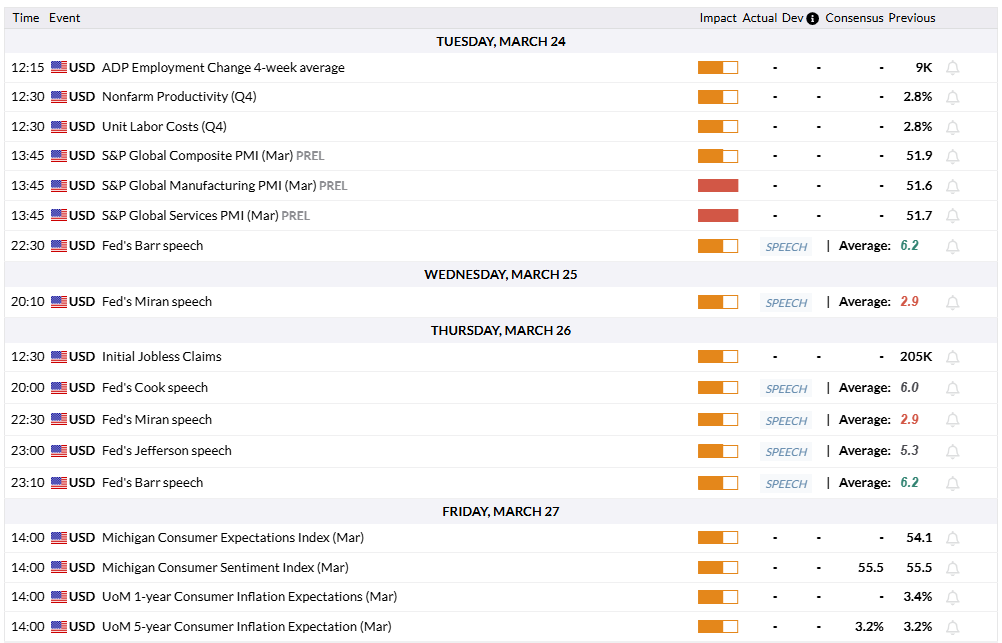
S&P Global will publish the Manufacturing and Services Purchasing Managers’ Index (PMI) data for March on Tuesday. Investors will pay close attention to the commentary surrounding input costs and the private sector’s expectations about the inflation outlook. In case the headline PMIs arrive in the expansion territory above 50 and the publication highlights upside risks to input cost inflation, the immediate market reaction could support the USD and force XAU/USD to stay on the back foot.
The US economic calendar will not feature any other high-tier data releases, so investors will remain focused on comments from policymakers and the fresh headlines on the Middle East crisis.
Citing four sources familiar with the matter, Axios reported that US President Donald Trump’s administration is considering plans to occupy or blockade Iran’s Kharg Island in an attempt to pressure Iran to allow safe passage of vessels through the Strait of Hormuz.
Meanwhile, Prime Minister Benjamin Netanyahu said Israel will halt its strikes on Iranian energy sites after US President Trump voiced his criticism of the Israeli attack on Iran’s Pars gas field, which is also an extension of Qatar's North Field.
It’s difficult to say whether there will be a de-escalation of the conflict in the near term. For markets, changes in energy prices will be key. If there is a significant correction in Oil prices, the USD could come under heavy selling pressure and pave the way for a steady recovery in XAU/USD. On the other hand, Gold is likely to have a hard time shaking off the bearish pressure if Oil prices continue to rise, feeding into inflation fears and reaffirming expectations for a response by major central banks.
Throughout the week, Fed policymakers are scheduled to deliver speeches. The CME FedWatch Tool shows that markets are pricing in a less than 10% probability of a 25-basis-points (bps) rate cut by end-2026. The market positioning suggests that the USD could come under pressure if Fed officials hint that a rate cut is still likely this year. Conversely, another leg lower in XAU/USD could be triggered if policymakers suggest that they could even consider a rate hike in case inflation fears materialize due a prolonged conflict in the Middle East.
Gold technical analysis: Bearish pressure builds
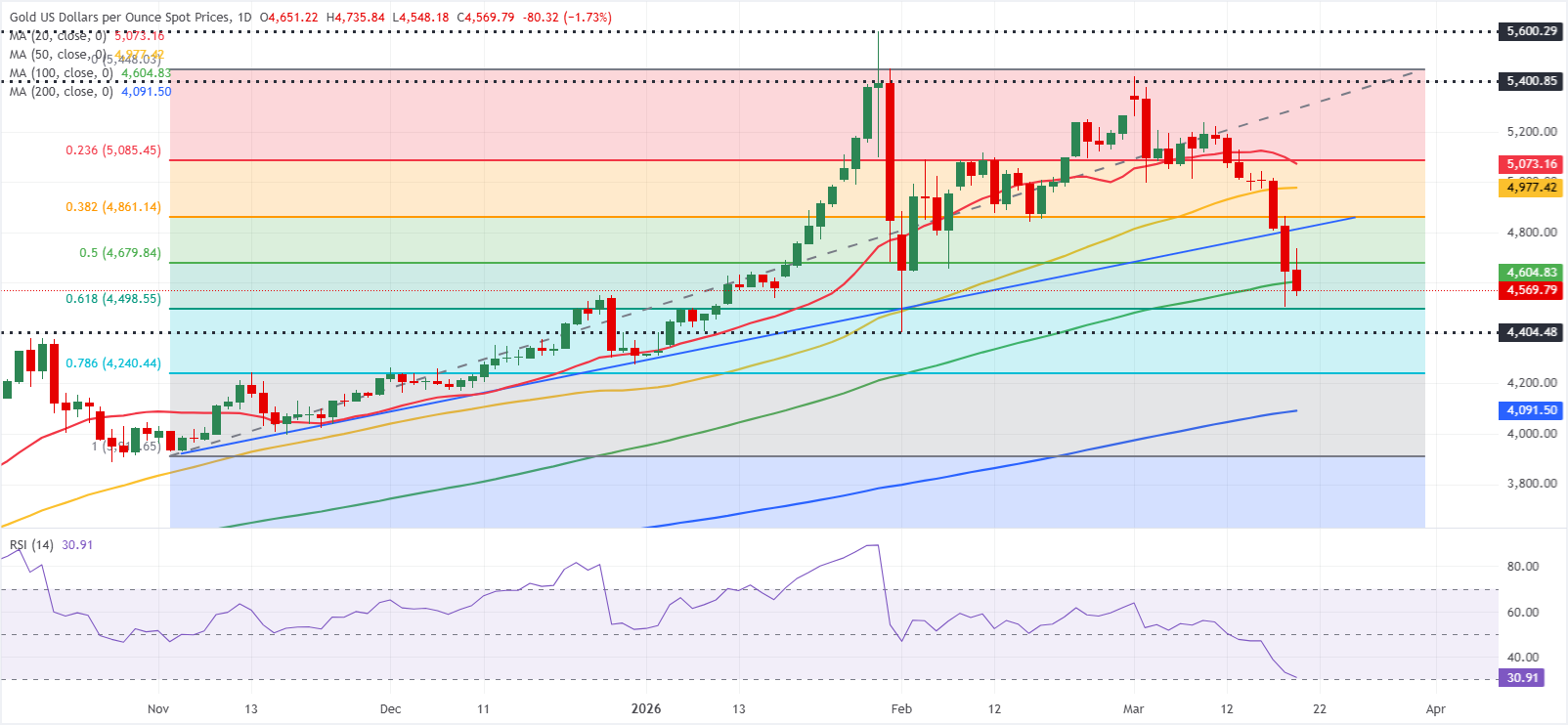
Gold broke below the ascending trend line drawn from early November and dipped below the 100-day Simple Moving Average (SMA). Additionally, the Relative Strength Index (RSI) indicator fell below 40 for the first time since November 2024, highlighting a buildup in bearish pressure.
The 100-day SMA aligns as the a pivot level at $4,600, above the first support at $4,500 (Fibonacci 61.8% retracement level of the November-February uptrend). A daily close below the latter level could attract more technical sellers. In this scenario, $4,400 (static level) could be seen as an interim support level ahead of $4,240 (Fibonacci 78.6% retracement).
If XAU/USD recovers above $4,860 (Fibonacci 38.2% retracement, descending trend line) and manages to flip that level into support, $4,980-$5,000 (50-day SMA, psychological level) could act as the next resistance area ahead of $5,080-$5,100 region, where the Fibo 23.6% retracement level meets the 20-day SMA.
Gold FAQs
Gold has played a key role in human’s history as it has been widely used as a store of value and medium of exchange. Currently, apart from its shine and usage for jewelry, the precious metal is widely seen as a safe-haven asset, meaning that it is considered a good investment during turbulent times. Gold is also widely seen as a hedge against inflation and against depreciating currencies as it doesn’t rely on any specific issuer or government.
Central banks are the biggest Gold holders. In their aim to support their currencies in turbulent times, central banks tend to diversify their reserves and buy Gold to improve the perceived strength of the economy and the currency. High Gold reserves can be a source of trust for a country’s solvency. Central banks added 1,136 tonnes of Gold worth around $70 billion to their reserves in 2022, according to data from the World Gold Council. This is the highest yearly purchase since records began. Central banks from emerging economies such as China, India and Turkey are quickly increasing their Gold reserves.
Gold has an inverse correlation with the US Dollar and US Treasuries, which are both major reserve and safe-haven assets. When the Dollar depreciates, Gold tends to rise, enabling investors and central banks to diversify their assets in turbulent times. Gold is also inversely correlated with risk assets. A rally in the stock market tends to weaken Gold price, while sell-offs in riskier markets tend to favor the precious metal.
The price can move due to a wide range of factors. Geopolitical instability or fears of a deep recession can quickly make Gold price escalate due to its safe-haven status. As a yield-less asset, Gold tends to rise with lower interest rates, while higher cost of money usually weighs down on the yellow metal. Still, most moves depend on how the US Dollar (USD) behaves as the asset is priced in dollars (XAU/USD). A strong Dollar tends to keep the price of Gold controlled, whereas a weaker Dollar is likely to push Gold prices up.
Author

Eren Sengezer
FXStreet
As an economist at heart, Eren Sengezer specializes in the assessment of the short-term and long-term impacts of macroeconomic data, central bank policies and political developments on financial assets.














