Gold Weekly Forecast: Fed meeting, US-Iran war to keep XAU/USD volatility high
- Gold extended its slide, registered losses for the second straight week.
- The near-term technical outlook points to a loss of bullish momentum.
- Investors will remain focused on the Middle East crisis and Fed meeting.

For the second consecutive week, Gold (XAU/USD) failed to benefit from the risk-averse market atmosphere and registered losses as growing inflation fears boosted the US Dollar (USD). The Federal Reserve’s (Fed) policy decisions, the Summary of Economic Projections (SEP) and the developments surrounding the Middle East conflict will continue to impact Gold’s valuation in the near term.
Gold edges lower on broad USD strength
Mixed geopolitical headlines paved the way for a volatile opening on Monday. Over the weekend, Iranian President Masoud Pezeshkian apologised to the neighbouring countries for attacks launched following United States (US)-Israel strikes and announced that Tehran will not strike "unless they attack first." Meanwhile, the United Arab Emirates, Kuwait and Iraq have decided to reduce Oil production, citing a lack of storage space due to the Iranian threat to the safe passage of ships through the Strait of Hormuz. After Crude prices surged at the weekly opening, news that the International Energy Agency (IEA) was considering a coordinated release of emergency Oil reserves among G7 member countries helped the same correct lower. Following a sharp decline toward $5,000, Gold erased a large portion of its daily losses to close above $5,100.
Gold stretched higher and gained about 1% on Tuesday as investors turned optimistic about a de-escalation of the conflict after US President Donald Trump hinted late Monday that operations against Iran could end soon, saying that "the war is very complete, pretty much."
The US data released on Wednesday showed that annual inflation in February, as measured by the change in the Consumer Price Index (CPI), held steady at 2.4%, as expected. On a monthly basis, the core CPI, which excludes volatile food and energy prices, rose 0.2% to match analysts’ estimates. In the meantime, the IEA announced that its 32 member countries unanimously agreed to make 400 million barrels of Oil from their emergency reserves available to the market. As gains in the commodity prices remained limited midweek, Gold fluctuated at around $5,200 before ending the day marginally lower.
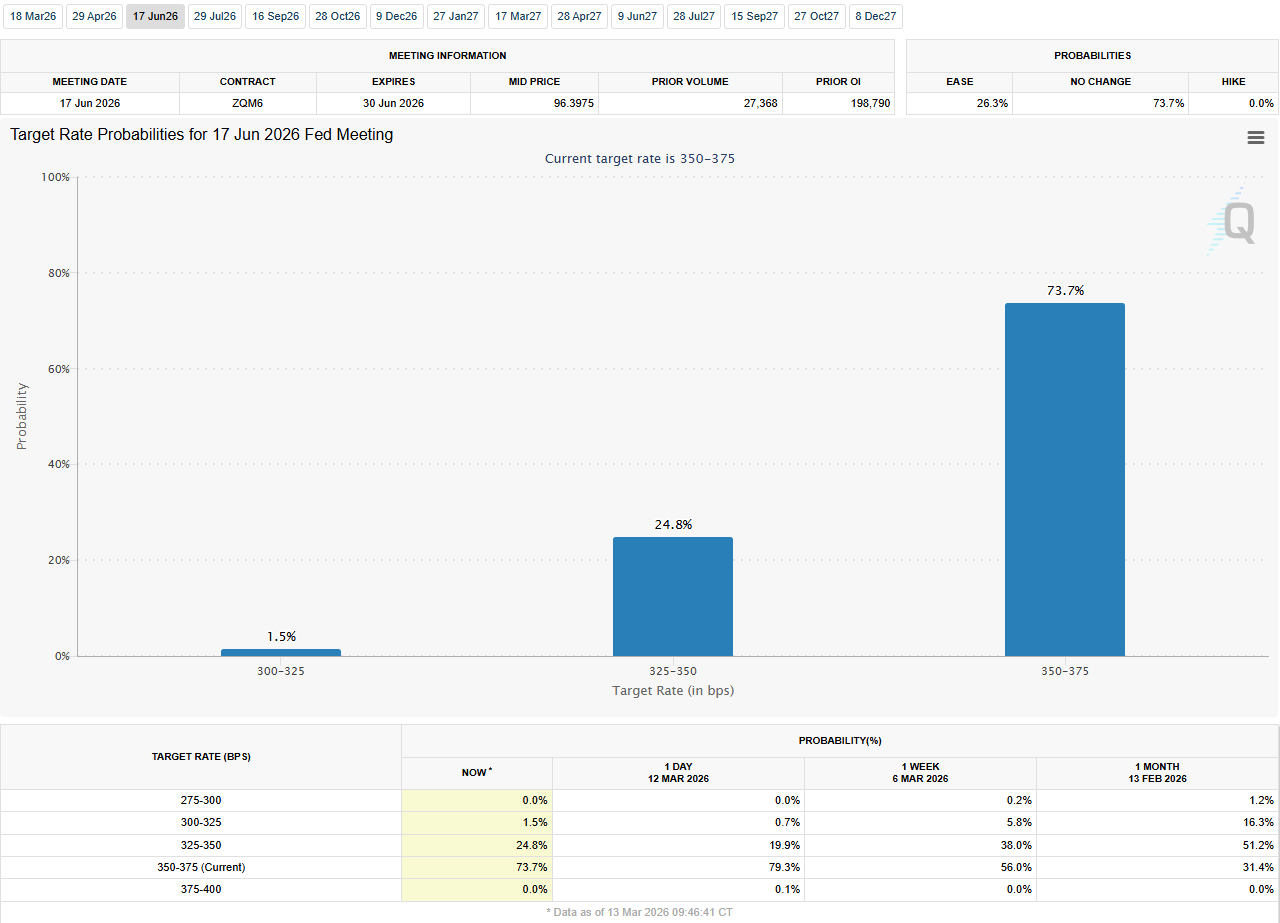
In the second half of the week, Crude prices continued to edge higher as Iraq reportedly shut down port operations after Iran attacked two foreign oil tankers, while Bahrain, Kuwait, the United Arab Emirates and Saudi Arabia said they intercepted drones and missiles. Moreover, Iran’s new supreme leader, Mojtaba Khamenei, said in his first public statement that the closure of the Strait of Hormuz maritime passage should be continued as a “tool to pressure the enemy,” while the Islamic Revolutionary Guard Corps has reportedly threatened to set the region’s Oil and gas infrastructure on fire if Iranian energy sites are attacked. With investors growing increasingly concerned about rising energy prices stoking inflation, the CME Group FedWatch Tool’s probability of the Fed leaving the policy rate unchanged in the next three consecutive meetings climbed to nearly 75% from about 55% a week ago. In turn, the US Dollar (USD) gathered strength and triggered a leg lower in XAU/USD.
TD Securities Senior Commodity Strategist Daniel Ghali highlights surprisingly weak Gold demand since the onset of the war and explains:
"The lack of inflows into Gold reflects (1) concerns around the debasement trade as markets price-out Fed cuts, (2) reduced Gold purchases by Middle Eastern nations; and (3) Gold positioning - Gold is no longer a fringe asset, and is instead now held by a large majority of institutional investors.”
In an attempt to limit Oil’s rise and help global energy markets stabilize, the US announced on Friday that they issued a 30-day waiver for countries to buy sanctioned Russian Oil and petroleum products currently stranded at sea. This headline failed to help Oil prices ease and made it difficult for Gold to hold its ground heading into the weekend.
Gold traders turn attention to Fed
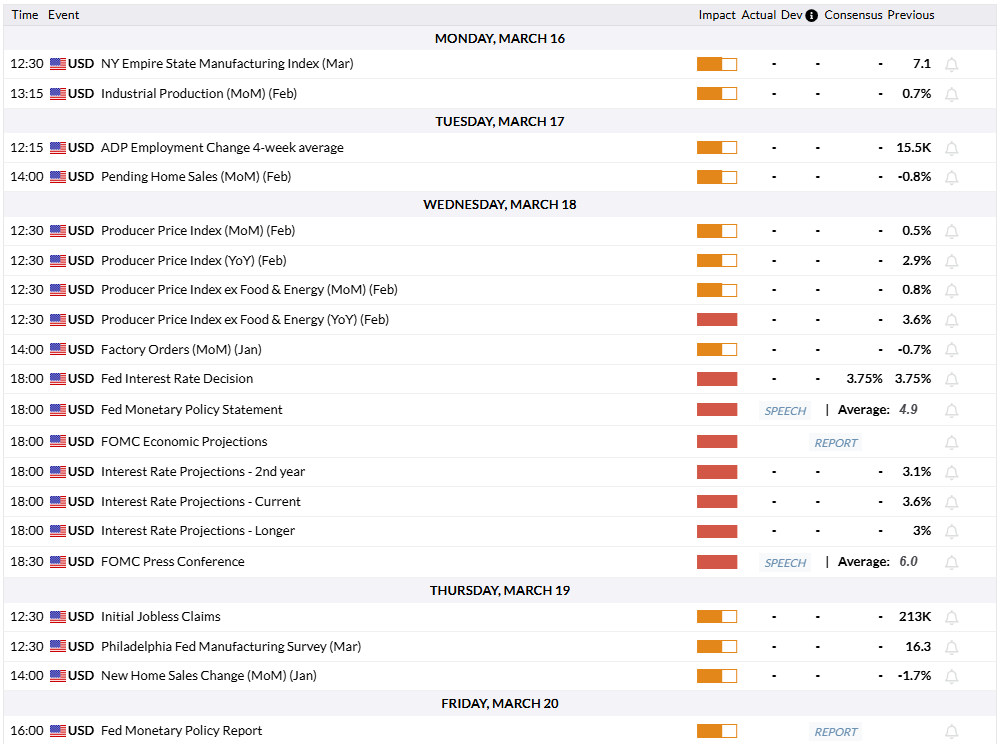
The US economic calendar will feature the New York Empire State Manufacturing Index and February Industrial Production data on Monday. Investors are likely to ignore these figures ahead of the Fed’s two-day policy meeting starting on Tuesday.
The Fed is widely anticipated to leave the policy rate unchanged in the 3.50%-3.75% range following the March meeting. The Summary of Economic Projections (SEP), released alongside the policy statement, will provide key information into the policymakers’ views on policy outlook.
In December, the SEP showed that the central bank’s projections implied a 25-basis-point (bps) rate cut in 2026, and another 25 bps reduction in 2027. However, the document highlighted a wide divergence of views on the appropriate path of rates in 2026 and beyond. Additionally, Fed policymakers’ end-2026 projection for PCE inflation came down to 2.4% from 2.6% in September’s SEP.
In case the new SEP shows an upward revision to the year-end PCE inflation projection, alongside a majority of policymakers expecting to hold the monetary policy rate steady for the remainder of the year, the USD could gather strength in the immediate reaction and cause XAU/USD to decline sharply. The CME FedWatch Tool currently shows markets are pricing in about a 35% probability that the Fed policy rate remains unchanged in 2026, leaving room for another USD rally. Conversely, the USD could come under bearish pressure and fuel a decisive rebound in XAU/USD if the document still projects at least a 25 bps rate cut for this year.
Investors will also scrutinize Fed Chair Jerome Powell’s comments in the post-meeting press conference. The US Bureau of Labor Statistics announced that Nonfarm Payrolls (NFP) declined by 92,000 in February. If Powell suggests that they will have to shift their focus back to inflation from the labor market, due to the uncertainty about the scale and the length of the impact of rising energy prices on inflation, this could reaffirm expectations for a steady policy rate for longer and weigh on Gold. On the other hand, XAU/USD could gain traction in case Powell suggests that they will need more time to reassess how the US-Iran conflict could influence inflation expectations and that they will be more attentive to labor market dynamics after seeing the sharp decline in February’s NFP.
Changes in Oil prices could continue to influence Gold’s performance in the near term. A de-escalation of the crisis in the Middle East and a normalization in the naval activity in the Strait of Hormuz could trigger a significant decline in Crude and ease inflation fears. In this scenario, the USD could come under pressure, allowing XAU/USD to gather bullish momentum.
Gold technical analysis: Bullish momentum fades away
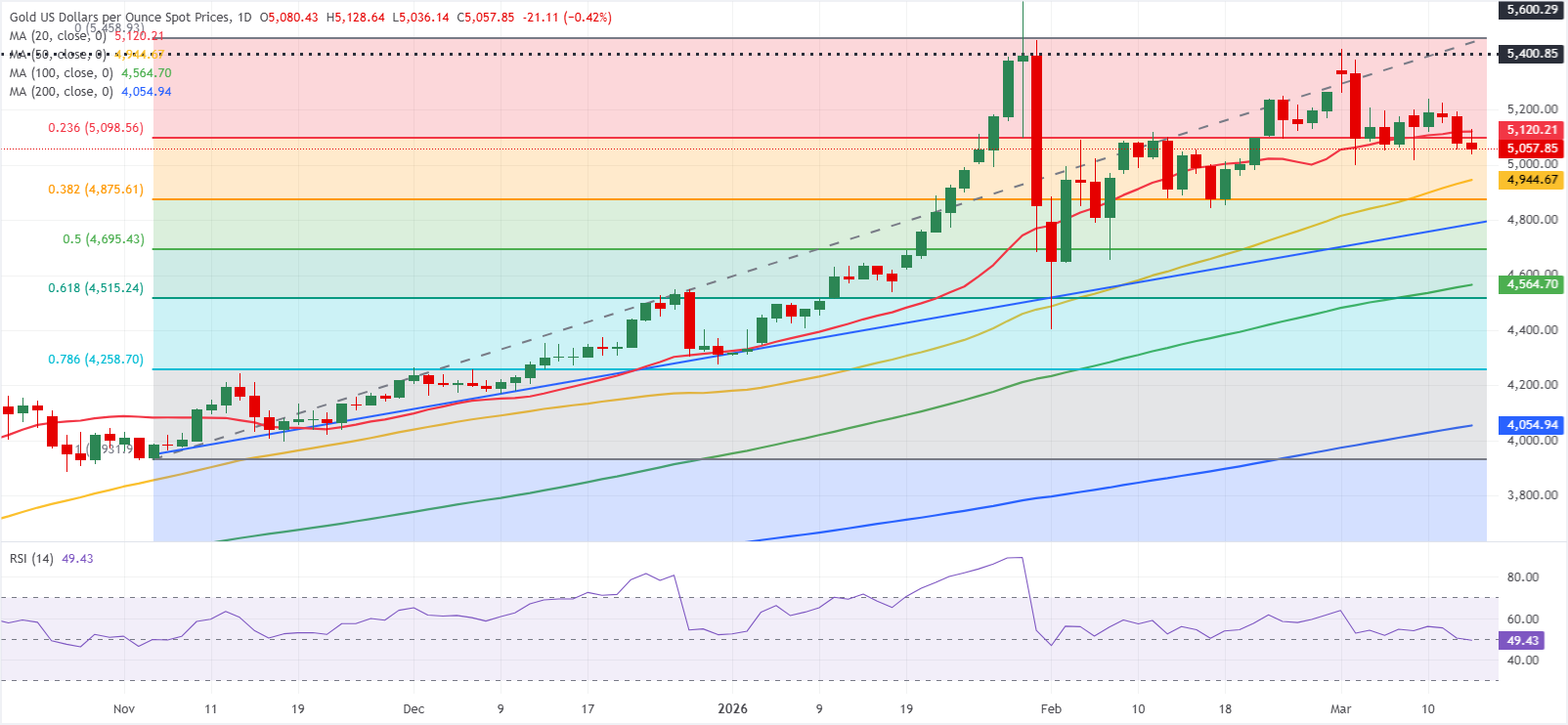
Gold closed below the 20-day Simple Moving Average (SMA) on Thursday and the Relative Strength Index (RSI) on the daily chart declined to the 50 region in the second half of the week, reflecting buyers’ hesitancy.
The Fibonacci 23.6% retracement of the November-February uptrend and the 20-day SMA form a pivot area at $5,100-$5,120. In case Gold stays below this region and confirms it as resistance, buyers could remain on the sidelines. Looking south, the first support level could be spotted at $4,945 (50-day SMA), ahead of $4,875 (Fibonacci 38.2% retracement) and the ascending trend line at $4,800.
On the upside, $5,200 (static level) remains intact as the first technical hurdle before $5,400 (static level, round level) and $5,598 (all-time high).
(This story was corrected on March 13 at 15:29 GMT to revise the bullet points to reflect current market conditions.)
Gold FAQs
Gold has played a key role in human’s history as it has been widely used as a store of value and medium of exchange. Currently, apart from its shine and usage for jewelry, the precious metal is widely seen as a safe-haven asset, meaning that it is considered a good investment during turbulent times. Gold is also widely seen as a hedge against inflation and against depreciating currencies as it doesn’t rely on any specific issuer or government.
Central banks are the biggest Gold holders. In their aim to support their currencies in turbulent times, central banks tend to diversify their reserves and buy Gold to improve the perceived strength of the economy and the currency. High Gold reserves can be a source of trust for a country’s solvency. Central banks added 1,136 tonnes of Gold worth around $70 billion to their reserves in 2022, according to data from the World Gold Council. This is the highest yearly purchase since records began. Central banks from emerging economies such as China, India and Turkey are quickly increasing their Gold reserves.
Gold has an inverse correlation with the US Dollar and US Treasuries, which are both major reserve and safe-haven assets. When the Dollar depreciates, Gold tends to rise, enabling investors and central banks to diversify their assets in turbulent times. Gold is also inversely correlated with risk assets. A rally in the stock market tends to weaken Gold price, while sell-offs in riskier markets tend to favor the precious metal.
The price can move due to a wide range of factors. Geopolitical instability or fears of a deep recession can quickly make Gold price escalate due to its safe-haven status. As a yield-less asset, Gold tends to rise with lower interest rates, while higher cost of money usually weighs down on the yellow metal. Still, most moves depend on how the US Dollar (USD) behaves as the asset is priced in dollars (XAU/USD). A strong Dollar tends to keep the price of Gold controlled, whereas a weaker Dollar is likely to push Gold prices up.
Author

Eren Sengezer
FXStreet
As an economist at heart, Eren Sengezer specializes in the assessment of the short-term and long-term impacts of macroeconomic data, central bank policies and political developments on financial assets.














