Gold to shine again? Peace hopes provide lift, but hopes alone aren’t enough

Gold is supposed to be the go-to asset as a solid hedge against geopolitical crisis. The Iran war has shown this isn’t always the case and that other factors may overpower the geopolitical factor. What’s behind the recent Gold underperformance, and what could support prices going forward? Well, recent hopes of a US-Iran peace deal give us clues.
The precious metal has underperformed since the Iran war began at the end of February. The ongoing chaos in the Middle East has been fueling anxiety about a lasting Oil price shock and inflationary concerns, forcing investors to price out interest rate cuts by central banks globally.
The resultant rise in global bond yields and a firmer US Dollar has added pressure to the non-interest-bearing bullion. Actually, the recent price action suggests that hawkish central bank expectations might continue to override the typical flight-to-safety impulse.
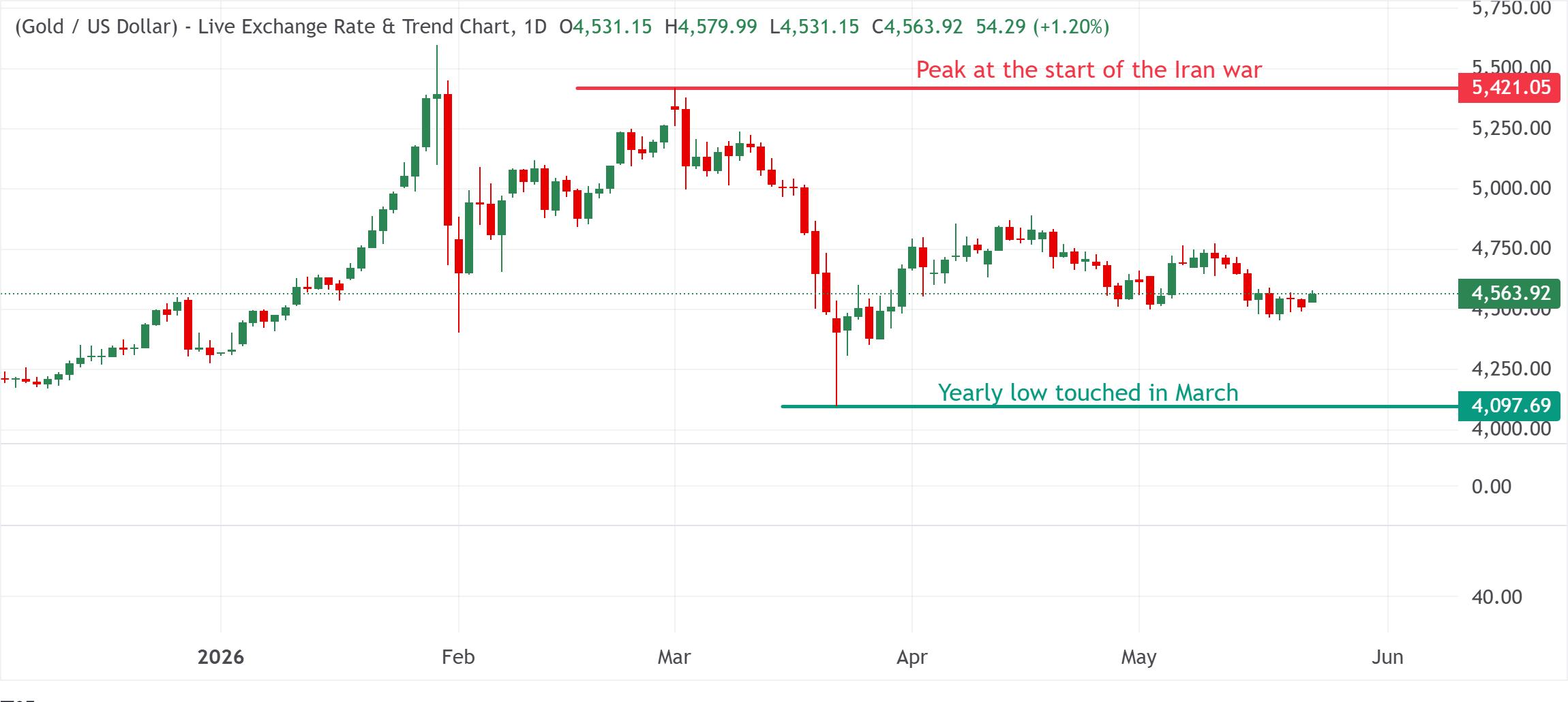
Central banks turn hawkish and that’s not good for Gold
Oil prices remain high amid supply disruptions due to the effective closure of the Strait of Hormuz and the US blockade of Iranian ports. The immediate increases in production costs through higher expenses for transportation, energy, and petroleum-based raw materials drove up the US Producer Price Index to the 6.0% YoY rate in April, marking the largest 12-month increase since December 2022.
Eventually, businesses might be forced to pass on the added costs, and the spillover effect would lead to higher consumer inflation. In response, central banks worldwide are adopting an increasingly hawkish stance to prevent inflation expectations from becoming unanchored.
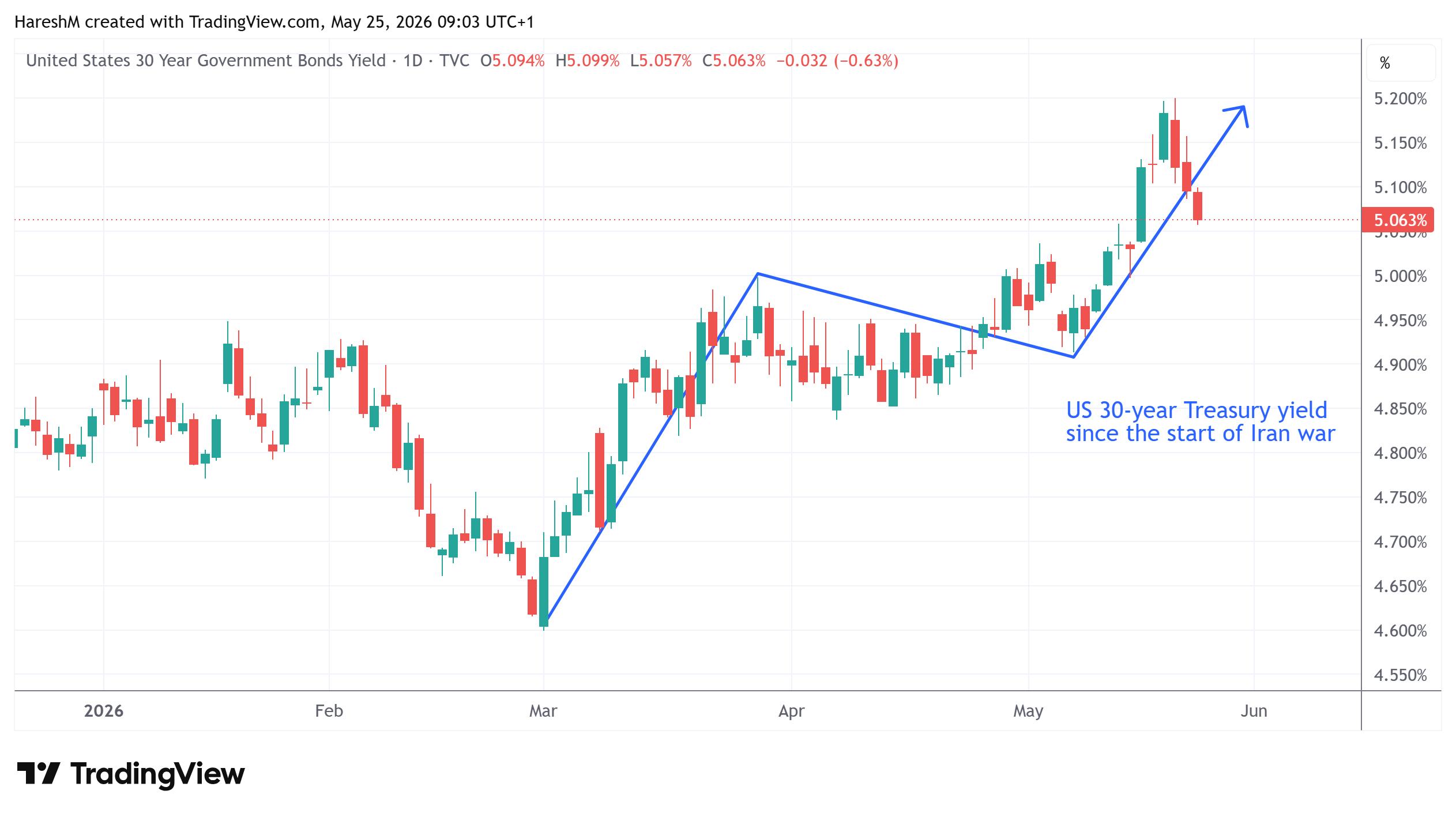
Rising global bond yields continue to weigh on Gold
Investors have aggressively repriced the interest-rate outlook for major economies, abandoning earlier predictions for rate cuts and even factoring in the possibility of interest rate hikes.
Consequently, global long-dated government bonds came under intense selling pressure, lifting the average yield on sovereign debt to multi-decade highs. In fact, the US 30-year yield advanced to a 2007 high last week, while UK long yields touched the highest level since 1998. This, in turn, increases the opportunity cost of holding non-yielding assets, prompting capital to flow away from Gold.
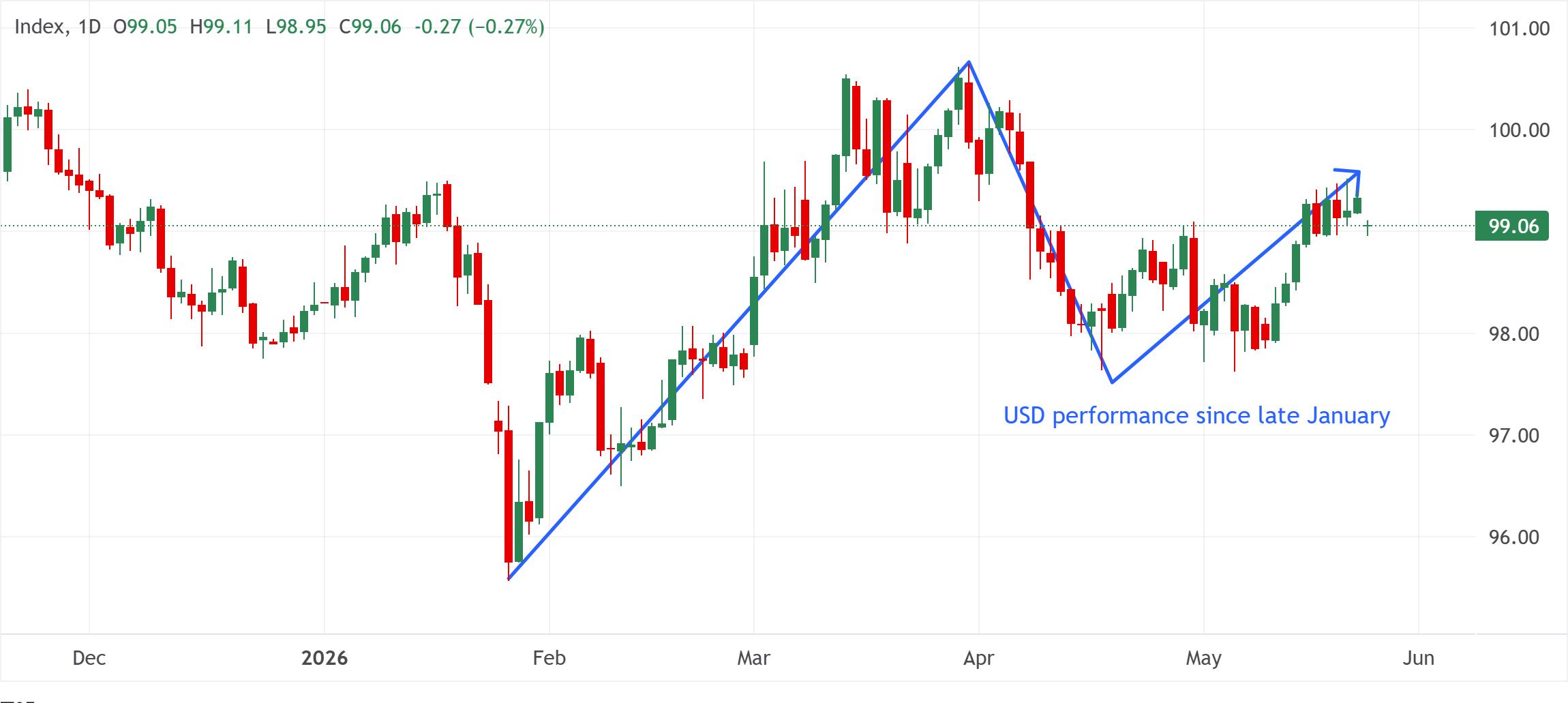
Firmer USD contributes to the near-term bearish sentiment
The US Dollar has exhibited resilient performance on the back of elevated US bond yields, as investors convert foreign currency to purchase higher-yielding Treasury securities.
A strong US labor market and economic data prompted Fed officials to lean toward keeping rates elevated or even raising them. In fact, the minutes of the April FOMC meeting revealed that members felt policy firming would likely be appropriate if inflation stays persistently above the 2% target.
This outlook further benefits the buck, making Gold more expensive for foreign investors as it is priced in USD globally.
What is needed to negate Gold’s negative outlook?
Persistent disruption to energy supplies through the Strait of Hormuz and inflation spikes keep Gold vulnerable to further liquidation. However, the medium-term outlook would be defined by monetary policy expectations.
Developments over the weekend fueled hopes for a potential US-Iran peace deal, prompting heavy USD selling and providing a lift to Gold on Monday. However, the US and Iran remain at odds over key issues, including blockades on the Strait of Hormuz and Tehran's nuclear program, keeping market enthusiasm in check.
The precious metal could find structural support from dovish central bank pivots and stabilizing bond markets, once geopolitical tensions ease. In simple words, Oil flows via the Strait of Hormuz should return to pre-war levels. That would push Oil prices down, ease inflation fears, and let central banks come back to the narrative that interest-rate cuts are on the table again.
Gold Technical Analysis: Bearish tilt is still in play
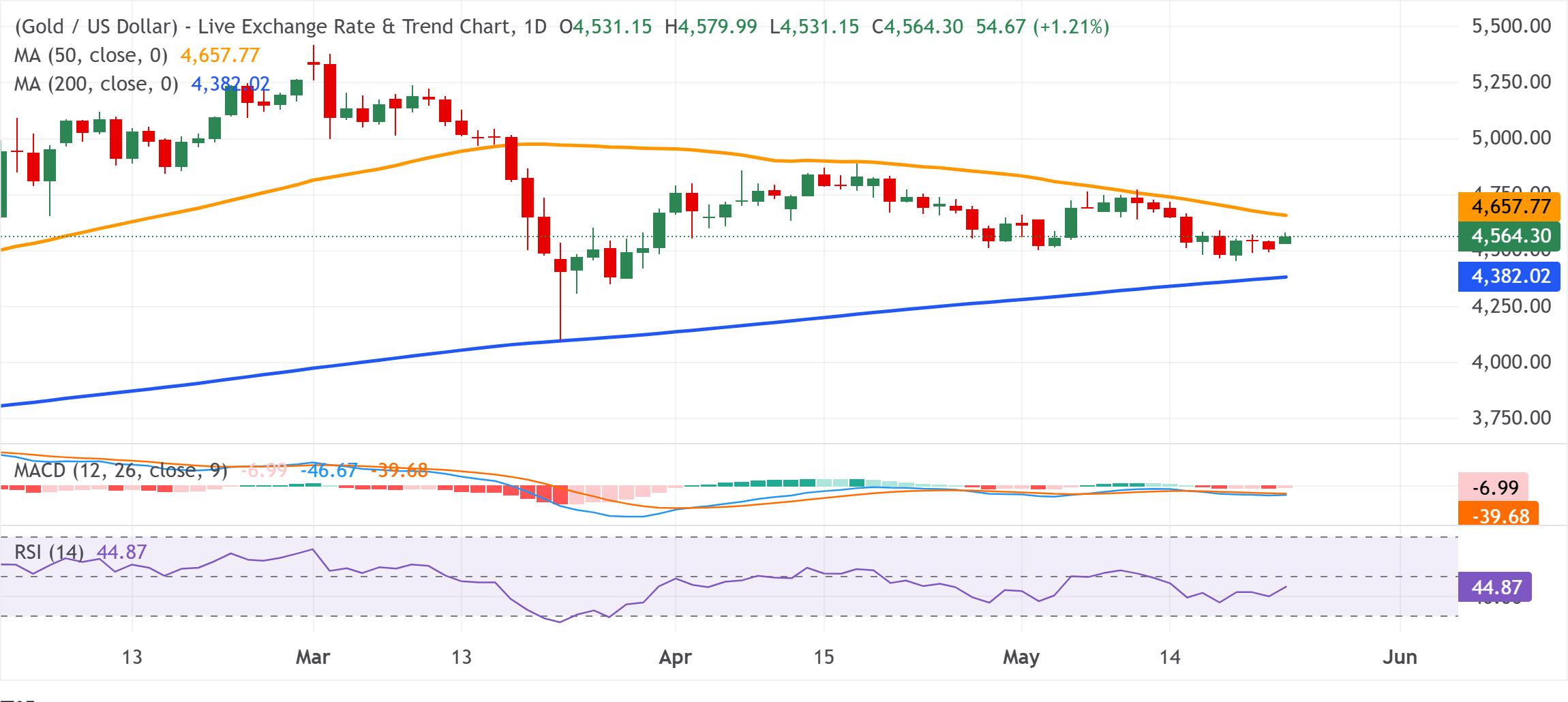
Gold has been consolidating in a broader range after breaking below the 50‑day Simple Moving Average (SMA) in March and failing to reclaim it on rebounds, underscoring persistent downward momentum. However, bears need to wait for a convincing break and acceptance below a technically significant 200-day SMA support, near the $4,375-$4,370 region, before positioning for deeper losses towards retesting the March low, around the $4,100 mark.
On the top side, the 50-day SMA breakpoint, currently around the $4,665-$4,670 area, might continue to act as an immediate strong barrier. A sustained strength beyond would negate the negative outlook and shift the bias in favor of bullish traders.
Gold FAQs
Gold has played a key role in human’s history as it has been widely used as a store of value and medium of exchange. Currently, apart from its shine and usage for jewelry, the precious metal is widely seen as a safe-haven asset, meaning that it is considered a good investment during turbulent times. Gold is also widely seen as a hedge against inflation and against depreciating currencies as it doesn’t rely on any specific issuer or government.
Central banks are the biggest Gold holders. In their aim to support their currencies in turbulent times, central banks tend to diversify their reserves and buy Gold to improve the perceived strength of the economy and the currency. High Gold reserves can be a source of trust for a country’s solvency. Central banks added 1,136 tonnes of Gold worth around $70 billion to their reserves in 2022, according to data from the World Gold Council. This is the highest yearly purchase since records began. Central banks from emerging economies such as China, India and Turkey are quickly increasing their Gold reserves.
Gold has an inverse correlation with the US Dollar and US Treasuries, which are both major reserve and safe-haven assets. When the Dollar depreciates, Gold tends to rise, enabling investors and central banks to diversify their assets in turbulent times. Gold is also inversely correlated with risk assets. A rally in the stock market tends to weaken Gold price, while sell-offs in riskier markets tend to favor the precious metal.
The price can move due to a wide range of factors. Geopolitical instability or fears of a deep recession can quickly make Gold price escalate due to its safe-haven status. As a yield-less asset, Gold tends to rise with lower interest rates, while higher cost of money usually weighs down on the yellow metal. Still, most moves depend on how the US Dollar (USD) behaves as the asset is priced in dollars (XAU/USD). A strong Dollar tends to keep the price of Gold controlled, whereas a weaker Dollar is likely to push Gold prices up.
Author

Haresh Menghani
FXStreet
Haresh Menghani is a detail-oriented professional with 10+ years of extensive experience in analysing the global financial markets.

















