Gold reassesses policy credibility as markets validate the Fed's message

Key takeaways
- Gold trades near the $4,050–4,070 participation zone after the Federal Reserve left interest rates unchanged and shifted market attention toward the consistency of future policy decisions.
- Treasury yields, the US Dollar and portfolio allocation remain the principal transmission channels connecting central bank communication with gold participation.
- Today's US GDP and Core PCE releases provide the next macro validation point following the Federal Reserve meeting and may reinforce or reshape the market's interpretation of yesterday's policy message.
- The Renko chart remains in a confirmed Compression regime, reflecting balanced participation as investors evaluate the next stage of the macro sequence.
Gold enters a new phase of policy assessment
Gold begins Thursday's session with financial markets moving beyond the Federal Reserve decision itself and focusing on the credibility of the policy framework communicated yesterday.
The Federal Open Market Committee kept interest rates unchanged, a result that broadly matched market expectations. Investors concentrated on the statement, Chair Kevin Warsh's press conference and the implications for the policy path during the second half of the year. Reuters reports that market participants interpreted the communication as maintaining the commitment to controlling inflation while providing limited forward guidance, leading traders to reassess the probability of additional tightening later this year.
Attention now shifts toward today's US GDP and Core PCE releases.
These reports represent the first opportunity for markets to evaluate whether incoming macroeconomic data remain aligned with the Federal Reserve's assessment of growth, inflation and financial conditions.
Gold therefore enters a different stage of the policy cycle.
Yesterday focused on communication.
Today focuses on validation.
Policy credibility shapes macro conviction
Gold continues functioning as the market's primary macro credibility asset.
Every central bank decision influences financial markets through several interconnected transmission channels before reaching portfolio allocation.
The current sequence develops through:
- Fed communication.
- Policy credibility.
- Macro validation.
- Portfolio allocation.
- Gold participation.
This framework extends beyond interest-rate expectations alone.
Institutional investors continuously evaluate whether monetary policy, economic activity and inflation remain internally consistent. Treasury markets, currency markets and reserve allocation all contribute to that assessment.
The Federal Reserve therefore establishes the initial framework, while incoming macroeconomic data determine whether markets reinforce that interpretation or gradually construct a different policy narrative.
The reaction following Wednesday's meeting illustrates this process. Treasury yields and the US Dollar adjusted as investors reassessed future policy expectations, while gold stabilized as markets absorbed the new information. Reuters notes that expectations for a September rate increase moderated following Chair Warsh's comments, supporting a modest recovery in gold prices.
The discussion has also broadened inside the Federal Open Market Committee. The Wall Street Journal highlights that three officials voted in favor of a rate increase, reinforcing the presence of differing views regarding inflation risks and future policy.
Today's macro data extend the transmission process
Thursday's calendar continues the policy sequence established by the Federal Reserve.
Advance GDP will provide an updated assessment of economic momentum.
Core PCE remains the Federal Reserve's preferred inflation measure and represents an important reference for evaluating underlying price dynamics.
Together these releases help determine whether yesterday's communication remains consistent with incoming macroeconomic evidence.
The Bank of England's policy decision adds another layer to the global macro picture by influencing relative interest-rate expectations, exchange-rate dynamics and international capital allocation.
Gold frequently reflects these cross-market adjustments because institutional portfolios continuously compare monetary policy across the major central banks.
Reserve allocation continues supporting the broader structure
Short-term participation remains heavily influenced by macroeconomic releases.
The longer-term structure continues reflecting reserve diversification and institutional demand for high-quality monetary assets.
Central banks remain active participants in the gold market as reserve managers continue evaluating currency diversification alongside fiscal, geopolitical and monetary developments.
This structural demand provides an important foundation beneath shorter-term fluctuations generated by economic releases and monetary policy communication.
Gold therefore maintains its role as a macro barometer connecting central bank credibility with institutional allocation decisions.
Technical structure
The Renko chart illustrates a market that has transitioned from event anticipation toward macro validation.
Following the Federal Reserve meeting, gold briefly recovered toward the $4,100 area before returning to the $4,050–4,070 participation zone, where price is currently rotating around the EMA200, positioned near $4,067.
The EMA9 and EMA21 have flattened considerably, indicating that short-term participation has become increasingly balanced as investors evaluate the next macro catalyst.
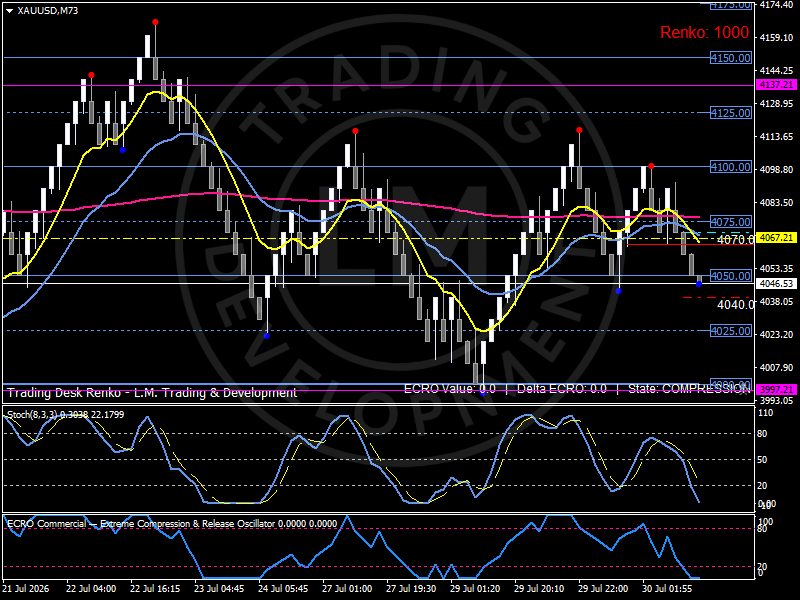
The most important technical signal comes from the ECRO, which currently reads 0.0 with Delta ECRO also at 0.0, confirming a fully developed Compression regime.
This configuration reflects an environment where directional participation has largely paused while institutional positioning awaits additional macro confirmation.
The stochastic oscillator has rotated back toward oversold territory, illustrating softer momentum alongside selective participation rather than broad liquidation.
Immediate support continues developing around $4,050, followed by the broader structural participation zone near $4,025–4,000.
Initial resistance remains near $4,100, while sustained acceptance above the EMA200 would strengthen attention toward $4,125 and $4,150.
The technical structure remains fully consistent with a market waiting for confirmation from today's GDP and Core PCE releases before expanding participation.
Bird's eye view
Market regime: Policy Validation
Macro sequence: Fed Communication → Policy Credibility → Macro Validation → Portfolio Allocation → Gold Participation.
Participation zone: $4,050–4,070.
Primary resistance: $4,100–4,125.
Structural support: $4,025–4,000.
Market state: Compression.
Macro anchors: Federal Reserve · GDP · Core PCE · Treasury Yields · US Dollar · Reserve Allocation.
Outlook
Gold enters the second half of the week's macro sequence with attention shifting from central bank communication toward macroeconomic confirmation.
The Federal Reserve has established the current policy framework.
Today's GDP and Core PCE releases will determine how confidently investors continue allocating capital within that framework.
The Renko structure reflects this transition through a confirmed Compression regime centred around the EMA200, where participation remains balanced while markets evaluate the next stage of the macro transmission process. Treasury yields, the US Dollar and incoming economic data now form the principal channels connecting yesterday's policy decision with the next move in gold participation.
Author

Luca Mattei
LM Trading & Development
Luca Mattei is a market analyst focusing on FX, metals, and macroeconomic trends. He develops trading tools for retail and professional traders, coding indicators and EAs for MT4/MT5 and strategies in Pine Script for TradingView.

















