Gold prices are falling: China is buying anyway

China is buying Gold even as prices have been falling, and this trend could have major implications for the US Dollar (USD), global central banks, and Gold (XAU/USD) prices. Driven by both Beijing's central bank and private investors, including households, China’s Gold-buying spree signals a broader shift in global reserve management and financial strategy that traders need to watch closely.

The scale of China’s Gold accumulation
According to China customs data, the country imported more than 1,000 tonnes of Gold between January and August 2026, worth approximately $158.8 billion. That already exceeded the 886 tonnes imported in all of 2025.
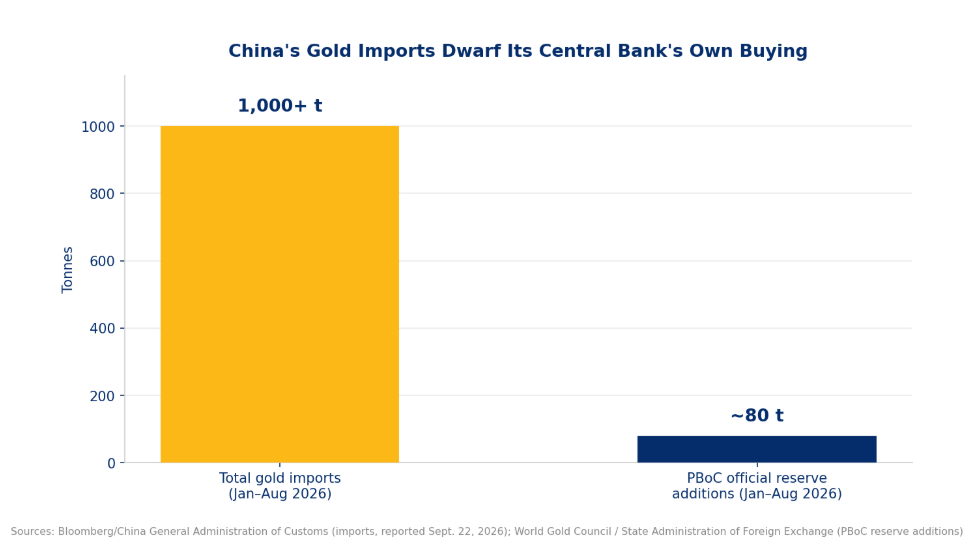
These imports represent total demand across China’s markets, but the bigger development is happening inside China's central bank. The People’s Bank of China (PBoC) has emerged as one of the world’s leading central bank buyers of bullion. It added 830,000 troy ounces to its gold reserves in October, equivalent to approximately 25.8 tonnes, according to official data. It was the 24th consecutive month the central bank increased its Gold holdings, and importantly, buying continued even as Gold prices kept falling.
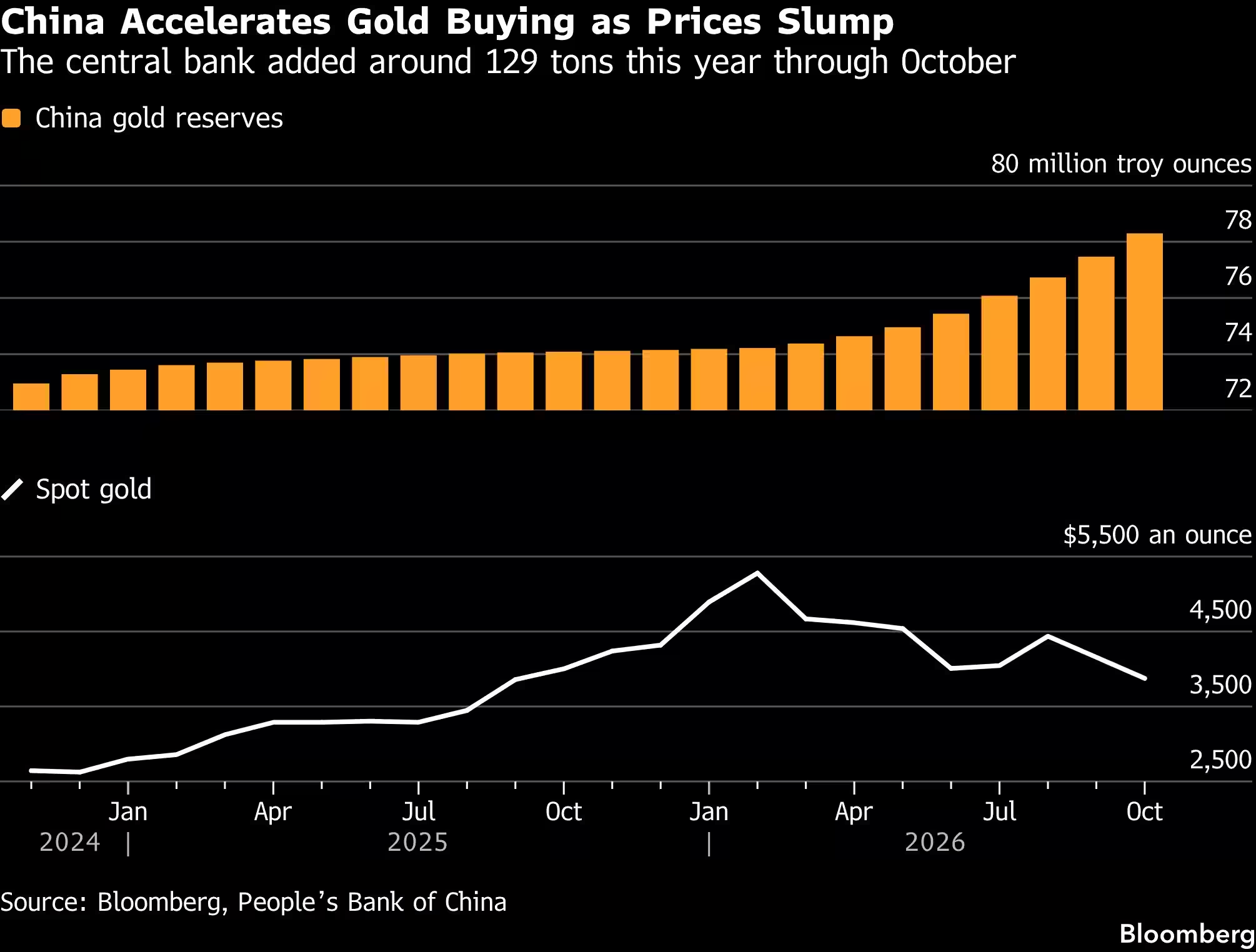
This tells us something important: Beijing is not simply trying to profit from short-term price movements. It is building its Gold reserves as part of a longer-term strategy.
Reserve diversification and moving away from the US Dollar
The first and perhaps most important reason for this strategy is reserve diversification and reducing dependence on the US Dollar. For decades, the US Dollar has dominated international trade, global payments and central-bank reserves. Countries hold Dollars and US Treasury securities because they are widely used, highly liquid, and supported by deep financial markets, but geopolitical tensions have changed how some governments view these assets.
One major turning point was the freezing of Russia's central bank assets by Western governments following the invasion of Ukraine in 2022. That episode highlighted a risk for countries holding large amounts of foreign assets: financial sanctions can restrict access to those assets. And this is where Gold becomes particularly attractive.
Unlike US Treasury securities, Gold is not a financial liability issued by another government. Physical Gold held within a country's own jurisdiction does not depend on another country's banking system or payment infrastructure to exist. For China, accumulating Gold provides an additional reserve asset outside the traditional Dollar-based financial system.
America's growing national debt is another factor. As US borrowing requirements increase, some governments may want to diversify their exposure rather than rely so heavily on Dollar-denominated assets. China has already reduced its holdings of US Treasury securities. According to the latest available US Treasury data, its reported holdings fell to $590.7 billion in August, the lowest level in 18 years.
However, this does not mean China is abandoning the US Dollar overnight. The Greenback remains the dominant global reserve currency, and Gold cannot replace all the functions of foreign-currency reserves. China still needs liquid foreign-currency assets to support international trade and payments. The bigger story is gradual diversification, not an immediate collapse of the USD system.
Domestic investors and households drive a second wave of demand
The central bank is not the only buyer; a second source of demand is emerging much closer to home. Chinese households are increasingly turning to Gold because confidence in some traditional investment options has weakened.
For years, real estate was one of the most popular ways for Chinese households to build wealth, but the prolonged property downturn has weakened confidence in housing as a reliable store of value. The stock market has also struggled, with local equities weakening during the third quarter of 2026, while China's government bond yields remain relatively low. In that environment, Gold is attracting investors looking for an alternative way to preserve savings.
According to the China Gold Association, Chinese purchases of Gold bars and coins increased by 28.4% in the first half of 2026 compared with the same period last year. At the same time, demand for gold jewelry fell by almost 34%. This distinction matters because it shows the increase is driven by investment demand rather than stronger consumer demand across every Gold category.
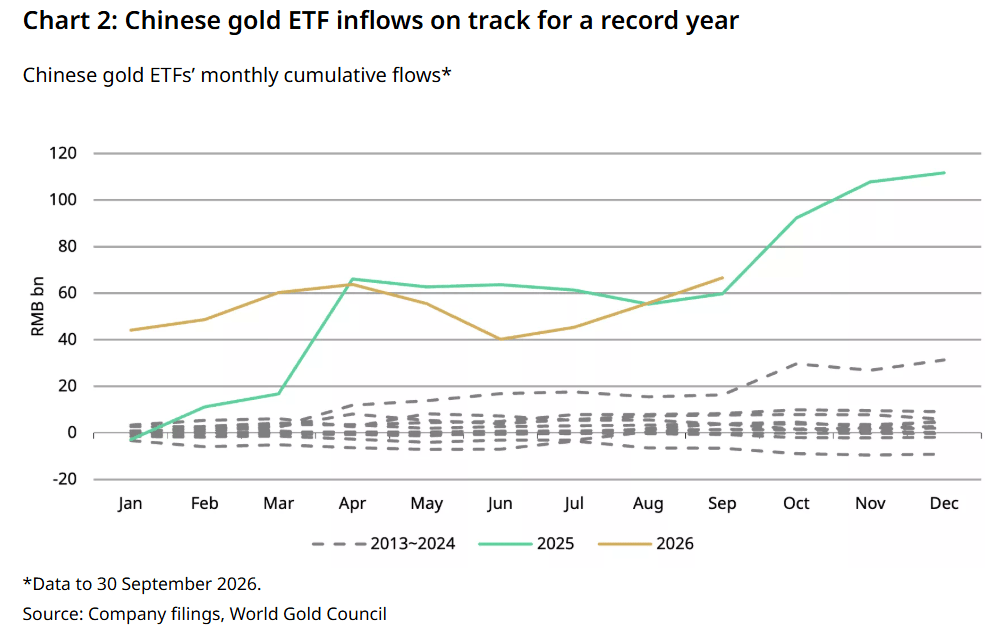
The World Gold Council (WGC) reported that Chinese Gold Exchange Traded Funds (ETFs) attracted approximately 11 tonnes of inflows in September, taking total holdings to a record 304 tonnes. Chinese Gold ETF demand remained strong even as prices declined, while jewelry demand was more subdued. Investment demand can remain strong when investors see lower prices as a buying opportunity, whereas jewelry demand can weaken when Gold becomes too expensive for consumers. China's demand is therefore coming from multiple sources, including central-bank accumulation, investment demand, and physical purchases by households.
A broader shift among global central banks
China is also part of a much broader shift in central-bank reserve management. Central banks worldwide have been reassessing how much of their reserves should be held in Gold because Gold offers diversification, has no issuing-country credit risk, and can help protect reserves against certain geopolitical and financial risks.
The WGC reported that central banks and other official institutions added a net 321 tonnes to reserves in Q3, up 42% year-on-year and the highest quarterly total since Q4 2024. This matters because central banks typically have longer investment horizons than short-term traders.
They are not necessarily buying Gold because they expect prices to rise next week or next month. They are building reserves for financial resilience over many years, which creates an important source of structural demand. If this trend continues, central-bank purchases could help cushion Gold during periods when other sources of investment demand weaken. However, central-bank buying is not unlimited, and it does not guarantee that Gold prices will always rise. Higher interest rates, a stronger US Dollar and changing reserve-management priorities can still influence demand.
Can China challenge the US Dollar?
China's Gold accumulation, its reduction in US Treasury holdings, and its efforts to expand Yuan-based financial infrastructure all point toward one broader objective: reducing reliance on the traditional Dollar-centered financial system.
Hong Kong is also seeking to strengthen its position as an international Gold trading and storage hub. Its central Gold clearing and settlement system began trial operations in July 2026. The official launch is planned for the first quarter of 2027, while the Hong Kong Stock Exchange is also preparing Yuan-denominated Gold futures.
A deeper Gold market connected to Yuan-denominated trading and settlement could help expand the Chinese currency's role in international commerce. Still, replacing the US Dollar is a much bigger challenge. The US Dollar benefits from deep capital markets, global liquidity, established payment networks, and widespread use in international trade.
Gold can diversify a country's reserves, but it cannot independently provide the liquidity and financial infrastructure the global economy requires. Rather than expecting an overnight change in the monetary system, investors should focus on a gradual shift toward greater reserve diversification, which could matter over time if more central banks allocate a larger share of their reserves to Gold.
What this means for Gold price and traders
For Gold traders, the most important takeaway is that Chinese buying could provide a structural source of support. If Gold prices decline because of higher US Treasury yields or a stronger US Dollar, central banks and Chinese investors may view that weakness as an opportunity to accumulate more, which could help absorb some selling pressure.
Even so, traders should not assume that Chinese buying will prevent every correction. Gold remains sensitive to Federal Reserve policy, real interest rates, the US Dollar, investment flows, and geopolitical developments. If US yields rise sharply and the US Dollar strengthens, Gold can still decline even while the People’s Bank of China continues purchasing.
The key is to distinguish between short-term price movements and longer-term demand. Central-bank buying may help support the longer-term outlook, but it does not eliminate volatility or guarantee a bullish trend.
Ultimately, China is not about to replace the US Dollar, and its Gold buying is about more than price appreciation. Its central bank is building financial protection against risks associated with dependence on foreign assets, while households and private investors are independently increasing their Gold exposure. That two-sided demand story is supportive of Gold, and while the US Dollar is not about to disappear, the global reserve system may gradually become more diversified.
(This article was created with the help of an Artificial Intelligence tool and reviewed by an editor. Know more.)
Gold FAQs
Gold has played a key role in human’s history as it has been widely used as a store of value and medium of exchange. Currently, apart from its shine and usage for jewelry, the precious metal is widely seen as a safe-haven asset, meaning that it is considered a good investment during turbulent times. Gold is also widely seen as a hedge against inflation and against depreciating currencies as it doesn’t rely on any specific issuer or government.
Central banks are the biggest Gold holders. In their aim to support their currencies in turbulent times, central banks tend to diversify their reserves and buy Gold to improve the perceived strength of the economy and the currency. High Gold reserves can be a source of trust for a country’s solvency. Central banks added 1,136 tonnes of Gold worth around $70 billion to their reserves in 2022, according to data from the World Gold Council. This is the highest yearly purchase since records began. Central banks from emerging economies such as China, India and Turkey are quickly increasing their Gold reserves.
Gold has an inverse correlation with the US Dollar and US Treasuries, which are both major reserve and safe-haven assets. When the Dollar depreciates, Gold tends to rise, enabling investors and central banks to diversify their assets in turbulent times. Gold is also inversely correlated with risk assets. A rally in the stock market tends to weaken Gold price, while sell-offs in riskier markets tend to favor the precious metal.
The price can move due to a wide range of factors. Geopolitical instability or fears of a deep recession can quickly make Gold price escalate due to its safe-haven status. As a yield-less asset, Gold tends to rise with lower interest rates, while higher cost of money usually weighs down on the yellow metal. Still, most moves depend on how the US Dollar (USD) behaves as the asset is priced in dollars (XAU/USD). A strong Dollar tends to keep the price of Gold controlled, whereas a weaker Dollar is likely to push Gold prices up.
Author
Dhwani Mehta
FXStreet
Residing in Mumbai (India), Dhwani is a Senior Analyst and Manager of the Asian session at FXStreet. She has over 10 years of experience in analyzing and covering the global financial markets, with specialization in Forex and commodities markets.