Gold Price Forecast: XAU/USD rebounds but not out of the woods yet
- Gold price finds buyers at monthly lows near $3,250 early Monday, as Fedspeak looms
- US Dollar mires in multi-year troughs amid dovish Fed bets, US trade and fiscal concerns.
- Gold price closed the week below critical support levels, further downside remains on the cards.

Gold price is holding the quick rebound from monthly lows early Monday, finding some comfort from the extended US Dollar (USD) weakness across the board.
Gold price looks to trade updates, Fedspeak
The US Dollar remains undermined against its major currency rivals at the start of the week, miring in nearly four-year troughs reached last Friday.
Fresh concerns over US trade deals, especially with Japan, and the passage of US President Donald Trump’s ‘big, beautiful’ spending bill by his July 4 target date.
In a pre-taped interview with Fox News’ “Sunday Morning Futures”, President Trump said he is not sure if the bill would be passed by this Friday’s deadline.
On Japanese trade, Trump whined that “they won’t take our cars, and we take millions of theirs. It’s not fair,” adding that “Japan could import more US oil and other products.”
These factors overshadowed the optimism of US trade deals with China and Canada.
The US and China have resolved issues surrounding shipments of rare earth minerals and magnets to the US Treasury Secretary Scott Bessent said on Friday.
Canada's Finance Ministry said early Monday that they will “rescind digital services tax to advance broader trade negotiations with the United States (US).
Additionally, increased bets of a US Federal Reserve (Fed) interest rate cut in September also weigh negatively on the Greenback, allowing Gold price to recover some ground.
However, the further recovery in Gold price appears at risk as the daily technical setup indicates bearish potential.
Traders will continue to pay close attention to the trade talks while scrutinizing speeches from several Fed policymakers due later on Monday.
All eyes remain on Tuesday’s US JOLTS Job Openings data and Fed Chair Jerome Powell’s speech at the European Central Bank (ECB) Forum on Central Banking 2025 in Sintra, Portugal.
Gold price technical analysis: Daily chart
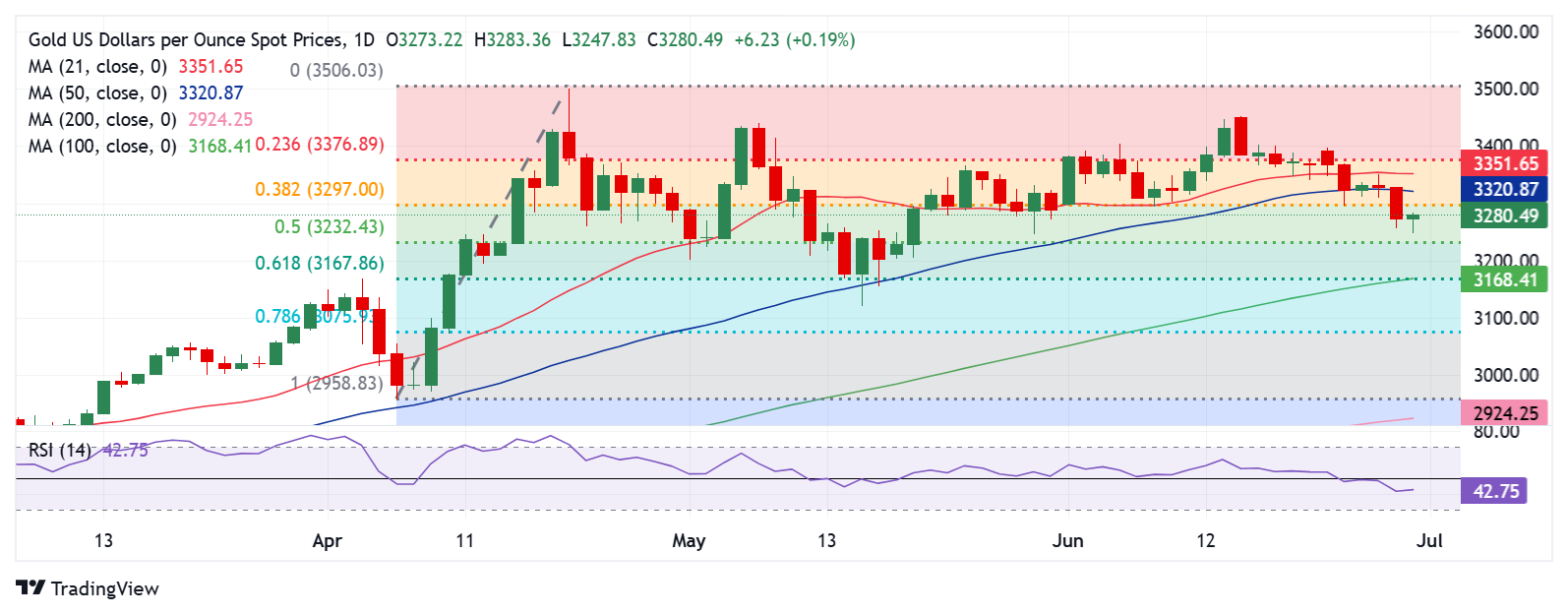
Gold price settled the week below the strong support of the 50-day Simple Moving Average (SMA), then at $3,325.
Sellers also cracked the 50% Fibonacci Retracement (Fibo) level of the April record rally at $3,297.
Early Monday, Gold price bounced off the $3,250 demand area, looking to regain the abovementioned support-turned-resistance at $3,297.
However, with the 14-day Relative Strength Index (RSI) remaining below the 50 level, any recovery attempts are likely to be short-lived.
If buyers manage to sustain the upturn and recapture the $3,297 barrier, a fresh advance toward the 50-day SMA, now at $3,321 cannot be ruled out.
Further up, the $3,350 psychological mark and the 21-day SMA confluence will be tested.
On the downside, a breach of the intraday low of $3,248, the 50% Fibo level of the same advance at $3,232 will come into play.
If the selling interest intensifies, the bearish target is seen at $3,168, the intersection of the 100-day SMA and the 61.8% Fibo level.
Gold FAQs
Gold has played a key role in human’s history as it has been widely used as a store of value and medium of exchange. Currently, apart from its shine and usage for jewelry, the precious metal is widely seen as a safe-haven asset, meaning that it is considered a good investment during turbulent times. Gold is also widely seen as a hedge against inflation and against depreciating currencies as it doesn’t rely on any specific issuer or government.
Central banks are the biggest Gold holders. In their aim to support their currencies in turbulent times, central banks tend to diversify their reserves and buy Gold to improve the perceived strength of the economy and the currency. High Gold reserves can be a source of trust for a country’s solvency. Central banks added 1,136 tonnes of Gold worth around $70 billion to their reserves in 2022, according to data from the World Gold Council. This is the highest yearly purchase since records began. Central banks from emerging economies such as China, India and Turkey are quickly increasing their Gold reserves.
Gold has an inverse correlation with the US Dollar and US Treasuries, which are both major reserve and safe-haven assets. When the Dollar depreciates, Gold tends to rise, enabling investors and central banks to diversify their assets in turbulent times. Gold is also inversely correlated with risk assets. A rally in the stock market tends to weaken Gold price, while sell-offs in riskier markets tend to favor the precious metal.
The price can move due to a wide range of factors. Geopolitical instability or fears of a deep recession can quickly make Gold price escalate due to its safe-haven status. As a yield-less asset, Gold tends to rise with lower interest rates, while higher cost of money usually weighs down on the yellow metal. Still, most moves depend on how the US Dollar (USD) behaves as the asset is priced in dollars (XAU/USD). A strong Dollar tends to keep the price of Gold controlled, whereas a weaker Dollar is likely to push Gold prices up.
Author

Dhwani Mehta
FXStreet
Residing in Mumbai (India), Dhwani is a Senior Analyst and Manager of the Asian session at FXStreet. She has over 10 years of experience in analyzing and covering the global financial markets, with specialization in Forex and commodities markets.