Gold Price Forecast: XAU/USD buyers take a breather before the next leg north
- Gold price clinches fresh two-month highs above $3,450, then retreats.
- US Dollar stays supported amid haven demand due to deepening Israel-Iran row.
- The path of least resistance appears to the upside for Gold price ahead of Fed.

Gold price has briefly pulled back from fresh two-month highs reached just above $3,450 early Monday. All eyes remain on the deepening Israel and Iran conflict and trade headlines for fresh trading impetus.
Gold price takes a brief hall en-route to $3,500
The US Dollar (USD) seems to have regained its lost footing in Asian trading on Monday, starting a new week on the front across its major currency rivals amid sagging investors’ confidence, leading to the minor pullback in Gold price.
Intensifying Iranian missiles attacks on Israel over the weekend, which continues well into early Monday, remains a drag on risk sentiment even as markets try to take into their stride and divert their attention to the upcoming central banks’ policy announcements this week.
On Sunday, Israel and Iran launched fresh attacks on Sunday, raising concerns of a broader regional conflict, which could out trade under risks through the Strait of Hormuz.
Israel's air force attacked surface-to-surface missile sites in central Iran.
Iran told mediators Qatar and Oman that it is not open to negotiating a ceasefire with the US while it is under Israeli attack.
Meanwhile, Reuters reported that Reuters US President Donald Trump had vetoed an Israeli plan in recent days to kill Iran's Supreme Leader Ayatollah Ali Khamenei, citing two US officials.
Gold buyers also face exhaustion after rising as much as 4% in the previous week as a sense of caution seeps in ahead of the US Federal Reserve (Fed) policy verdict due later on Wednesday.
Markets continue to price in the first interest rate of this year to come in September, still expecting two 25 basis points (bps) rate cuts by year-end.
Dovish Fed expectations continue to lend support to bright metal alongside the Middle East geopolitical crisis, with markets awaiting fresh impetus for the next leg higher.
Monday’s Retail Sales and Industrial Production data from China failed to lift Gold price as the focus now remain on US Retail Sales and the Bank of Japan (BoJ) policy decision on Tuesday.
The BoJ policy announcements could fuel the USD/JPY pair-driven volatility in the Greenback, eventually impacting the USD-denominated Gold price.
Gold price technical analysis: Daily chart
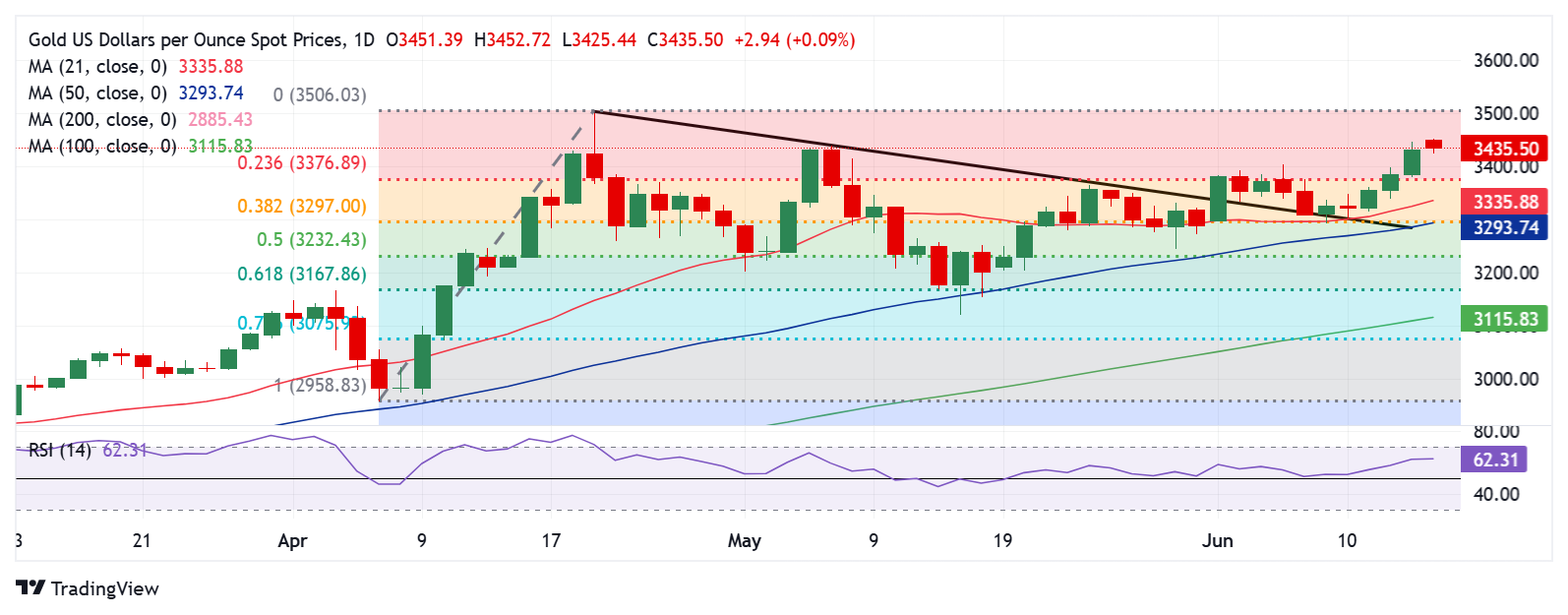
Gold price has stalled its recent uptrend, having failed to close the week above the critical resistance near $3,440.
However, the bullish potential remains in place as the 14-day Relative Strength Index (RSI) stays comfortably above the midline, currently near 62.50.
The retreat from two-month highs of could meet initial demand at $3,400, below which the sellers could challenge the previous strong resistance now support at $3,377, the 23.6% Fibonacci Retracement (Fibo) level of the April record rally.
The next downside cushion will be aligned at the 21-day Simple Moving Average (SMA) at $3,336 if the $3,350 psychological barrier gives way.
On the upside, acceptance above the aforesaid static resistance at $3,440 is critical to resuming the advance toward the record highs of $3,500.
The two-month highs of $3,453 could test bearish commitments buyers regain poise.
Gold FAQs
Gold has played a key role in human’s history as it has been widely used as a store of value and medium of exchange. Currently, apart from its shine and usage for jewelry, the precious metal is widely seen as a safe-haven asset, meaning that it is considered a good investment during turbulent times. Gold is also widely seen as a hedge against inflation and against depreciating currencies as it doesn’t rely on any specific issuer or government.
Central banks are the biggest Gold holders. In their aim to support their currencies in turbulent times, central banks tend to diversify their reserves and buy Gold to improve the perceived strength of the economy and the currency. High Gold reserves can be a source of trust for a country’s solvency. Central banks added 1,136 tonnes of Gold worth around $70 billion to their reserves in 2022, according to data from the World Gold Council. This is the highest yearly purchase since records began. Central banks from emerging economies such as China, India and Turkey are quickly increasing their Gold reserves.
Gold has an inverse correlation with the US Dollar and US Treasuries, which are both major reserve and safe-haven assets. When the Dollar depreciates, Gold tends to rise, enabling investors and central banks to diversify their assets in turbulent times. Gold is also inversely correlated with risk assets. A rally in the stock market tends to weaken Gold price, while sell-offs in riskier markets tend to favor the precious metal.
The price can move due to a wide range of factors. Geopolitical instability or fears of a deep recession can quickly make Gold price escalate due to its safe-haven status. As a yield-less asset, Gold tends to rise with lower interest rates, while higher cost of money usually weighs down on the yellow metal. Still, most moves depend on how the US Dollar (USD) behaves as the asset is priced in dollars (XAU/USD). A strong Dollar tends to keep the price of Gold controlled, whereas a weaker Dollar is likely to push Gold prices up.
Author

Dhwani Mehta
FXStreet
Residing in Mumbai (India), Dhwani is a Senior Analyst and Manager of the Asian session at FXStreet. She has over 10 years of experience in analyzing and covering the global financial markets, with specialization in Forex and commodities markets.

















