Gold Price Forecast: Trump policy concerns offset hawkish Fed bets; what’s next for XAU/USD?
- Gold price treads water below $2,700 as the US inflation week sets in.
- Trump’s policy uncertainty outweighs strong US NFP-led hawkish Fed bets.
- Gold buyers remain defiant amid a symmetrical triangle breakout, but profit-taking could seep in.

Gold price pauses its four-day uptrend, treading water below $2,700 in Asian trading on Monday. Gold buyers seem to face exhaustion following a relentless rise in the previous week.
Gold price stalls but upside remains intact
The US Dollar (USD) has entered a bullish consolidation phase alongside the US Treasury bond yields, leaving Gold price gyrating in a tight range below the monthly high of $2,698 set on Friday.
However, China’s efforts to stabilize the Chinese Yuan and prop up economic growth lend support to the non-yielding Gold price, keeping its downside attempts capped. Additionally, markets remain wary of the potential trade policies implemented by US President-elect Donald Trump and their impact on inflation and the economy, underpinning the safe-haven appeal of the bright metal.
Furthermore, the ongoing upsurge in WTI oil prices also adds to the inflationary concerns in the Trump 2.0 era, supporting the inflation-hedge Gold price. Oil price shot through the roof on Friday after the US Treasury imposed wider sanctions on Russian oil supply. US sanctions are expected to affect Russian crude exports to top buyers China and India.
In the day ahead, it remains to be seen if Gold price manages to resume the uptrend as traders could resort to profit-taking on their long positions heading toward Wednesday’s US Consumer Price Index (CPI) data release, which holds more relevance after Friday’s stellar Nonfarm Payrolls (NFP) report ramped up bets for just one interest rate cut by the US Federal Reserve (Fed) this year.
The Labor Department’s NFP report showed that the US economy created 256,000 jobs in December against November’s 227,000 job gains and the expected 160,000 figure. The Unemployment Rate unexpectedly fell to 4.1% versus a steady reading of 4.2% expected in the reported period.
“Markets have already scaled back expectations for Fed rate cuts to just 27 basis points (bps) for all of 2025, with the terminal level now seen around 4.0% compared to the 3.0% many had hoped for this time last year,” according to Refinitiv’s US Dollar Interest Rate Probabilities.
More so, traders will monitor the demand for physical Gold in India and China for fresh trading impulses. Reuters reported that “Gold discounts in India rose this week as consumers refrained from buying as local prices hit a month's high.” In China, the world’s top Gold consumer, Gold buying activity seems to have picked as the Year of the Snake draws closer.
Gold price technical analysis: Daily chart
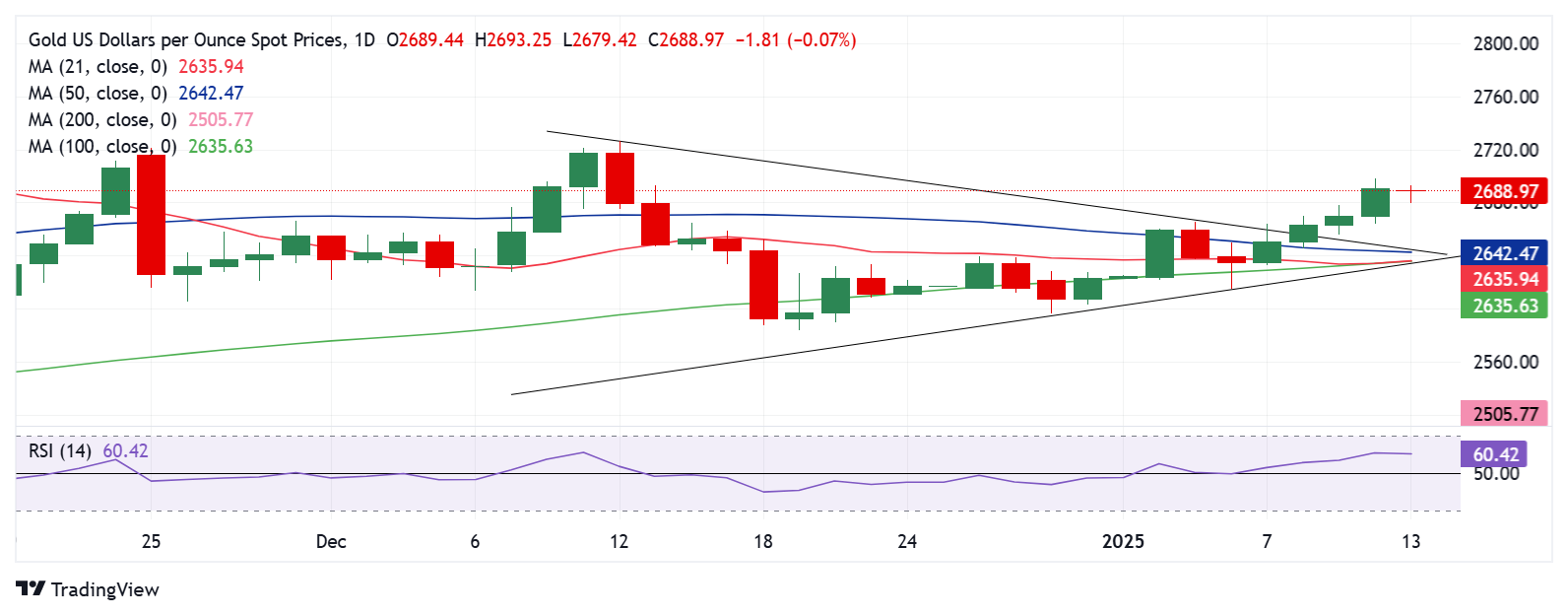
The daily chart shows that despite a Bear Cross in play, Gold buyers remained defiant and flexed their muscles on Friday, extending the symmetrical triangle breakout.
Gold price confirmed an upside break from a month-long symmetrical triangle pattern on January 8, adding credence to the ongoing bullish momentum. Meanwhile, the 21-day Simple Moving Average (SMA) crossed the 100-day SMA from above on a daily closing basis on Thursday, validiting the Bear Cross.
The 14-day Relative Strength Index (RSI) holds comfortably above the midline, currently near 60.00, backing the case for more upside in Gold price.
Gold price could extend its four-day advance to take out the $2,700 barrier should buyers regain poise.
The next upside barriers are aligned at the $2,710 round level and the December 12 high of $2,726.
Conversely, strong support is around $2,645, where the 50-day SMA coincides with the triangle resistance.
If that cap is cracked, Gold price will find immediate respite at $2,635, the confluence of the 21-day SMA, the 100-day SMA and the triangle support.
The last line of defense for Gold buyers is seen at the January 6 low of $2,615.
(This story was corrected on January 13 at 6:50 GMT to say that a stellar NFP report ramped up bets for just one interest rate cut by the Fed this year, not a hike.)
Gold FAQs
Gold has played a key role in human’s history as it has been widely used as a store of value and medium of exchange. Currently, apart from its shine and usage for jewelry, the precious metal is widely seen as a safe-haven asset, meaning that it is considered a good investment during turbulent times. Gold is also widely seen as a hedge against inflation and against depreciating currencies as it doesn’t rely on any specific issuer or government.
Central banks are the biggest Gold holders. In their aim to support their currencies in turbulent times, central banks tend to diversify their reserves and buy Gold to improve the perceived strength of the economy and the currency. High Gold reserves can be a source of trust for a country’s solvency. Central banks added 1,136 tonnes of Gold worth around $70 billion to their reserves in 2022, according to data from the World Gold Council. This is the highest yearly purchase since records began. Central banks from emerging economies such as China, India and Turkey are quickly increasing their Gold reserves.
Gold has an inverse correlation with the US Dollar and US Treasuries, which are both major reserve and safe-haven assets. When the Dollar depreciates, Gold tends to rise, enabling investors and central banks to diversify their assets in turbulent times. Gold is also inversely correlated with risk assets. A rally in the stock market tends to weaken Gold price, while sell-offs in riskier markets tend to favor the precious metal.
The price can move due to a wide range of factors. Geopolitical instability or fears of a deep recession can quickly make Gold price escalate due to its safe-haven status. As a yield-less asset, Gold tends to rise with lower interest rates, while higher cost of money usually weighs down on the yellow metal. Still, most moves depend on how the US Dollar (USD) behaves as the asset is priced in dollars (XAU/USD). A strong Dollar tends to keep the price of Gold controlled, whereas a weaker Dollar is likely to push Gold prices up.
Author

Dhwani Mehta
FXStreet
Residing in Mumbai (India), Dhwani is a Senior Analyst and Manager of the Asian session at FXStreet. She has over 10 years of experience in analyzing and covering the global financial markets, with specialization in Forex and commodities markets.
















