Gold is rebounding, but something is still pulling it back

Gold (XAU/USD) attempts a modest rebound on Wednesday after suffering a sharp decline on Tuesday. The latest selling pressure followed stronger-than-expected United States (US) inflation figures and increasingly hawkish comments from Federal Reserve (Fed) officials, prompting investors to reconsider the trajectory of monetary policy.
Although Gold manages to defend the psychological $4,000 level, its repeated failures to sustain gains above $4,100 suggest that buyers remain cautious.
US inflation gives the Fed another reason to tighten
Tuesday's US Consumer Price Index (CPI) report reinforces concerns that inflation remains too persistent for the Fed to consider easing monetary policy. Headline CPI increased 0.4% MoM in October, exceeding market expectations of 0.3%, although slowing from September's 0.6% increase. More importantly, Core CPI, which excludes volatile food and energy prices, rose 0.3%, above the 0.2% forecast and matching September's reading.
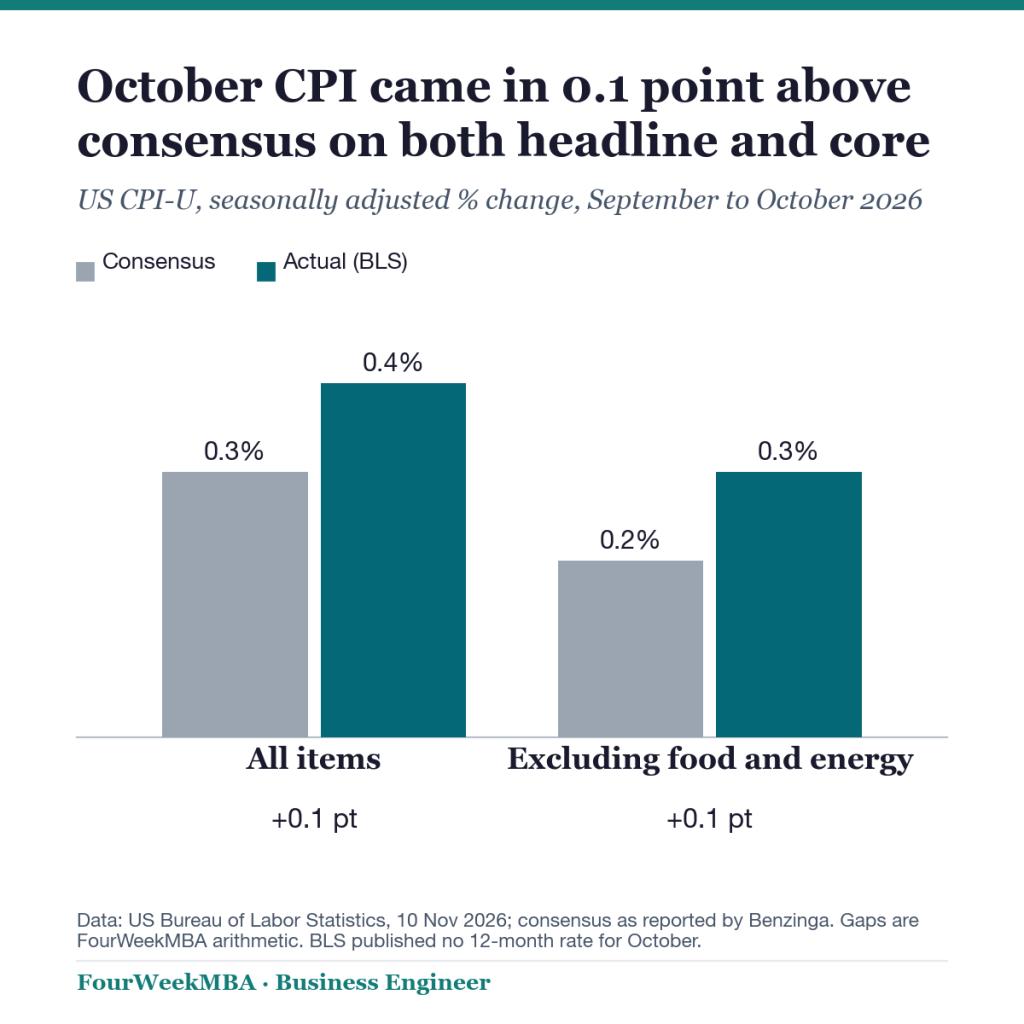
Commerzbank warns that “core inflation, a key gauge of the underlying trend, thus remains (too) high and is no longer trending downward,” highlighting the difficulty of bringing inflation sustainably under control.
Strategists at Deutsche Bank highlight the persistence of underlying inflation, noting that “it was the third consecutive month with core CPI at +0.3%, and if you take those three months together, the annualised pace for core CPI is running at +3.75%.” The bank adds that “that’s the fastest pace on that measure since April 2024, so it made it increasingly difficult to dismiss this as a blip.”
The inflation surprise came shortly after Fed Governor Christopher Waller signaled that a “half-point Fed rate hike may be needed in December” if monthly core inflation remains “around 0.3% or higher.” With October's figures meeting that level, investors are increasingly considering a more aggressive monetary policy response.
Other Fed officials reinforce this message. Philadelphia Fed President Anna Paulson called for “further gradual tightening,” while Dallas Fed President Lorie Logan argued that “it is clear that the Fed needs at least two more quarter-percentage-point increases.” These comments suggest that the central bank's tightening cycle could extend beyond December, creating a difficult environment for non-yielding assets such as Gold.
Treasury yields and the US Dollar tighten their grip on Gold
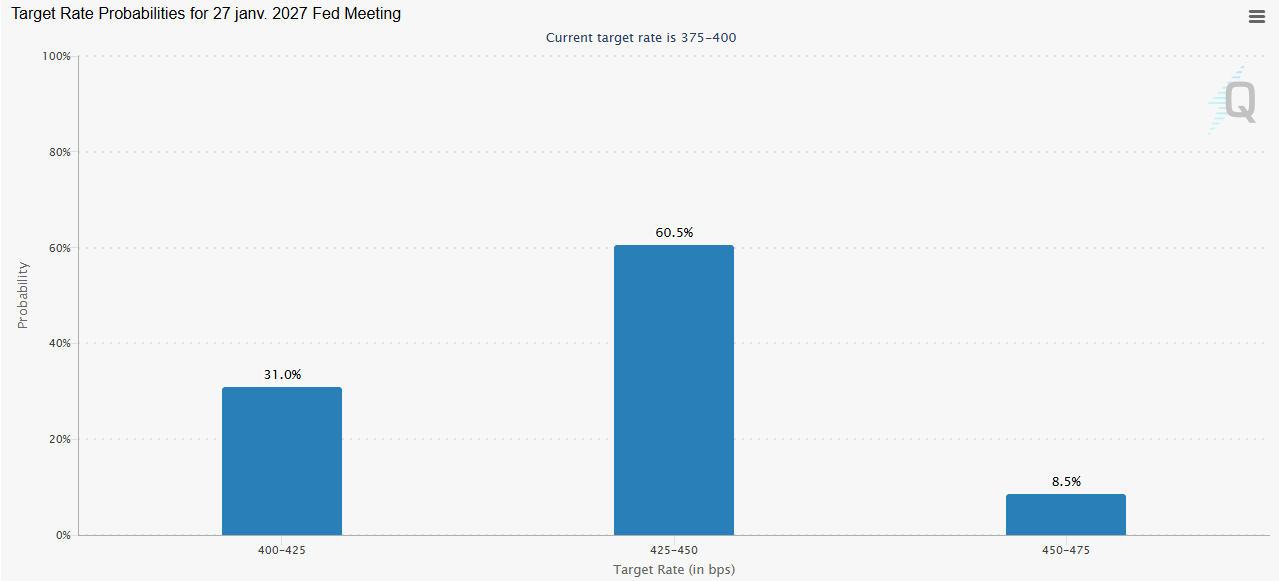
The changing monetary policy outlook is already producing significant reactions across financial markets. According to the CME FedWatch Tool, investors assign approximately an 85% chance to a 25-basis-point interest rate increase in December, alongside a 15% chance of a larger 50-basis-point move. More importantly, expectations of another rate hike in January rose sharply, with the chance exceeding 60%, compared with just 19% before Tuesday's repricing.
The reaction in the US Treasury market is particularly revealing. Two-year government bond yields jumped approximately 19 basis points on Tuesday, while the benchmark 10-year yield rose around 14 basis points, moving to around 5% on Wednesday.
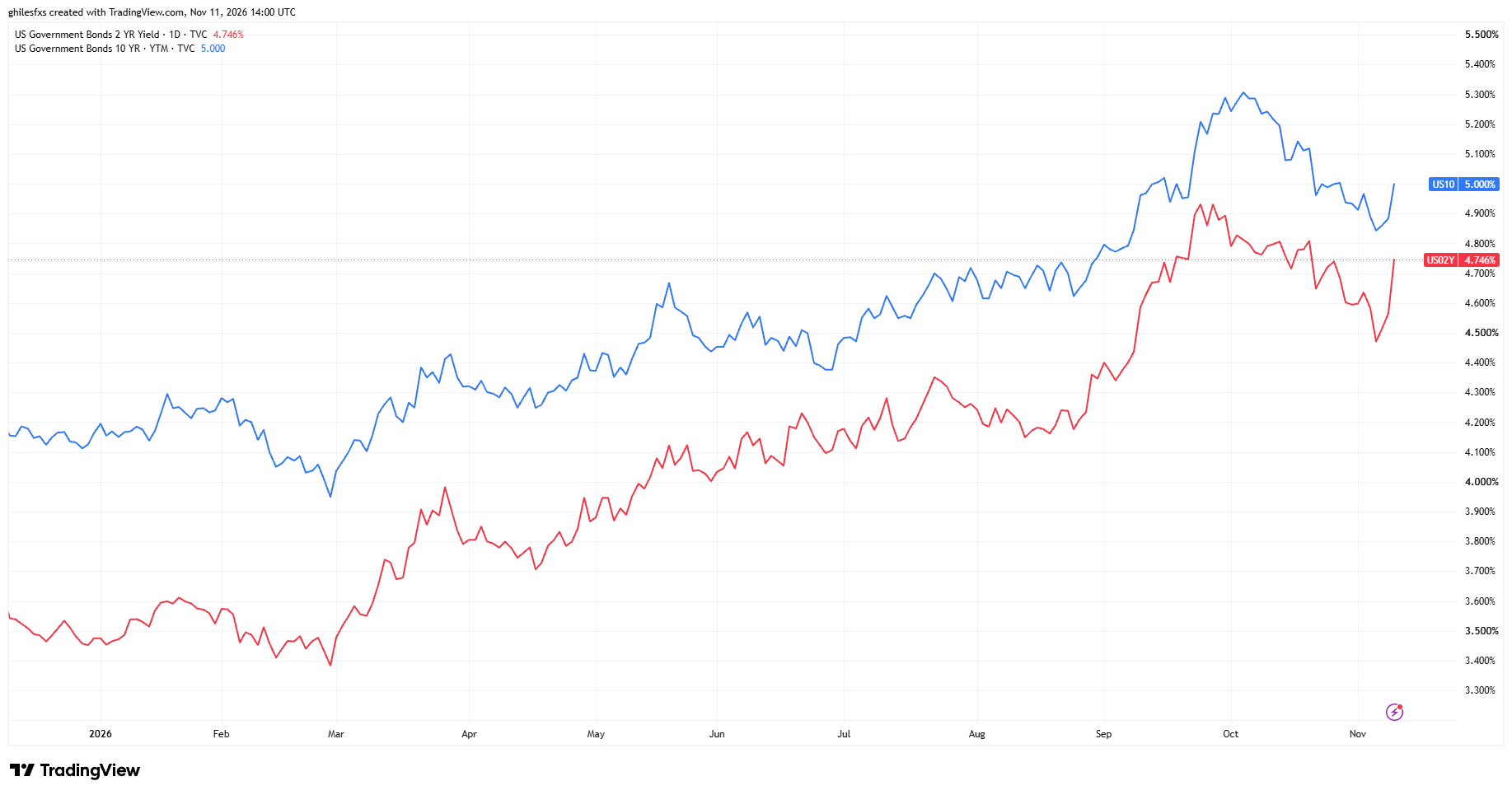
Higher Treasury yields increase the opportunity cost of holding Gold, which generates no interest income. At the same time, expectations of tighter monetary policy strengthen the US Dollar (USD), making the precious metal more expensive for investors holding other currencies. This combination of elevated bond yields and a stronger US Dollar helps explain why Gold struggles to extend its rebound despite recovering from Tuesday's losses.
Could lower Oil prices eventually offer some relief?
Not every development is unfavorable for Gold. West Texas Intermediate (WTI) Oil prices have fallen more than 15% since the beginning of November, retreating toward $83 amid renewed diplomatic efforts involving Iran, before rebounding slightly to around $86 on Wednesday, after hitting $104 on October 30.
Lower energy costs could eventually reduce inflationary pressures, potentially limiting the need for additional Fed tightening. However, October's Core CPI figures suggest that inflation remains persistent beyond the energy sector. Consequently, falling Oil prices alone may not be sufficient to alter the Fed's near-term policy outlook.
Furthermore, easing geopolitical tensions could reduce safe-haven demand for Gold, partially offsetting the potential benefits of lower inflation. Nevertheless, continued central bank purchases and investment flows into Gold-backed Exchange-Traded Funds (ETFs) could provide longer-term support, even as monetary policy expectations constrain the immediate recovery.
The $4,000-$3,870 support zone remains decisive
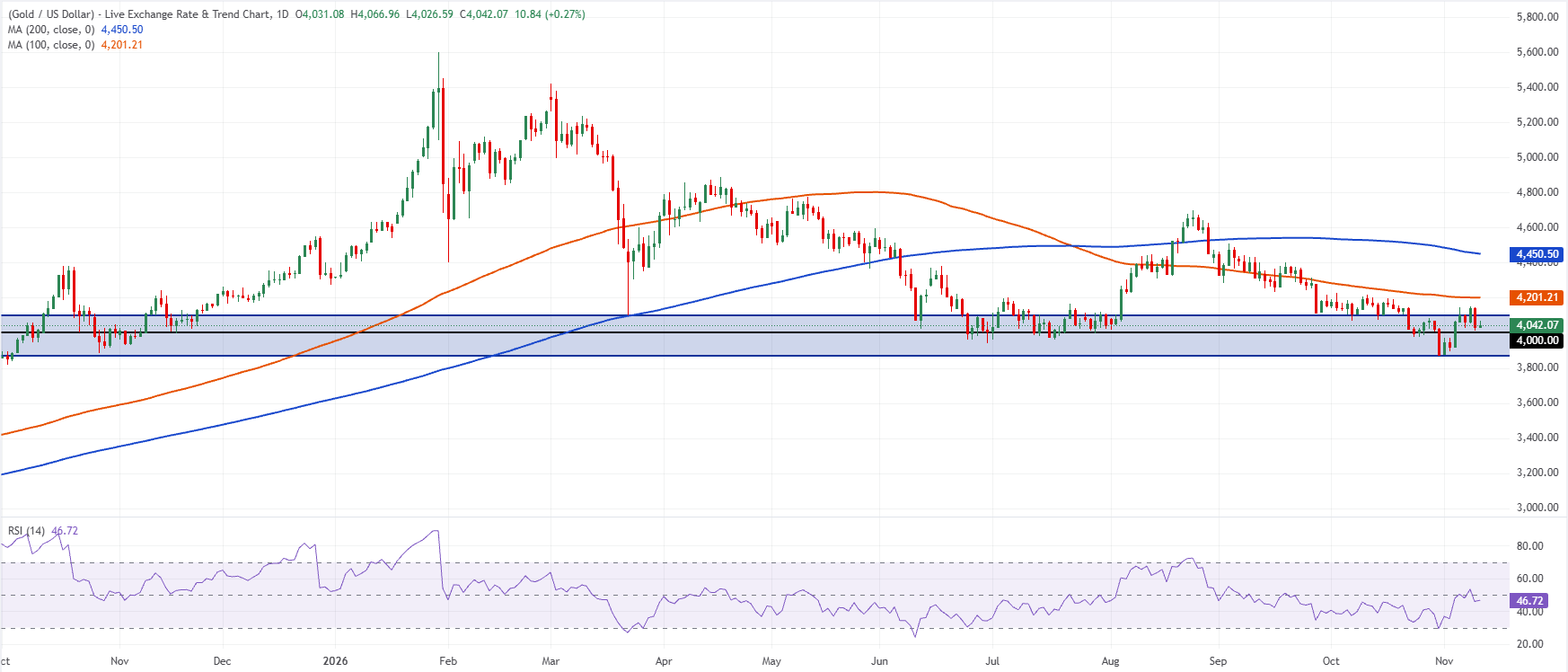
Gold's daily chart continues to reflect a fragile market structure, with the precious metal trading below its 100-day Simple Moving Average (SMA) near $4,201 and its 200-day SMA around $4,450. Despite Wednesday's modest rebound, the repeated inability to establish a sustained recovery above $4,100 suggests that sellers retain control of the broader trend.
The immediate focus remains on the important support zone between $4,000 and $3,870, which has repeatedly attracted buyers in recent months. A sustained break below $4,000 would expose the lower boundary of this area near $3,870, corresponding to the late-October low. Losing this support could signal a deeper bearish correction.
Conversely, buyers must first reclaim $4,100 to improve the short-term outlook. A sustained move above this level could open the door toward the 100-day SMA around $4,201, although the 200-day SMA near $4,450 remains a significant longer-term obstacle.
The daily Relative Strength Index (RSI) stands near 47, indicating subdued momentum without oversold conditions.
Ultimately, Gold's ability to defend the $4,000-$3,870 support zone may determine whether Wednesday's recovery develops into a more sustainable rebound or simply represents another temporary pause in the broader decline. Unless inflation pressures ease or Fed rate-hike expectations soften, the precious metal could struggle to regain meaningful bullish momentum.
Author

Ghiles Guezout
FXStreet
Ghiles Guezout is a Market Analyst with a strong background in stock market investments, trading, and cryptocurrencies. He combines fundamental and technical analysis skills to identify market opportunities.