|

Gold Back Over Trend Line Support, More Upside To Come?

Gold is trading over 0.9% higher and has pushed overt the $1600 mark, as it attempts to pare some of Friday’s losses.

Safe haven

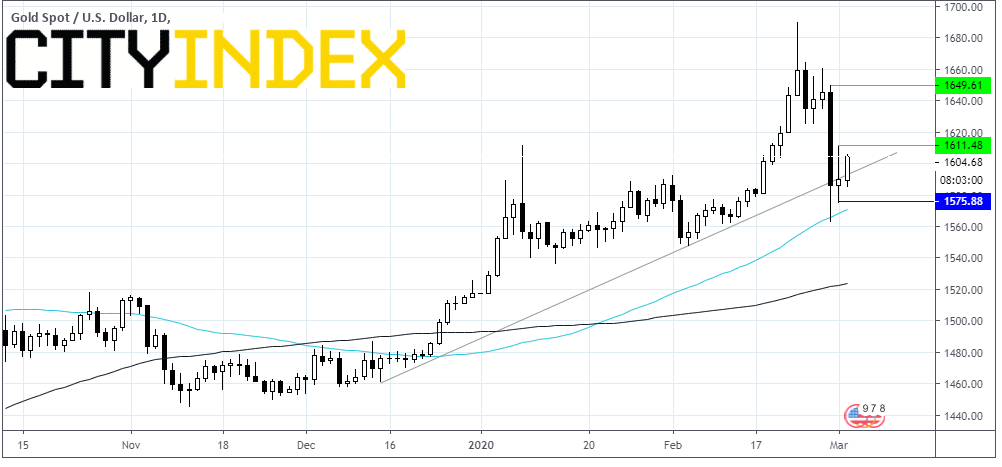
Gold has had an interesting reaction to coronavirus. The price of gold trended steadily higher as coronavirus fears increased flows into safe haven assets. Gold advanced in every trading session par 5 across the month of February. Friday was one of those losing sessions. On Friday, despite coronavirus risks remaining high gold sold off sharply in a serious bout of profit taking. The price slipped through trend line support, testing the 50 sma before rebounding.

Easing monetary policy

Gold is once again climbing higher after the Federal Reserve hinted that it could ease policy in a bid to shore up the US economy in the face of risks posed by the coronavirus outbreak. The BoE and BoJ alluded to the same, whilst the group of 7 finance ministers (G7) said they would use all appropriate policy tools.

The prospect of the Fed and its peers easing monetary policy is music to the ears of gold bugs. In a lower interest rate environment, the opportunity cost of holding non -yielding gold declines, boosting demand for the precious metal.

Level to watch

Gold is trading 0.9% higher, crucially pushing back over the ascending trendline which began last December. A close above the said trend line could initiate another push higher.

Immediate resistance can be seen at $1605 (today’s high) a breakthrough here could open the door to $1611 (yesterday’s high) prior to $1650 (Friday’s high).

Immediate support is at $1595 (trend line) prior to $1575 (yesterday’s low) and $1569 (50 sma).
Gold

Author

More from Fiona Cincotta
Share:

Editor's Picks

AUD/USD meets fresh supply and tests 0.7100 amid weak Australian PMIs

AUD/USD has come under fresh selling pressure and is testing 0.7100 in the Asian session on Wednesday. Australia's flash PMIs showed manufacturing slipped into contraction and services expanding slowly for a second straight month, renewing the pair's downside. Furthermore, a bullish US Dollar acts as a headwind for the pair as traders keenly await the crucial Trump-Xi summit on Thursday. Meanwhile, markets shrug off US-Iran indirect talks.

USD/JPY stands firm near mid-157.00s, close to two-week high

USD/JPY hovers around mid-157.00s in the Asian session on Wednesday, near two-week highs touched last Friday as the BoJ's dovish rate hike continues to undermine the Japanese Yen. Meanwhile, the US Dollar remains firm amid the Fed's hawkish stance, adding support to the pair, though JPY intervention fears cap further gains. Markets pay little heed to the completion of the round of US-Iran indirect talks ahead of Trump-Xi meeting.

Gold sticks to losses below $4,350 as USD buying remains unabated amid hawkish Fed

Gold struggles to capitalize on the previous day's goodish rebound from sub-$4,300 levels and meets with fresh supply during the Asian session. The US Dollar extends its recent uptrend, hitting a fresh high since July 30 amid the Federal Reserve's hawkish outlook. This, in turn, is seen as a key factor undermining the non-yielding bullion.

Cardano Bulls push higher as open interest, funding rates rise

Cardano (ADA) extends gains, trading above $0.262 after rallying more than 14% so far this week. The bullish momentum is supported by rising Open Interest (OI), positive funding rates and signs of whale accumulation. If buying pressure persists, ADA could extend its rally and target higher levels. Cardano’s derivatives metrics show strengthening conditions.

Trump meets Xi: Why markets are watching this summit so closely

United States President Donald Trump and Chinese President Xi Jinping are set to meet in Washington on Thursday for a summit closely watched by markets. After several months of easing trade tensions between the US and China, the meeting could determine whether the world's two largest economies extend their truce or enter a new period of uncertainty.

BoJ Recap: Not as hawkish as expected

The Bank of Japan (BoJ) raised its short-term interest-rate target to 1.25% from 1.00% in a 7-2 vote, marking another step in the normalisation of monetary policy and widely matching what everyone has been expecting for weeks.