GBP/USD Weekly Forecast: Pound Sterling to retain bearish bias, eyeing US CPI, UK GDP
- GBP/USD touched the lowest level in seven months below 1.2050.
- Top-tier economic data from the US and UK to provide GBP/USD a fresh directional impetus.
- Downside risks remain intact for Pound Sterling against the US Dollar in the week ahead.

The Pound Sterling struggled to stay resilient against the United States Dollar (USD), knocking GBP/USD to the lowest level since March just below the 1.2050 level. Although GBP/USD staged a rebound ahead of the weekend, it still remains in the woods as attention turns toward the US Consumer Price Index (CPI) and the UK Gross Domestic Product (GDP) releases in the upcoming week.
GBP/USD: What happened last week?
The downbeat sentiment around the GBP/USD pair was primarily driven by the monetary policy and macroeconomic divergences between the US and the UK, which justified the ongoing uptrend in the United States Dollar (USD) and the US Treasury bond yields. There was little from the UK side of the equation that impacted the Pound Sterling valuations.
At the beginning of the week, market bets for one more US Federal Reserve (Fed) rate hike by the end of this year gathered steam, helped by an unexpected increase in the US JOLTS Job Openings data. The US Labor Department said on Tuesday that job openings unexpectedly increased by 690,000 to 9.610 million in August, the biggest gain in over two years. The data pointed to a persistently tight labor market in the United States that could compel the Fed to raise interest rates next month.
The US Dollar hit fresh 11-month highs at 107.35 against its major FX rivals, sending GBP/USD to a fresh seven-month low of 1.2037. The Greenback also capitalized on the Congressional late passage of a stopgap funding bill over the weekend, with overwhelming Democratic support to avoid the federal government's fourth partial shutdown in a decade.
Renewed US political tensions, particularly the ousting of California Republican Kevin McCarthy from his position as House speaker, contributed to the bond market turmoil and triggered a fresh rally in the US Treasury bond yields. The benchmark 10-year US Treasury bond yield hit the highest level since 2007 at 4.88%.
The tide, however, turned against the US Dollar after bond yields tumbled, as the bond market was rescued by a 5% sell-off in Oil prices, weak US ADP jobs data and the ISM Services PMI. Softer-than-expected US labor data dialed down expectations of a November Fed rate hike.
According to the ADP report on Wednesday, the US private sector added just 89,000 jobs in September, down from an upwardly revised 180,000 in August and far below the 153,000 estimate. US ISM Services PMI fell from 54.5 to 53.6 in September, although the data matched expectations. Following the data release, odds of a Fed rate hike in November dropped to 23% from about 31% pre-release.
In the latter part of the week, the US Dollar extended its corrective downside and drove GBP/USD back toward 1.2200, as several Fed policymakers expressed caution against a potential ‘soft-landing’ for the US economy, in the wake of surging borrowing costs. Further, expectations of loosening US labor market conditions also contributed to the pullback in the US Dollar and rescued the Pound Sterling.
Ahead of the weekend, the September jobs report showed that Nonfarm Payrolls rose by 336,000. The initial market reaction caused GBP/USD to turn south as this reading surpassed the market expectation of 170,000 by a wide margin. After falling below 1.2150, however, the pair regained its traction and recovered to the 1.2200 area, supported by week-end flows.
Week ahead: All eyes on US inflation and UK GDP data
Following an eventful week, GBP/USD traders will witness a quiet start to a relatively data-light week. It’s a United States Columbus Day holiday on Monday, and hence, trading conditions are likely to remain thin, leaving the pair subject to wild fluctuations.
Tuesday is also quiet data-wise but the scheduled speech from Fed Governor Christopher Waller will be closely scrutinized. On Wednesday, the Producer Price Index (PPI) inflation data from the US will be published, followed by the Minutes of the Fed’s September policy meeting, which could throw a fresh light on the thoughts of members, possibly leading to a significant impact on the US Dollar valuations.
The first top-tier economic data from the United Kingdom will feature on Thursday, which will be the monthly GDP print for August. At the same time, the Industrial Production and Trade Balance data for the month will be also reported. The BoE’s Credit Conditions Survey for the third quarter will follow the British data dump.
However, also on Thursday, the main event risk that day will be the US CPI inflation data, which will likely reprice market expectations for the next policy move by the Fed. The US weekly Jobless Claims data will also drop alongside the US CPI report.
China’s CPI and PPI data will be published on Friday and are expected to set the tone for markets that day, affecting risk-sensitive currencies such as the Pound Sterling. Later in the American session, the University of Michigan (UoM) will release its preliminary reading of Consumer Sentiment and Inflation Expectations data for October, wrapping up a US data-centric week.

GBP/USD: Technical outlook
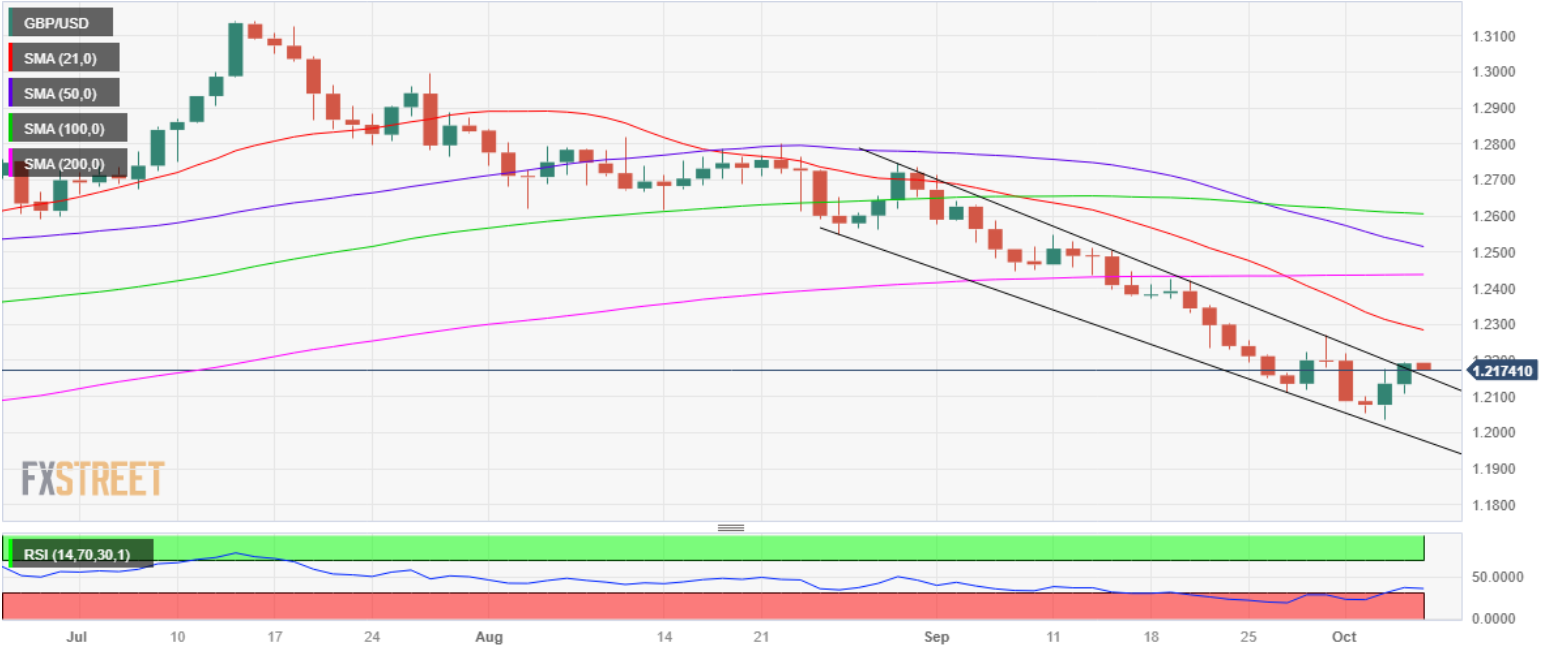
GBP/USD confirmed a falling wedge breakout after closing Thursday above the descending trendline resistance at 1.2180.
The upside break suggests that Pound Sterling buyers could be primed for a sustained recovery in the week ahead.
However, the 14-day Relative Strength Index (RSI) indicator remains below the midline, indicating that the GBP/USD recovery could remain limited.
On the upside, Pound Sterling buyers need to take out the 1.2200 barrier on a weekly closing basis to unleash additional upswing toward 1.2280, the confluence of the falling 21-day Simple Moving Average (SMA) and the September 29 high.
If they manage to find a strong foothold above the latter, the pair could extend further toward the flattish 200-day SMA at 1.2438.
Conversely, if Pound Sterling sellers regain control, GBP/USD could resume its downtrend toward the multi-month low of 1.2037.
A sustained break below the latter will put the falling wedge support of 1.1977 at risk. The next relevant downside target is seen at the 1.1900 round level.
GBP/USD: Forecast poll
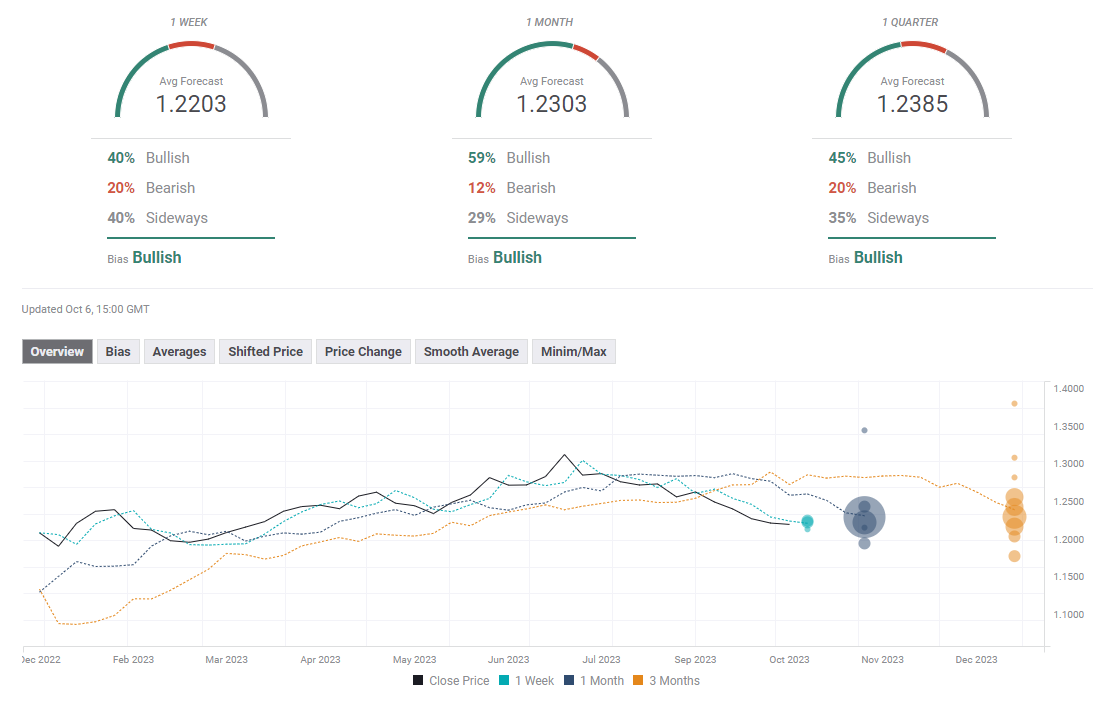
FXStreet Forecast Poll points to a mixed picture in the near term, with the one-week average target aligning at 1.2200. The one-month outlook, however, remains bullish.
Author

Dhwani Mehta
FXStreet
Residing in Mumbai (India), Dhwani is a Senior Analyst and Manager of the Asian session at FXStreet. She has over 10 years of experience in analyzing and covering the global financial markets, with specialization in Forex and commodities markets.