GBP/USD Weekly Forecast: Pound Sterling eyes top-tier UK data for fresh directional impetus
- GBP/USD hit a three-week high above 1.2300, then corrected sharply.
- United Kingdom jobs and inflation data to inject volatility around the Pound Sterling.
- GBP/USD sees limited room to the upside, with a Death Cross lurking on the daily chart.

The Pound Sterling snapped its recovery against the United States Dollar (USD), as GBP/USD reversed sharply from a three-week high near 1.2350. It remains to be seen if the GBP/USD pair can resume its recent uptrend ahead of the key United Kingdom’s (UK) employment and Consumer Price Index (CPI) inflation data in the week ahead.
GBP/USD: What happened last week?
It was all about the US Dollar once again in the past week, barring the renewed Middle East geopolitical tensions at the beginning of the week, which fuelled good two-way businesses in the GBP/USD pair.
The week kicked off with intense volatility, as global flight to safety emerged after the Hamas movement from the Gaza enclave launched airstrikes on an Israeli town near the Gaza Strip, killing over 1000 people and taking many hostages. In retaliation, Israel declared ‘a state of war’. Israeli air attacks also killed more a 1000people and damaged numerous residential buildings in the besieged Gaza Strip.
The US Dollar was the go-to safe-haven asset across the financial markets, sending GBP/USD sharply lower to near 1.2150 region. However, the pair witnessed a swift recovery after the focis shifted back toward the US Federal Reserve (Fed) policy expectations, brushing aside the geopolitical tensions.
The recent dovish shift in tone from the Fed policymakers prompted traders to pare back their bets of one more rate hike by the world’s most powerful central bank by the year-end. Dovish Fed talks strengthened the narrative that higher borrowing costs for households and businesses could do the Fed’s job of bringing inflationary pressures down, dissuading the Fed from more tightening.
This thesis continued to undermine the US Dollar across its major rivals in the first half of the week, tracking the downward trajectory in the US Treasury bond yields. Subsequently, GBP/USD built on its recovery from multi-month lows and hit the highest level in three weeks at 1.2337 on Wednesday.
Pound Sterling buyers, however, failed to preserve the upside and gave into the bearish pressures after the US Dollar rebounded firmly alongside the US Treasury bond yields on a surprisingly hotter US CPI inflation data on Thursday. The US CPI increased 0.4% last month after a 0.3% gain in August, the Labor Department said on Thursday. On an annual basis, the headline CPI rose 3.7% in September, at the same pace as seen in August while beating estimates of a 3.6% rise.
The US inflation data reinforced the Fed’s “higher rates for longer” narrative, spiking up the US Dollar at the expense of the Pound Sterling. GBP/USD tumbled over 150 pips to surrender 1.2200 yet again in the aftermath of the all-important US macroeconomic data.
On Friday, GBP/USD attempted a tepid bounce and regained 1.2200, helped by a broad retreat in the US Dollar, as traders weighed the renewed hawkish Fed expectations.
The Greenback got fresh impetus ahead of hte weekly close, as the preliminary estimate of the October Michigan Consumer Sentiment Index came in at 63, much worse than the 67.4 expected and the previous 68.1.
A busy United Kingdom docket ahead
Following the fateful Middle East conflict, GBP/USD traders will take a breather, as Monday accounts for a quiet start to a busy week ahead.
There are no top-tier economic data releases from both sides of the Atlantic, and hence, attention turns toward Tuesday’s labor market report from the United Kingdom, with the wage inflation data eagerly anticipated for fresh hints on the BoE’s next interest rate move. Later that day, the US docket features the Retail Sales and Industrial Production data, which will throw fresh light on the state of the US economy.
Wednesday kicks off with the high-impact GDP, Retail Sales and Industrial Output data from China. The Chinese data is likely to have a significant influence on risk sentiment, eventually affecting the US Dollar valuations, as well as, the risk sensitive currencies such as the Pound Sterling.
The main event risk, however, for the British Pound is expected to be the UK CPI inflation data due Wednesday at 06:00 GMT. The data could have a meaningful impact on the BoE’s path forward on interest rates, infusing intense volatility around the GBP/USD pair. In American trading on Wednesday, US traders will look forward to the Building Permits and Housing Starts for some trading incentives.
The UK economic calendar is data-empty on Thursday while the US will see the release of the weekly Jobless Claims and a couple of other minority reports. The UK Retail Sales publication will be the only relevant economic data due on Friday.
Apart from the statistics, traders will keep a close eye on the geopolitical developments, Oil price action and speeches from Fed officials for the next directional impetus in GBP/USD.

GBP/USD: Technical outlook
Having confirmed a falling wedge breakout in the weekend ended October 6, GBP/USD extended its winning momentum and temporarily recaptured the downward-sloping 21-day Simple Moving Average (SMA), now offering resistance at 1.2233.
Pound Sterling sellers, however, fought back control, as the 14-day Relative Strength Index (RSI) indicator continued to stay within the bearish territory, below the 50 level.
GBP/USD, therefore, failed to sustain at higher and fell back below the 21-day SMA barrier.
Adding credence to the bearish potential, the descending 50-day SMA is on its way to pierce through the horizontal 200-day SMA from above. If the crossover occurs, it would validate a Death Cross.
On the upside, a sustained move above the 21-day SMA of 1.2233 could unleash a meaningful uptrend toward the confluence area of the 100- and 200-day SMAs around 1.2450.
Ahead of that, the two-week high of 1.2337 will be retested. If Pound Sterling buyers manage to break through the abovementioned stiff resistance levels, a test of the mildly bearish 100-day SMA at 1.2600 cannot be ruled out.
Conversely, if the pair resumes the latest downside, the 1.2100 round level could be the next cushion. GBP/USD sellers will then target the falling wedge resistance-turned-support at 1.2052. Further down, the 1.2000 psychological level will be a line in the sand for Pound Sterling buyers.

GBP/USD sentiment poll
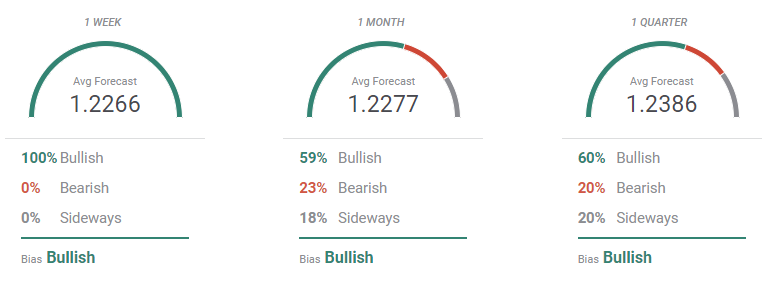
According to the FXStreet Forecast Poll, the GBP/USD pair may recover some ground, although gains are meant to be limited. 100% of the polled experts see above current levels in the weekly perspective, with the pair averaging 1.2266. Buyers decreased to 59% in the monthly view and stand at 60% in the quarterly perspective, with GBP/USD seen at 1.2386 on average.
The Overview chart shows that the three moving averages under study have lost their downward strength but are mostly flat as most potential targets fall around the current level. In the wider perspective, in fact, the risk skews to the downside as the pair is even seen below the 1.2000 mark.
Author

Dhwani Mehta
FXStreet
Residing in Mumbai (India), Dhwani is a Senior Analyst and Manager of the Asian session at FXStreet. She has over 10 years of experience in analyzing and covering the global financial markets, with specialization in Forex and commodities markets.