GBP/USD Weekly Forecast: Down but not out, awaiting the Fed
- GBP/USD corrects from 15-month highs as US Dollar sellers take a breather.
- All eyes remain on the US Federal Reserve policy announcements in the week ahead.
- GBP/USD bulls could re-emerge at lower levels while the key 1.2835 support holds.

Following a stunning week, the Pound Sterling corrected sharply against the United States Dollar (USD), knocking GBP/USD back under the 1.3000 psychological level. In the week ahead, the pair awaits the all-important US Federal Reserve (Fed) monetary policy decision and top-tier economic data from the United States for a fresh directional impetus.
GBP/USD: What happened last week?
The focus turned back toward China in the early part of the week after the world’s second-largest economy reported below-forecast growth, alongside mixed economic activity data, which rekindled China’s slowdown worries and helped put a flow under the safe-haven US Dollar. China’s GDP expanded 6.3% in the second quarter, accelerating from 4.5% in the first three months of the year but the rate missed estimates for a growth of 7.3%. Meanwhile, the country’s Retail Sales missed estimates with a 3.1% increase in June. Industrial Production, however, came in at 4.4% in the reported period vs. 2.7% expected.
Investors also took that as an excuse to unwind their USD short positions after the previous two weeks of sharp declines. Tuesday’s US Retail Sales report also underpinned the sentiment around the US currency. The US Commerce Department showed on Tuesday that the country’s Retail Sales increased 0.2% last month against 0.5% expected. Despite the below-forecast reading, the underlying sales remained resilient, with online sales surging by 1.9%. Meanwhile, sales at food services and drinking places edged up 0.1%.
However, expectations that the Federal Reserve could potentially pause its rate hike cycle after the 25 basis points (bps) increase in July kept the US Dollar recovery checked. According to CME Group’s FedWatch Tool, markets have fully priced in a 25 bps Fed rate hike next week. Previous week’s softer US inflation data combined and dovish Fedspeak ramped up bets for a Fed rate hike pause beyond July.
Against this backdrop, GBP/USD extended its correction from 15-month highs near 1.3140, only to witness further follow-through selling after soft UK inflation data. The annual Consumer Price Index (CPI) advanced 7.9% in June, slowing sharply from an 8.7% increase recorded in May, the latest data published by the UK Office for National Statistics (ONS) showed on Wednesday. The market had estimated an 8.2% growth. The Core CPI gauge (excluding volatile food and energy items) increased 6.9% YoY last month, compared with a 7.1% rise seen in May while beating expectations of a 7.1% print. Downbeat UK data poured cold water on hopes for another 50 bps rate hike by the Bank of England (BoE) in August.
In the second half of the week, GBP/USD reached fresh eight-day lows on the 1.2800 level, as the US Dollar embarked upon a meaningful recovery, courtesy of disappointing tech earnings reports and the revival of the hawkish Fed expectations. US weekly Jobless Claims data indicated fresh signs of labor market resiliency, bringing odds for another rate hike this year back on the table. The latest data published by the US Labor Department showed Thursday that the initial Unemployment Claims fell by 9,000 to 228,000 in the week ended July 15 against 237,000 in the previous week, hitting a two-month low.
On the final trading day of the week, GBP/USD paused its run of declines and attempted a comeback, drawing support from the upbeat UK Retail Sales data and a broad-based US Dollar retreat. The UK Retail Sales rose 0.7% over the month in June vs. 0.2% expected and 0.1% prior, according to the latest data published by the Office for National Statistics (ONS) on Friday. The Core Retail Sales, stripping the auto motor fuel sales, jumped 0.8% MoM vs. 0.1% expected and 0% seen in May. Meanwhile, the end-of-the-week flows and pre-Fed decision market’s repositioning also helped the pair recover some lost ground.
Week ahead: Federal Reserve in spotlight
A slew of key event risks from the United States are due on the cards in the upcoming week while the United Kingdom economic calendar remains relatively light.
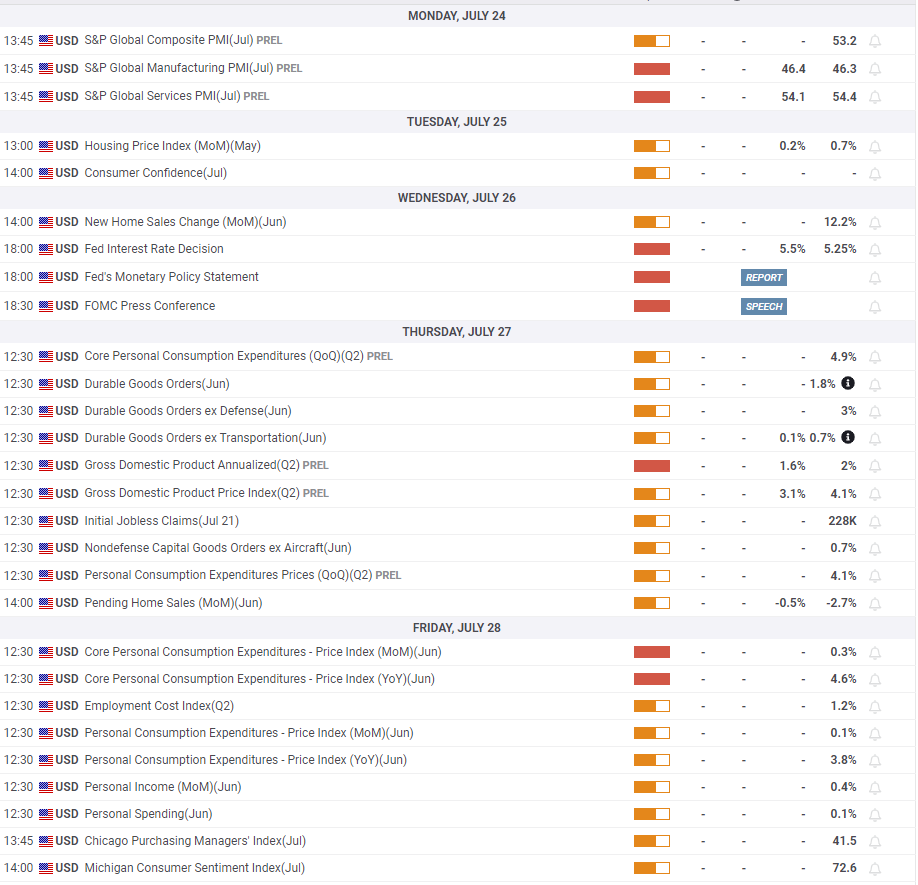
The S&P Global preliminary Manufacturing and Services PMI reports from both sides of the Atlantic will dominate GBP/USD flows on Monday. However, Tuesday has nothing much to offer, data-wise, except for the US Conference Board Consumer Confidence index.
Wednesday is critical, as the Federal Reserve will announce its interest rates decision, followed by Chair Jerome Powell’s press conference. The Fed’s outlook on the interest rate path and inflation will be key to determining the next direction in the US Dollar, as well as the GBP/USD pair.
Another eventful day awaits on Thursday, with the European Central Bank (ECB) policy decision, US Q2 advance Gross Domestic Product, Durable Goods and Pending Home Sales data due on the cards. Volatility around the major could spike on these high-impact macro events.
On Friday, the main focus will be on the Fed’s preferred inflation gauge, the Core Personal Consumption Expenditures - Price Index, which could help reprice Fed’s policy expectations. Traders will also look forward to the revised University of Michigan (UoM) Consumer Sentiment and Inflation Expectations data, which will wrap up a blockbuster week.

GBP/USD: Technical outlook
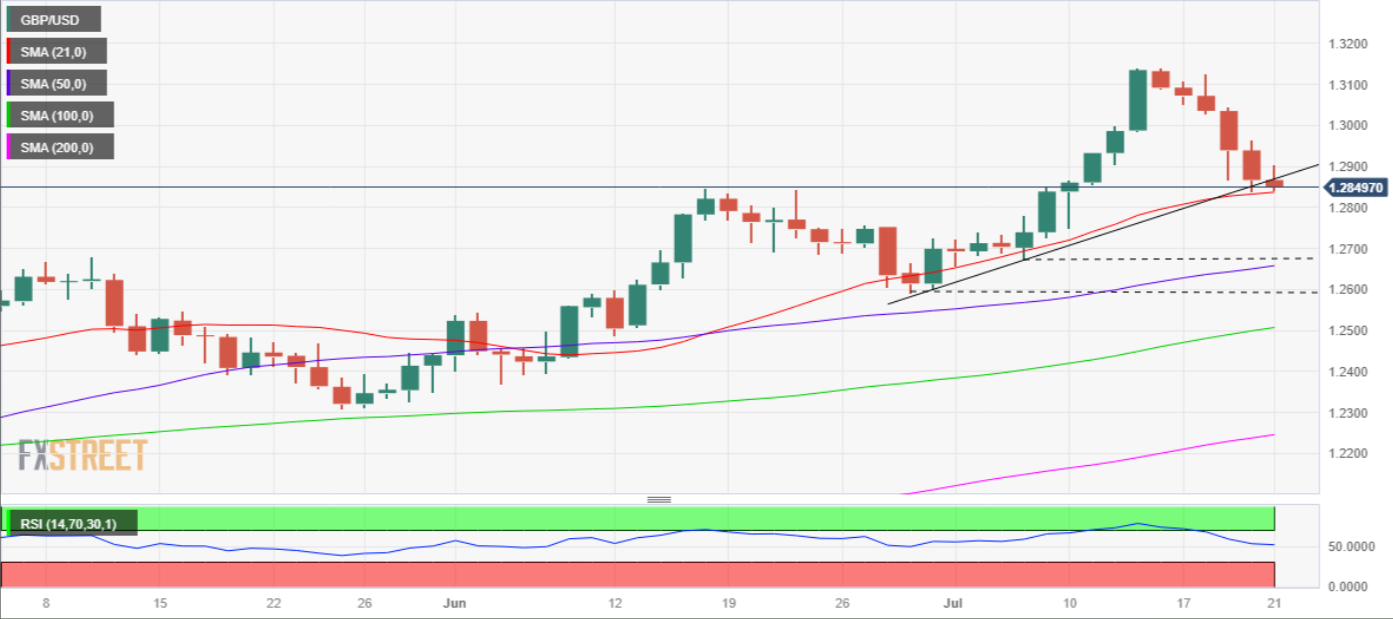
GBP/USD is teasing a critical daily support line, pegged at 1.2860, wrapping a down week. If the said support level is breached along with the bullish 21-Daily Moving Average (DMA) at 1.2835 on a daily closing basis, it could kickstart a fresh downtrend toward 1.2750. That level is the confluence of the psychological threshold and the July 10 low.
The next crucial demand area is seen around 1.2660, where the upward-sloping 50 DMA tests the July 6 low. Further down, the June 29 low of 1.2591 is set to test bearish traders’ commitments. The downside, however, appears limited as the 14-day Relative Strength Index (RSI) holds above the 50 threshold. Therefore, any further retracement in the pair could be seen as a good dip-buying opportunity.
On the flip side, should Pound Sterling bulls manage to defend the above-mentioned ascending trendline support at 1.2861, a meaningful upswing toward the 1.3000 level cannot be ruled out. Pound Sterling buyers will face the next stiff resistance near the 1.3150 psychological level, near where the April 14 2022 high aligns. The March 23 high of 1.3298 will be on buyers’ radars if the latter is scaled on a sustained basis.
GBP/USD: Forecast poll
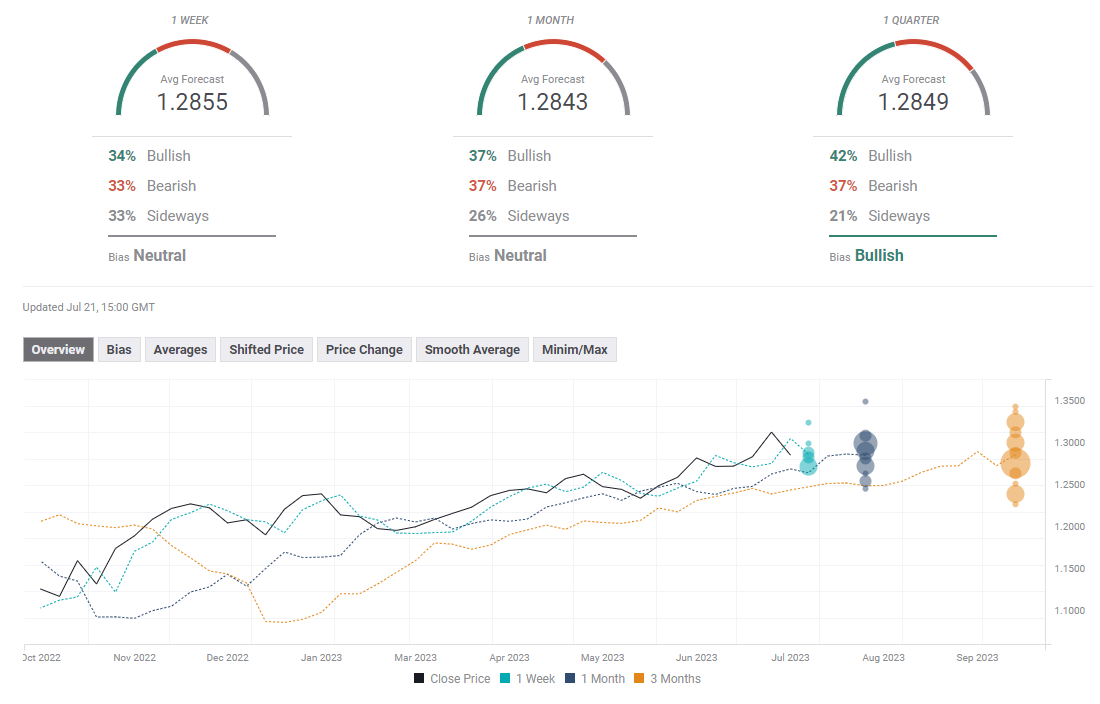
FXStreet Forecast Poll paints a mixed picture for GBP/USD. Experts are split virtually evenly between bullish, bearish and neutral bias in the one-week and one-month outlooks.
Author

Dhwani Mehta
FXStreet
Residing in Mumbai (India), Dhwani is a Senior Analyst and Manager of the Asian session at FXStreet. She has over 10 years of experience in analyzing and covering the global financial markets, with specialization in Forex and commodities markets.

















