GBP/USD: Market not expecting BoE rate cut in March
GBP/USD contracted to 1.3350 on Thursday, with the pound remaining under pressure and trading near three-month lows.
Pressure on the dollar has eased over the past 24 hours following reports that Iran has offered to discuss terms for a potential end to the conflict. According to The New York Times, representatives of the Iranian Ministry of Intelligence made contact with the CIA through intermediaries, just one day after the commencement of joint US-Israel attacks. However, Israeli authorities have advised Washington not to respond to this proposal just yet.
Investors are also weighing the impact of rising energy prices on the Bank of England’s (BoE) future policy. With inflationary risks rising, expectations of an imminent rate cut have diminished significantly.
The market now assigns only a 20% probability of a BoE rate cut this month, a sharp decline from around 75% just a week ago.
Meanwhile, the UK’s Office for Budget Responsibility (OBR) has downgraded its economic growth forecast for 2026 to 1.1%, down from the previously anticipated 1.4%. However, the outlook for 2027 and 2028 remains more optimistic, with annual growth projected at around 1.6%. A gradual decline in government borrowing and inflation is also expected.
Technical analysis
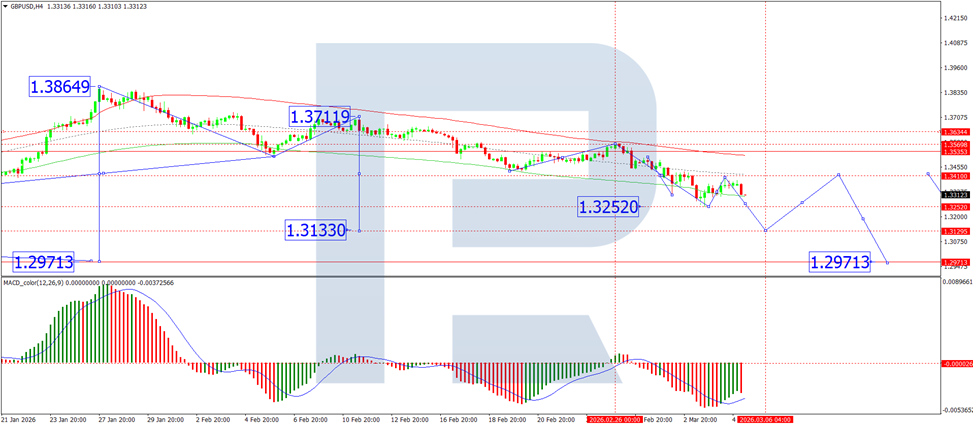
On the H4 GBP/USD chart, the market is forming a wide consolidation range around the 1.3326 level, currently extending up to 1.3393. A decline to 1.3131 is expected in the near term. Following this correction, a new consolidation phase is likely. An upside breakout would pave the way for the wave to extend to 1.3410, while a downside breakout would suggest further movement towards 1.2971. This scenario is confirmed by the MACD indicator, which shows its signal line below the zero line and pointing firmly downwards.
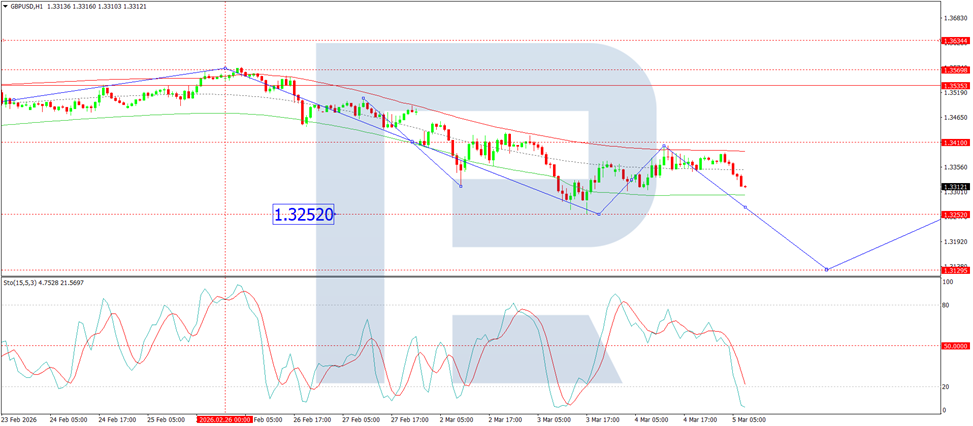
On the H1 chart, the market has formed a compact consolidation range around the 1.3333 level. A downside breakout has initiated a wave structure extending to 1.3266. If this level is breached, further downside potential towards 1.3125 is possible. This scenario is supported by the Stochastic oscillator, whose signal line is below the 50 level and pointing firmly downwards.
Conclusion
GBP/USD remains under pressure, with shifting central bank expectations and geopolitical developments driving price action. The dramatic reversal in BoE rate-cut probabilities – from 75% to just 20% in a week – reflects growing concerns about inflation driven by rising energy prices. While tentative diplomatic signals from Iran have temporarily eased dollar strength, the technical outlook for the pair remains decidedly bearish, with further downside anticipated in the near term.
Author

RoboForex Analysis Department
RoboForex
RoboForex Analysis Department provides timely market insights, expert technical analysis, and actionable forecasts across forex, commodities, indices, and equities.

















