GBP/USD appreciates BoE pause: Now focus shifts to geopolitics

GBP/USD rose during the previous session and is now correcting to 1.3403. The pound responded positively to the Bank of England’s decision to keep interest rates unchanged, with market attention focused on the regulator’s guidance on how the Iran conflict might influence future policy.
The Monetary Policy Committee voted unanimously for a pause (9-0), a notable shift from February’s more divided 5-4 alignment. Some members have acknowledged the possibility of future rate hikes. The BoE has adopted a wait-and-see approach amid significant uncertainty.
While the rate pause was widely anticipated, market expectations have shifted markedly. Until recently, rate cuts were priced in, but rising oil prices amid the Iran conflict have increased inflationary risks and tilted sentiment towards a more hawkish policy stance.
The BoE estimates that inflation could accelerate to 3.5% in the coming quarters and highlighted the risk that inflation expectations could become entrenched in the economy. At the same time, signs of an economic slowdown persist, which could restrain price increases, though the primary risk now centres on inflation.
Additional labour market data revealed a slowdown in wage growth to its lowest rate since late 2020. Unemployment remains at 5.2%, with employment showing signs of stabilisation. Under normal circumstances, such data might support softer rhetoric; however, the current geopolitical environment and elevated energy prices have pushed inflation risks to the forefront.
Overall, the BoE’s stance remains cautious. While the rate pause continues, the scope for policy easing is diminishing, limiting the pound’s upside potential.
Technical analysis
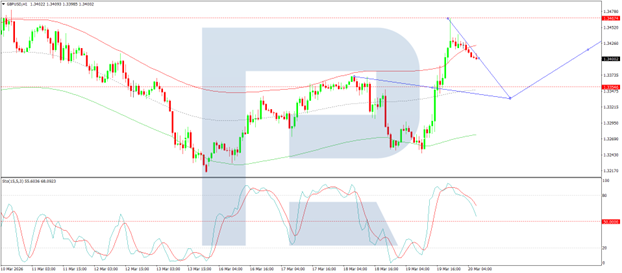
On the H4 GBP/USD chart, the market is forming a broad consolidation range around 1.3354, currently extending up to 1.3467. A decline to 1.3333 is expected in the near term, with a new consolidation range likely to form following this correction. An upside breakout would pave the way for a continuation wave towards 1.3494, while a downside breakout would suggest further movement towards 1.3133. Technically, this scenario is confirmed by the MACD indicator, whose signal line is above zero and pointing firmly upwards.
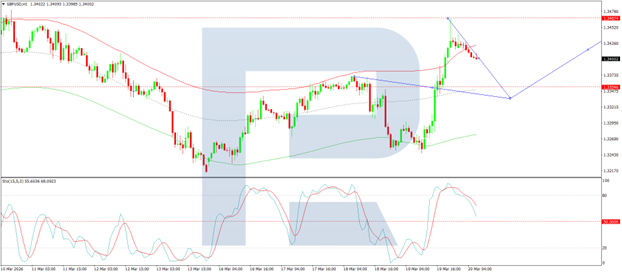
On the H1 chart, the market has formed a compact consolidation range around 1.3424. A downside breakout has initiated a wave structure extending to 1.3333. Should this level be breached, further downside towards 1.3125 is possible. Conversely, an upside breakout from the range could trigger a growth wave towards 1.3494. Technically, this scenario is confirmed by the Stochastic oscillator, with its signal line below 80 and pointing firmly downwards towards 20.
Conclusion
GBP/USD’s positive reaction to the BoE’s unanimous hold reflects market recognition that rising inflation risks – driven by geopolitical tensions and higher energy prices – are narrowing the path to policy easing. While the Bank’s cautious stance and the unanimous vote provide some support for sterling, the shift from rate-cut expectations to potential rate hikes has recalibrated market sentiment. With geopolitical developments now taking centre stage and technical indicators pointing to further consolidation, sterling’s near-term direction will likely hinge on whether inflation concerns continue to outweigh signs of domestic economic slowdown.
Author

RoboForex Analysis Department
RoboForex
RoboForex Analysis Department provides timely market insights, expert technical analysis, and actionable forecasts across forex, commodities, indices, and equities.

















