Eurozone potential growth could fall below 1% over the next few years

While US growth was boosted by stronger productivity growth in 2024-25, the eurozone’s expansion relied mostly on higher labour input. However, demographics don’t bode well, and unless the eurozone experiences a sudden acceleration of productivity growth, potential GDP growth is likely to fall below 1% in the coming years.
The slow agony of economic decline
Eurozone economic growth has been subdued for many years now, putting aside the V-shaped recovery after the deep pandemic recession. In his 2024 report, former ECB President Mario Draghi warned that without radical reforms and massive investment, the European Union faces a "slow agony" of economic decline.
It is sometimes argued that Europe deliberately prioritises well-being over growth. But the European welfare state, which in most European countries has a pay-as-you-go pension system, needs economic growth to remain sustainable. Not to mention public finances that are already in dire straits in several member states. Without economic growth, debt-to-GDP ratios risk becoming unsustainable.
Potential growth matters more than the business cycle
Growth is not constant over time; it moves with the business cycle. For longer-term assessments, economists therefore focus on potential growth – an economy’s cruising speed without overheating risks. So how fast can the eurozone and its member states grow on a sustained basis? The European Commission has already offered a clue. In its Autumn 2025 report, it projected EU potential growth to decline gradually from 1.5% in 2024 to 1.3% in 2027, with the eurozone slowing from 1.4% to 1.2% over the same period.
Let’s deconstruct these forecasts. How were they calculated? Potential growth can be seen as driven by four building blocks: working-age population growth, labour force participation (how the employment share of the working-age population evolves), hours worked per person, and productivity growth per hour. If we want to understand where Europe is heading, the first thing to do is to look at how those drivers have behaved recently.
Productivity, not people, is Europe’s missing growth engine
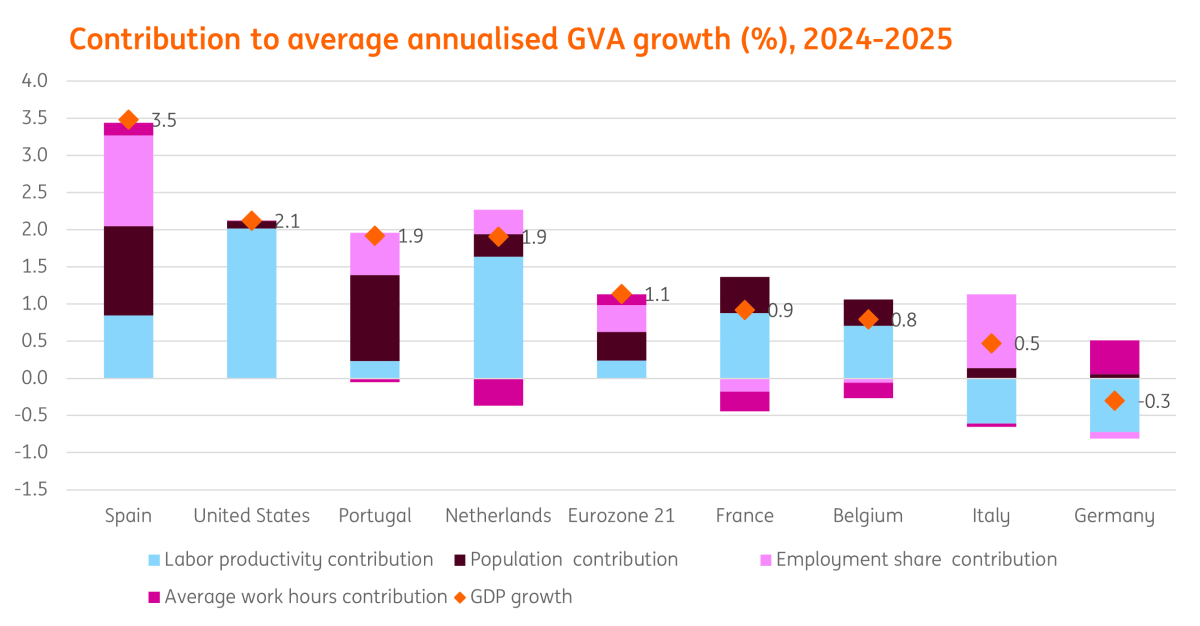
Over 2024-25, the eurozone grew by 1.1%, compared to 2.1% in the US. This growth difference between the US and the eurozone is often attributed to divergent demographics, with the US considered to have a faster-expanding labour force. But guess what: in the US, a full 2 percentage points of GDP growth was due to an increase in labour productivity per hour, while the growth in the total number of hours worked added a mere 0.1pp. Conversely, in the eurozone, productivity added only 0.2pp, while the growth of the population and the increase in the employment rate added 0.8pp to the economic expansion. So, the mix of growth drivers has been quite divergent between the two sides of the Atlantic. That matters for the outlook. Labour supply can support growth for a time, but it is not a substitute for sustained productivity gains, especially not in ageing societies.
Delving into country-specific patterns provides deeper insights into the eurozone’s growth pattern. The much-vaunted Spanish growth miracle over the last two years is largely due to strong labour growth driven by an immigration wave. France’s productivity increase is likely due to a composition effect, according to the think tank OFCE. Since 2024, reduced subsidies for apprenticeships have likely led to a relative exit of less productive workers from employment, weighing on the employment rate while mechanically raising productivity per hour.
Italy and Germany even had negative productivity growth over 2024-25. However, productivity growth also has a cyclical component. With rather rigid labour markets in Europe and a tendency towards labour hoarding in adverse times, it comes as no surprise that labour productivity has been tanking in Germany and Italy. Therefore, these productivity figures might be an underestimation of the trend for productivity growth in those countries, though even correcting for this, productivity growth is likely to be very low (the annualised 10-year average productivity growth is -0.1% for Italy and 0.5% for Germany).
US labour productivity surges ahead of the Eurozone
What about the future?
As Spain has shown, growth in the labour force through immigration can be an important growth driver. However, this growth model is unlikely to be a template for the rest of the eurozone. A December 2025 survey showed that in major European countries, a significant majority oppose increasing immigration. Perhaps unsurprisingly, a relative majority of Spaniards considered the level of legal immigration as mostly good for their country, while in countries like France and Germany, it was seen as mostly bad. In that regard, we assume that the bulk of labour force growth in eurozone countries will be determined by the shifts in the population age pyramid.
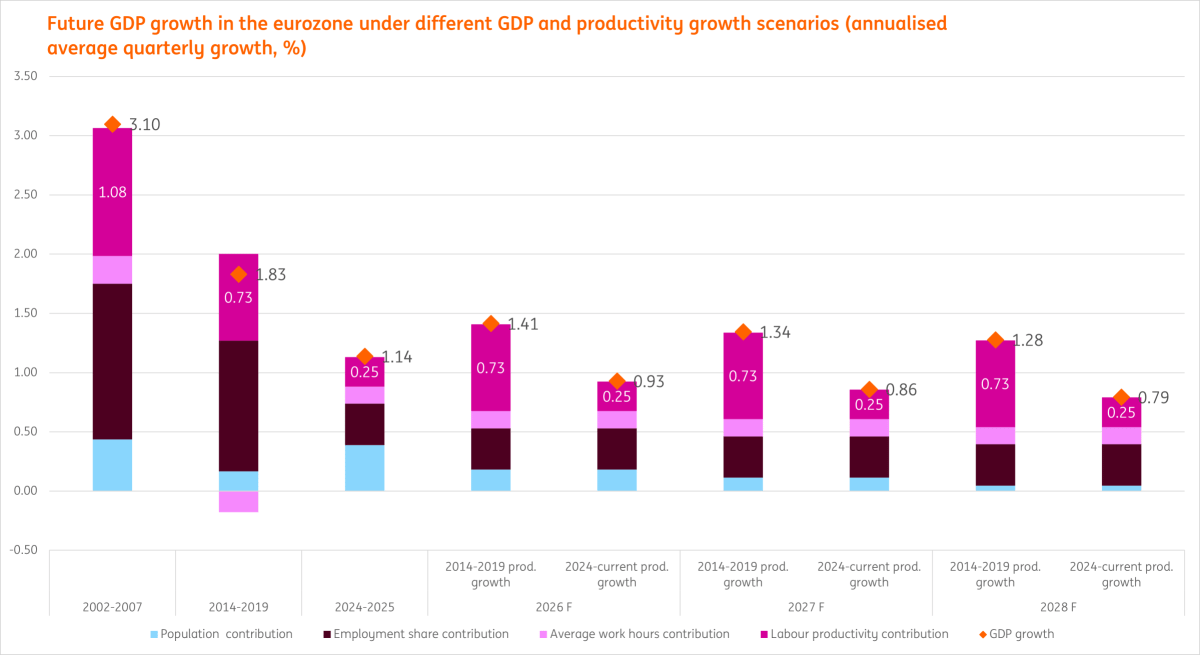
Thus, over the next three years alone, the contribution of population to GDP growth is projected to decline by 0.35 percentage points. If the employment share, average working hours, and productivity keep growing at the same pace we saw over the last two years, this is sufficient to see potential growth drop below 1%, to even 0.8% projected growth in 2028.
It is also worth noting that this hinges on governments sustaining policies that raise labour force participation, such as increasing the actual retirement age. Maintaining potential growth at today’s levels would require a renewed acceleration in productivity. If productivity were to return close to its 2014-19 pace – excluding the Covid years, which severely distorted the data – that would be sufficient to keep potential growth broadly stable.
Unless the Eurozone experiences a sudden acceleration in productivity growth, potential GDP growth is likely to fall below 1%
Words, words, words
This brings us back to the start of our article: ambition on the policy front is needed to kick-start sustainable productivity growth to keep growth and public finances sustainable. Last week, Nikos Christodoulides, President of the Republic of Cyprus, as the rotating Presidency of the Council of the European Union, the Presidents of the European Parliament and the European Commission, signed the “One Europe, One Market Roadmap”. The roadmap aims to strengthen Europe's competitiveness, with concrete actions and targets for agreements by the end of 2027. This is not the first plan to make Europe an economic powerhouse (again). Remember the Lisbon Agenda from the year 2000, which envisaged the European Union becoming "the most competitive and dynamic knowledge-based economy in the world, capable of sustainable economic growth with more and better jobs and greater social cohesion"?
The reality is that European politicians are still in firefighting mode against the multiple shocks that the European economy has faced. That leaves little attention or appetite for more structural policies. In September, the Draghi Report will be two years old. According to the Draghi Tracker, only 14% of the policy recommendations have been implemented to date. This reinforces our view that policy reforms will proceed slowly, making a decline in eurozone potential growth below 1% increasingly likely in the coming years.
Author

ING Global Economics Team
ING Economic and Financial Analysis
From Trump to trade, FX to Brexit, ING’s global economists have it covered. Go to ING.com/THINK to stay a step ahead.

















