EUR/USD reacts to data: Fed rate hike expectations fall

EUR/USD stood at 1.1537 on Friday, with markets continuing to digest incoming economic data. Soft US inflation figures have reduced expectations of a Federal Reserve rate hike in September.
Data released on Thursday showed that producer prices were flat in July. Together with the benign CPI report, this suggests that inflationary pressures are not yet accelerating.
Markets are now pricing in a 35% probability of a 25-basis-point Fed rate hike in September, down from 55% a week earlier. Moderate inflation reduces the need for near-term policy tightening.
Recent data also suggest that the initial inflationary impact of the Middle East conflict and high energy prices may be easing. However, uncertainty surrounding a potential agreement and the reopening of the Strait of Hormuz continues to pose risks to the inflation outlook.
Technical analysis
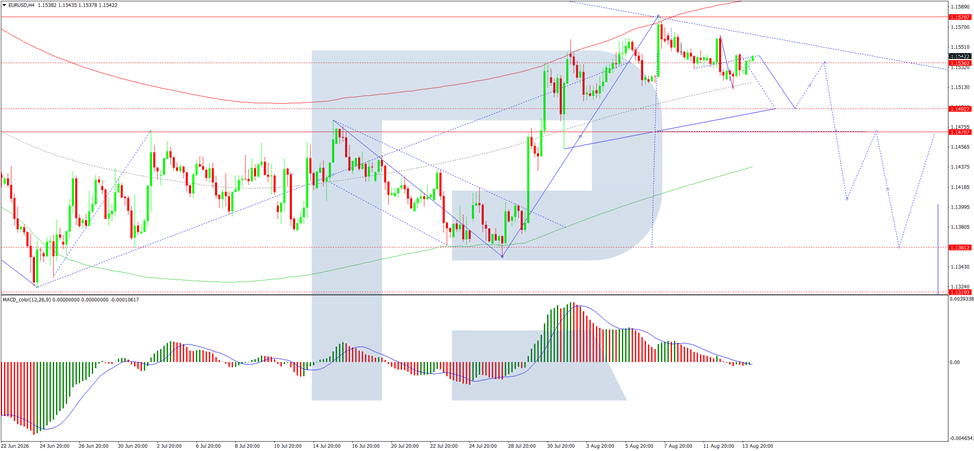
On the H4 chart of EUR/USD, the market continues to trade within a consolidation range, currently extending between 1.1511 and 1.1545, with the upper boundary being tested from below. The consolidation range around the 1.1546 level is nearing completion. An upside breakout would suggest a corrective move towards 1.1570, followed by a decline to 1.1492. A direct downside breakout would open the way for a move towards 1.1492, with scope for the trend to extend to 1.1400. The MACD indicator supports this scenario, with its signal line below zero and pointing downwards, reflecting continued bearish momentum.
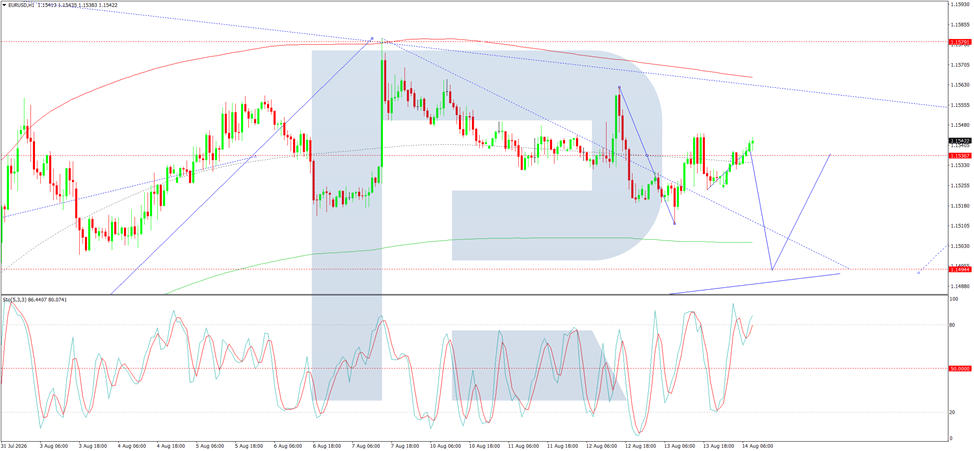
On the H1 chart, the market has completed an upward move to 1.1543. A consolidation range is currently forming below this level. A move lower towards 1.1492 is expected, followed by a move higher to 1.1536, and then a continuation of the downward trend to 1.1400, with scope for a further decline to 1.1330. The Stochastic oscillator confirms this scenario, with its signal line below 80 and trending downward towards 20, indicating increasing short-term downside pressure.
Conclusion
EUR/USD remains range-bound as markets assess the implications of softer US inflation data, which have reduced the likelihood of a September Fed rate hike from 55% to 35%. Producer prices were flat in July, adding to evidence that inflationary pressures are moderating. The initial impact of the Middle East conflict and high energy prices appears to be fading. However, uncertainty over a potential US–Iran agreement and the reopening of the Strait of Hormuz still poses risks. Technically, the pair may see a short-term corrective move towards 1.1570 before resuming its broader bearish trend towards 1.1492 and potentially 1.1400. The near-term direction will depend on further US economic data and geopolitical developments.
Author

RoboForex Analysis Department
RoboForex
RoboForex Analysis Department provides timely market insights, expert technical analysis, and actionable forecasts across forex, commodities, indices, and equities.















