EUR/USD Forecast: US Dollar fights back despite banks’ downgrades, Chinese turmoil

EUR/USD Current Price: 1.0886
- S&P Global Ratings downgraded ratings for several United States banks.
- US Treasury yields stabilized at fresh highs ahead of the Jackson Hole Symposium.
- EUR/USD bearish case gains traction as the pair approaches 1.0833, the July monthly low.
The US Dollar remained under pressure throughout the first half of Tuesday, with EUR/USD extending its weekly advance to 1.0929. On the one hand, stock markets rallied, led by a surge in Wall Street’s tech sector, yet on the other, Treasury yields continued to strengthen ahead of the Jackson Hole Symposium and words from central banks’ leaders. The yield on the 10-year note reached levels last seen in 2007, while the 2-year note yield flirted with the 5% threshold.
Financial markets are navigating stormy waters these days, as speculative interest is picturing high rates for longer alongside additional, sporadic hikes. At the same time, overall encouraging macroeconomic data supports the hawkish case, as the risk of an economic setback decreases.
Chinese noise still weighs
Meanwhile, China is the primary source of concern, as the world’s second-largest economy struggles to recover its growth status following extended coronavirus-related restrictions. News that huge local companies failed to repay loans triggered all the alarms after Evergrande, one of China’s largest property developers, collapsed in 2021. Another real estate company and a shadow trust bank joined the boat in August, spurring concerns of a financial crisis and as the People’s Bank of China (PBoC) failed to deliver decisive measures to spook fears. The Yuan trades near its year-to-day low against the American currency.
Ahead of Wall Street’s opening, S&P Global Ratings downgraded ratings for several United States (US) banks, weighing on the market mood. The announcement came a week after Moody’s Investors Service did the same to 10 US lenders and triggered near-term US Dollar demand, with EUR/USD retreating below the 1.0900 threshold.
The macroeconomic calendar remains scarce. The Euro Zone released the June Current Account, which posted a seasonally adjusted surplus of €35.84 billion, beating expectations. The US will publish July Existing Home Sales and the August Richmond Fed Manufacturing Index, followed by speeches from a couple of Federal Reserve (Fed) officials.
By the end of the week, the Jackson Hole Symposium will feature speeches from multiple central banks’ speakers, with Fed Chair Jerome Powell scheduled to deliver remarks on Friday.
EUR/USD short-term technical outlook
From a technical perspective, bulls seem on the brink of giving up. The daily chart shows sellers surged on a test of the 100 Simple Moving Average (SMA), which remains directionless at around 1.0930. At the same time, the 20 SMA gained downward traction above the longer one, maintaining its bearish slope. Meanwhile, the Momentum indicator advances within negative levels, while the Relative Strength Index (RSI) indicator anticipates a continued slide as per turning south near oversold readings.
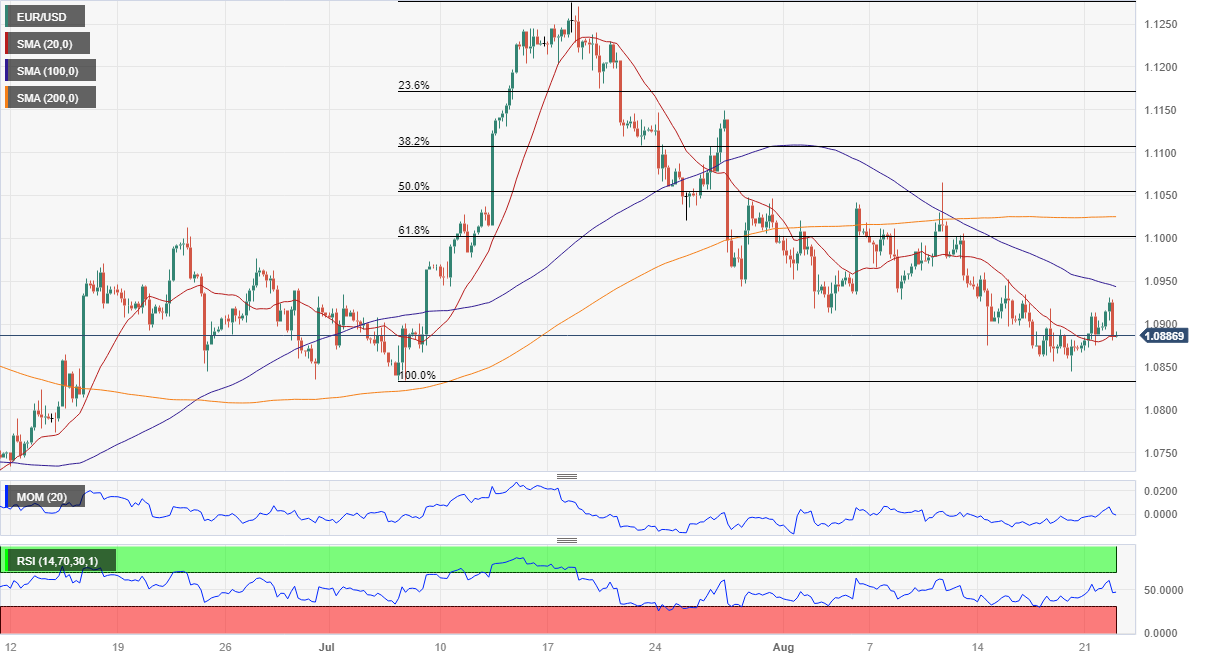
Technical readings in the 4-hour chart favor a bearish continuation. The pair is pressuring a directionless 20 SMA, while the intraday run stalled below a mildly bearish 100 SMA. The 200 SMA, in the meantime, lacks directional strength at around 1.1030. Finally, technical indicators gyrated south, reflecting increased selling interest. As it happens in the daily chart, the RSI indicator anticipates a continued slide, having already pierced its midline. A critical support level is 1.0833, July’s monthly low, as the bearish case will become stronger once below it.
Support levels: 1.0835 1.0790 1.0740
Resistance levels: 1.0930 1.0960 1.1005
Author

Valeria Bednarik
FXStreet
Valeria Bednarik was born and lives in Buenos Aires, Argentina. Her passion for math and numbers pushed her into studying economics in her younger years.

















