EUR/USD Forecast: US Dollar broad weakness saving the day

EUR/USD Current Price: 1.0830
- The Euro cannot attract buyers amid speculation that the ECB will slow the pace of tightening.
- A sharp decline in government bond yields undermines demand for the US Dollar.
- EUR/USD gains downward traction in the near term but holds well above 1.0745.
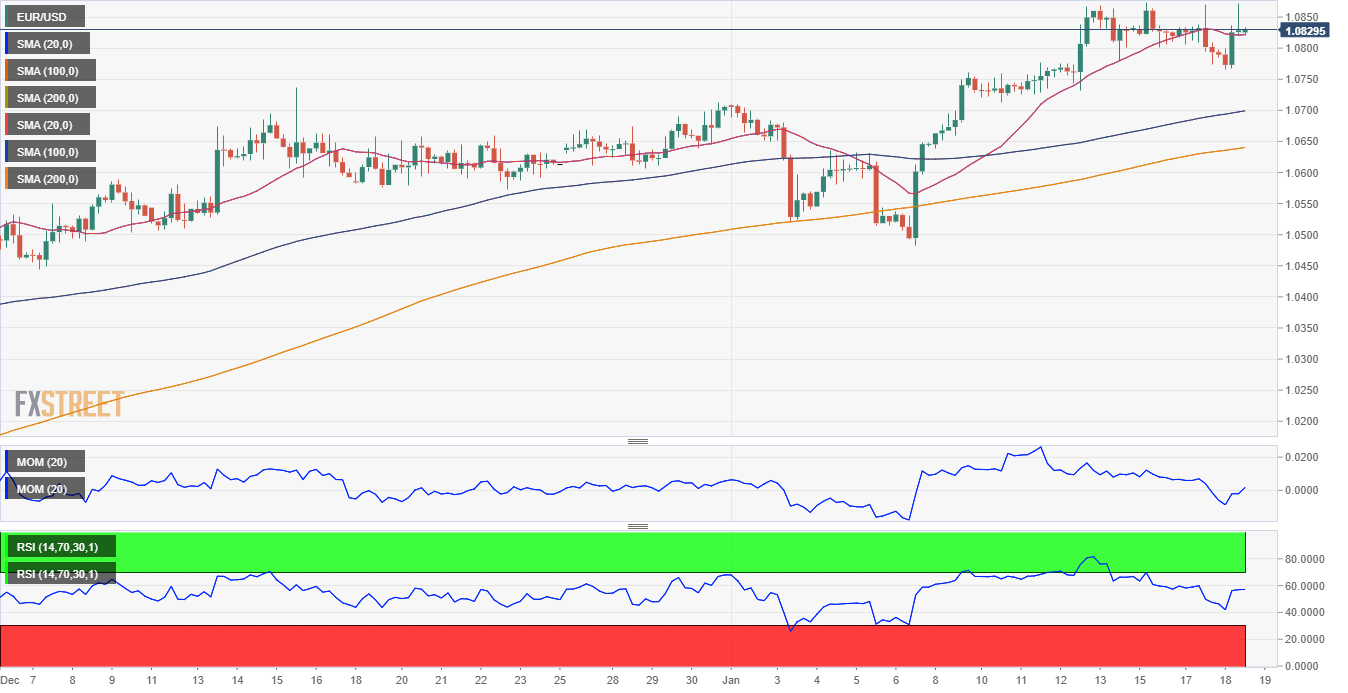
The EUR/USD pair peaked on Wednesday at 1.0870 but trimmed part of its intraday gains ahead of Wall Street’s opening and currently trades around 1.0830. The US Dollar is the worst performer across the FX board, plummeting during European trading hours on the back of easing government bond yields.
However, the Euro cannot take full advantage of its rival’s soft tone. In part, the lack of follow-through of the EUR could be explained by market talks suggesting European Central Bank (ECB) policymakers are discussing slowing the pace of quantitative tightening. On Tuesday, market rumors made the rounds pointing at a 50 basic points (bps) rate hike in February, followed by a 25 bps hike in March. On the other hand, European Central Bank policymaker Francois Villeroy de Galhau said on Wednesday that it is “too early to speculate about what we will do in March.” His words failed to impress market participants.
The US Dollar weakness comes from government bond yields. The Bank of Japan (BoJ) announced its decision on monetary policy and decided to stay pat. Governor Haruhiko Kuroda said there is “no need to further expand bond target band.” The yield on the 10-year Japanese Government Bond (JGB) fell to an intraday low of 0.36% after flirting with 0.60% on Tuesday. It currently stands at 0.44%, below the upper limit of the BoJ’s band at 0.50%. In turn, the US 10-year Treasury note now offers 3.47%, down 6 bps on the day.
Inflation and Retail Sales
On the data front, the Euro Zone published the final estimate of the December Harmonized Index of Consumer Prices (HICP), which was confirmed at 9.2% YoY. Additionally, November Construction output declined 0.8% in the month, worse than anticipated.
The United States published MBA Mortgage Approvals for the week ended January 13, up a whopping 27.9%, as interest rates dropped to their lowest point in months. Coming up next, the country will release the December Producer Price Index (PPI) and December Retail Sales.
EUR/USD short-term technical outlook
From a technical point of view, the EUR/USD pair has a limited bullish scope, yet chances of a steeper decline seem out of the picture for now. The pair continues to develop above a critical Fibonacci support level, the 61.8% retracement of the 2022 decline at 1.0745. In the daily chart, the pair is in a consolidative phase, with technical indicators heading nowhere within positive levels, in line with buyers’ dominance. At the same time, the pair is developing above all its moving averages, with the 20 SMA maintaining its upward slope at around 1.0685.
In the near term, and according to the 4-hour chart, chances of another leg south. The pair is battling to hold above a now flat 20 Simple Moving Average (SMA) while the longer moving averages maintain their upward slopes far below the latter. Technical indicators, on the other hand, retreated from their early peaks and head north, the Momentum capped at its 100 level and within negative levels, and the Relative Strength Index (RSI) holding within neutral levels.
Support levels: 1.0800 1.0745 1.0690
Resistance levels: 1.0870 1.0910 1.0955
Author

Valeria Bednarik
FXStreet
Valeria Bednarik was born and lives in Buenos Aires, Argentina. Her passion for math and numbers pushed her into studying economics in her younger years.