EUR/USD Forecast: Euro needs to overcome 1.0700 to extend rebound
- EUR/USD started to move sideways near 1.0700 following Monday's rebound.
- Euro could stretch higher once it stabilizes above 1.0700.
- US economic docket will feature housing data on Tuesday.

EUR/USD gained traction in the second half of the day on Monday and closed in positive territory. Early Tuesday, the pair struggled to preserve its recovery momentum and went into a consolidation phase at around 1.0700.
Following a bearish opening, Wall Street's main indexes staged a rebound in the American session and made it difficult for the US Dollar (USD) to continue to outperform its rivals. In the early European session, US stock index futures trade modestly higher on the day. In case US stocks edge higher after the opening bell, the USD could struggle to find demand and allow EUR/USD to hold its ground.
Meanwhile, European Central Bank (ECB) Governing Council member Francois Villeroy de Galhau said that they intend to maintain the rate on the deposit facility at 4% "for a sufficiently long time." Moreover, “I wish that the September rate hike was the last but I can't rule out further rate increases," policymaker Peter Kazimir said on Monday. In addition to the improving risk mood, those hawkish comments also seem to be supporting EUR/USD in the first half of the week.
Euro price this week
The table below shows the percentage change of Euro (EUR) against listed major currencies this week. Euro was the strongest against the Pound Sterling.
| USD | EUR | GBP | CAD | AUD | JPY | NZD | CHF | |
| USD | -0.21% | 0.13% | -0.57% | -0.21% | -0.12% | -0.55% | -0.17% | |
| EUR | 0.20% | 0.33% | -0.38% | 0.01% | 0.08% | -0.34% | 0.05% | |
| GBP | -0.12% | -0.33% | -0.70% | -0.32% | -0.26% | -0.67% | -0.29% | |
| CAD | 0.56% | 0.36% | 0.68% | 0.36% | 0.45% | 0.04% | 0.41% | |
| AUD | 0.21% | -0.01% | 0.32% | -0.36% | 0.07% | -0.34% | 0.02% | |
| JPY | 0.12% | -0.11% | 0.24% | -0.44% | -0.09% | -0.43% | -0.02% | |
| NZD | 0.57% | 0.34% | 0.67% | -0.02% | 0.34% | 0.41% | 0.43% | |
| CHF | 0.15% | -0.05% | 0.29% | -0.42% | -0.05% | 0.02% | -0.39% |
The heat map shows percentage changes of major currencies against each other. The base currency is picked from the left column, while the quote currency is picked from the top row. For example, if you pick the Euro from the left column and move along the horizontal line to the Japanese Yen, the percentage change displayed in the box will represent EUR (base)/JPY (quote).
Later in the day, August Building Permits and Housing Starts figures will be featured in the US economic docket. Ahead of the Federal Reserve's policy announcements on Wednesday, however, investors could overlook these data.
EUR/USD Technical Analysis
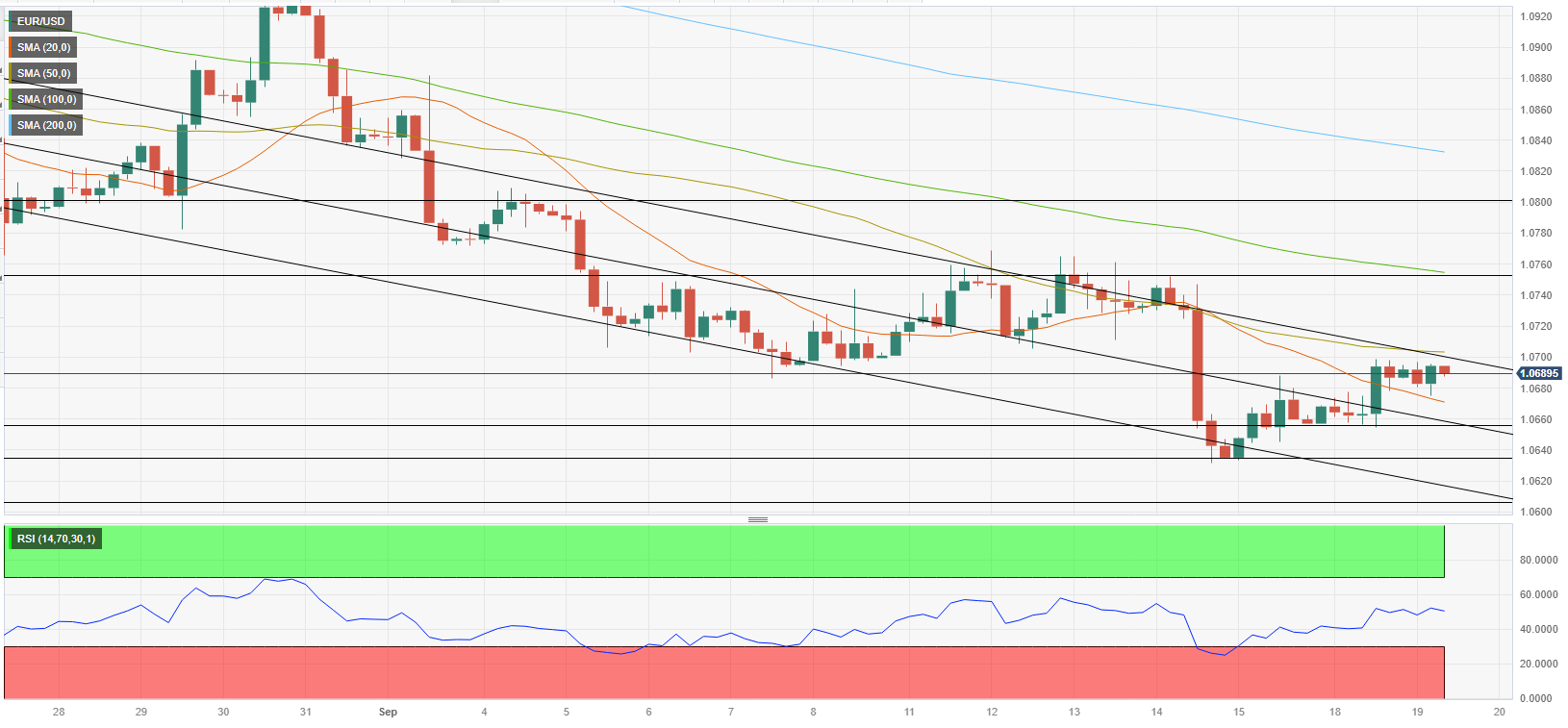
The last five 4-hour candles close above the 20-period Simple Moving Average (SMA) on the 4-hour chart. In addition, the Relative Strength Index (RSI) indicator rose to the 50 area, suggesting that sellers remain on the sidelines.
On the upside, 1.0700 (psychological level, upper limit of the descending regression channel, 50-period SMA) forms key resistance for EUR/USD. In case the pair rises above that level and starts using it as support, the next recovery targets could be set at 1.0750 (static level, 100-period SMA) and 1.0800 (psychological level, static level).
If EUR/USD fails to reclaim 1.0700, it could come under renewed bearish pressure. In that scenario, supports could be seen at 1.0670 (20-period SMA), 1.0650 (mid-point of the descending channel) and 1.0630 (static level).
Author

Eren Sengezer
FXStreet
As an economist at heart, Eren Sengezer specializes in the assessment of the short-term and long-term impacts of macroeconomic data, central bank policies and political developments on financial assets.

















