EUR/USD Forecast: Euro bulls ignore dismal sentiment data
- EUR/USD has continued to edge higher following Monday's positive close.
- Disappointing sentiment data from Germany and the euro area had little to no impact on the euro.
- Annual CPI inflation in the US is forecast to edge lower to 8.1% in August from 8.5% in July.

After having registered modest losses on Monday, EUR/USD has managed to stretch higher early Tuesday and climbed above 1.0150. Unless safe-haven flows start to dominate the financial markets, the pair remains on track to extend its rebound.
The risk-positive market atmosphere and hawkish comments from European Central Bank fueled EUR/USD's rally on Monday. Although the pair erased a portion of its daily gains during the American trading hours, it ended up closing the day above the key 1.0100 handle.
The data from the euro area showed early Tuesday that the Economic Sentiment Index of the ZEW survey slumped to -60.7 in September from -54.9 in August. For Germany, the Economic Sentiment Index slumped to -61.9 from -55.3. "Together with the more negative assessment of the current situation, the outlook for the next six months has deteriorated further," ZEW said in its publication.
Despite the gloomy sentiment data, the shared currency stays relatively resilient against the dollar as investors wait for the US Bureau of Labor Statistics to publish the August Consumer Price Index (CPI) data.
On a yearly basis, the CPI is forecast to decline to 8.1% from 8.5% in July. The Core CPI, however, is expected to edge higher to 6.1% from 5.9%. Considering that markets are nearly fully pricing in a 75 basis points Fed rate hike in September, the positive impact of a hot inflation report on the dollar's valuation could remain short-lived. On the other hand, a smaller than expected increase in Core CPI should put additional weight on the greenback's shoulders and help EUR/USD preserve its bullish momentum.
EUR/USD Technical Analysis
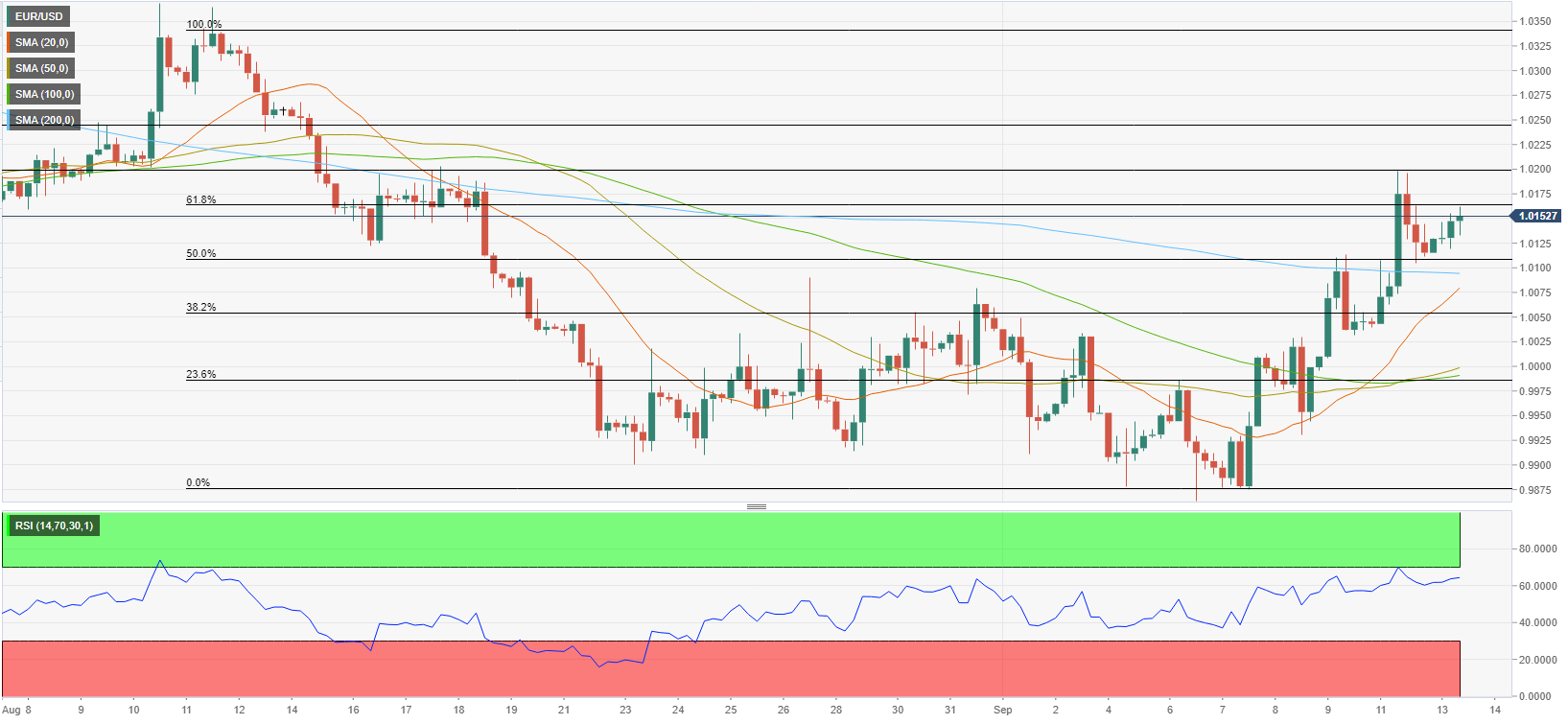
EUR/USD is trading within a touching distance of 1.0160 (Fibonacci 61.8% retracement of the latest downtrend). In case the pair clears that hurdle and flips into support, it could test 1.0200 (psychological level, Monday high) and target 1.0245 (static level) afterwards.
On the downside, 1.0100 (200-period SMA, Fibonacci 50% retracement) aligns as key support. A daily close below that level could be seen as a significant bearish development and bring in additional sellers, dragging the pair back toward 1.0050 (Fibonacci 38.2% retracement) and 1.0000 (psychological level, 50-period SMA, 100-period SMA).
In the meantime, the Relative Strength Index (RSI) indicator on the four-hour chart holds comfortably above 60, confirming the near-term bullish bias.
Author

Eren Sengezer
FXStreet
As an economist at heart, Eren Sengezer specializes in the assessment of the short-term and long-term impacts of macroeconomic data, central bank policies and political developments on financial assets.

















