EUR/USD: Brief results and immediate prospects

According to the latest CME Group data, approximately 75% of market participants believe that the Fed will still raise interest rates by 0.25%, and then take a break. Some Fed officials believe that maintaining a high level of inflation is an even bigger problem for the economy than recession risks.
However, 25% of market participants believe that the Fed will put the tightening process on pause already at the meeting on May 2-3, and then, before the end of the year, will move on to lowering the interest rate.
In particular, the head of the Chicago Fed, Austen Goolsby, argues that monetary tightening may not be justified if it increases financial stress and pressure on the economy. And most of the leaders of the US Central Bank believe that the current financial crisis will lead to at least a moderate, but still a recession that will begin at the end of this year, after which the economy will recover over the next two years. This is their opinion, but the real situation can be much steeper and more negative. Will the Fed then stick to a tough policy or go back to easing it, and will this help the economy, which, as we have already noted, is sliding into recession for the time being? And then what will happen to the dollar, which is already collapsing at the current 5.00% Fed key interest rate, the highest among the world's largest central banks.
The euro, the main competitor of the dollar in the foreign exchange market, yesterday received support from data on industrial production in the Eurozone countries. In February, the indicator rose by +1.5% (against the forecast of +1.0%) and by +2.0% in annual terms (against expectations of +1.5%). The output of capital goods, according to other data of the Eurostat report, such as manufacturing equipment, increased by +2.2% (+10.4% yoy), energy production increased by +1.1%, and non-durable consumer goods - by +1.9%, which indicates, if not the recovery of the European economy, but at least a reduction in recession risks.
Most of the ECB management believes that at the May meeting of the bank it is necessary to continue tightening monetary stimulus and again raise the interest rate by 50 basis points: inflation is still high, and if we do not act tough now, then the negative dynamics will increase.
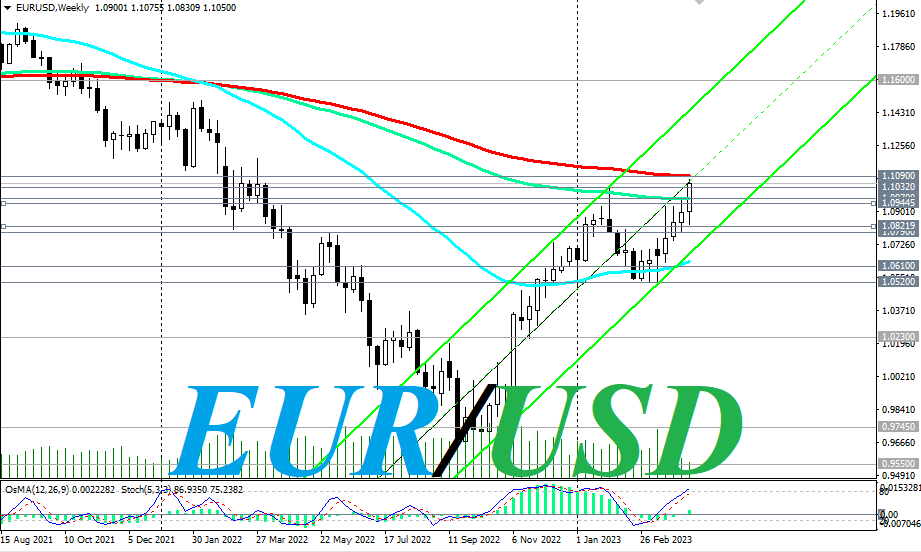
At the time of publication of this article, the EUR/USD pair continues to develop an upward trend, approaching the key long-term resistance level of 1.1090 and renewing highs since April 2022.
Below the key resistance level of 1.1090 EUR/USD is still in the zone of the global downtrend, and only a breakdown of the resistance level of 1.1600 will bring EUR/USD into the zone of the global bull market.
If a new portion of disappointing macro data does not arrive from the US in the near future, then near the level of 1.1090 we expect a rebound, or at least stabilization near it, in order to then determine the direction of further movement. So far, everything is not in favor of the dollar.
Support levels: 1.1032, 1.1000, 1.0970, 1.0944, 1.0822, 1.0800, 1.0790, 1.0700, 1.0610, 1.0520.
Resistance levels: 1.1090, 1.1200, 1.1600.
Author

Yuri Papshev
Independent Analyst
Independent trader and analyst at Forex market. Trade experience - more than 10 years. In trade Yuri Papshev uses a combination of fundamental and technical analysis.