Dow Jones Industrial Average surrenders a midday rally as Crude Oil and yields climb
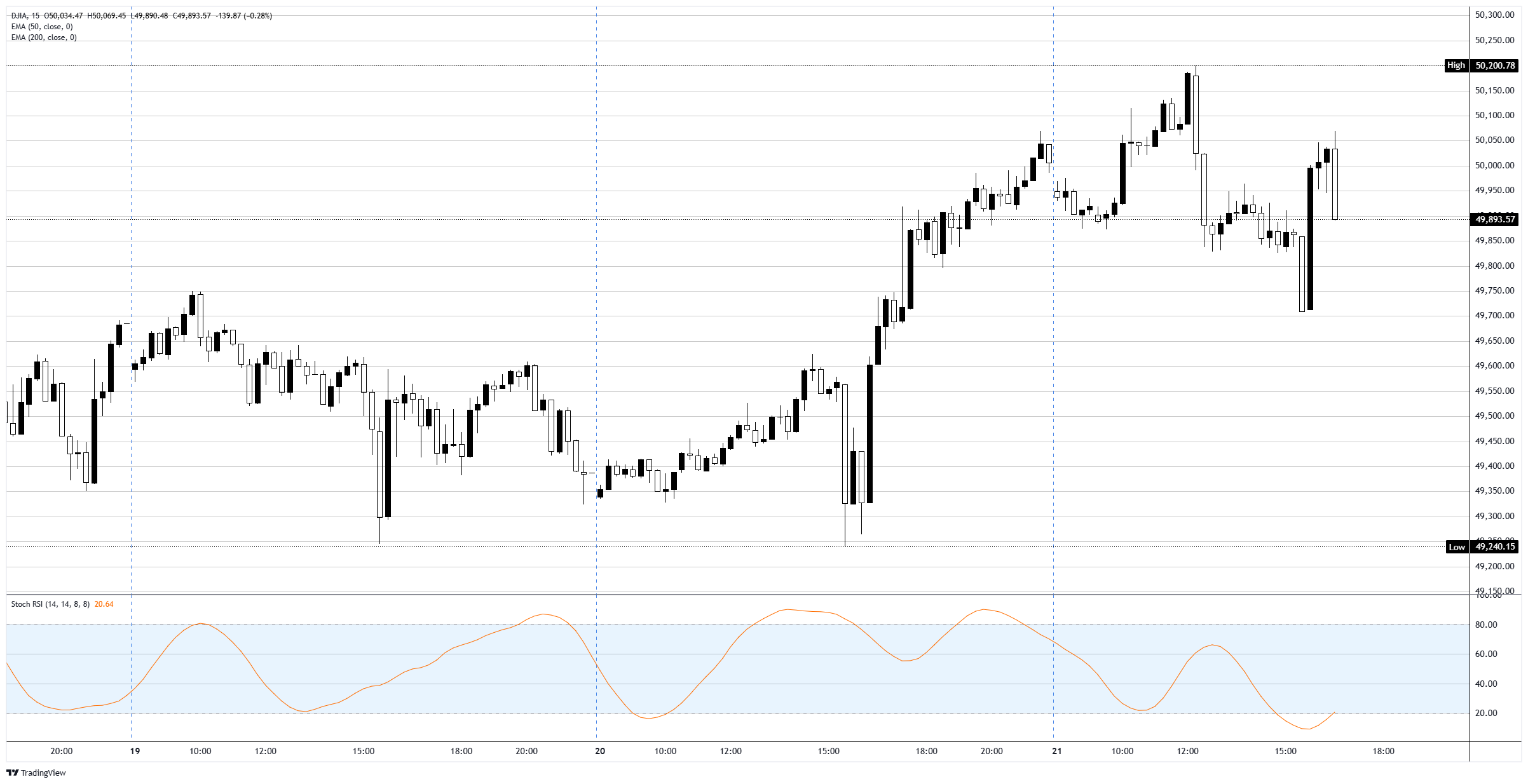
- The Dow swung hard on Thursday, pushing toward 50,000 before reversing and lagging the S&P 500 and Nasdaq into the close.
- Kevin Warsh is sworn in as Fed chair on Friday, the rate-cut champion President Trump picked, arriving just as markets price holds through 2026 and a rising tail risk of a hike.
- The Iran war is the spoiler. Higher oil is feeding inflation, the 10-year yield is back near multi-month highs, and mortgage rates just hit their highest since last summer.
- Mixed data only muddies the picture, with firm housing and jobless numbers running into a collapsing Philadelphia manufacturing read.

There is a delicious irony arriving in Washington on Friday. Kevin Warsh, the man President Trump hand-picked to run the Federal Reserve (Fed) precisely because he is expected to lower interest rates, will be sworn in as chair at the exact moment the market has all but given up on a cut this year. Fed funds futures now price holds through the rest of 2026, and the quiet conversation among traders has shifted toward whether the next move could be a hike rather than an ease. The Dow Jones Industrial Average spent Thursday caught in that crosscurrent, spiking toward the 50,000 area before unwinding the move to trade roughly flat at the time of writing, lagging the broader S&P 500 and the Nasdaq. For an index stuffed with rate-sensitive industrials and financials, a central bank that cannot cut is a problem no leadership change fixes.
A rate cutter with no room to cut
Warsh was confirmed last week in the closest vote for a Fed chair in modern history, a near party-line result that underlined how politically charged the seat has become. Trump has made no secret of wanting lower rates, and Warsh has argued in the past that there is room to ease. The trouble is timing. He inherits a central bank that has held the funds rate at 3.50% to 3.75% for two straight meetings, with the most recent inflation reading running near 4% YoY, well above the 2% target and pushed higher by energy costs tied to the Iran war. Outgoing chair Jerome Powell, who keeps his board seat and his vote, spent his final press conference nudging the committee toward a more neutral, wait-and-see footing. So the new chair may want to cut, but the data and a good chunk of his own committee are pulling the other way.
Yields and mortgages are doing the tightening
While the Fed sits still, the bond market has been tightening on its own. The 10-year Treasury yield has pushed back toward the mid-4% area as firmer oil revives inflation fears, and the knock-on effect is landing where households feel it most. The 30-year mortgage rate has climbed to around its highest level since last summer, up sharply in a matter of days and closing in on the 7% mark, which is awkward for an administration that made housing affordability a headline goal. Thursday's data did little to settle things. Housing starts and building permits came in firm and Initial Jobless Claims held near 209K, but the Philadelphia Fed manufacturing survey collapsed into negative territory from the high twenties, and the Services Purchasing Managers Index (PMI) slipped below the prior month. Firm labor, wobbling growth, sticky inflation. That is the stagflation-lite cocktail that leaves the Dow without a clean catalyst in either direction.
What Friday brings
The swearing-in itself is largely ceremonial, but it marks the symbolic start of the post-Powell era, and any early read on tone will be parsed hard. More tradeable is the University of Michigan (UoM) sentiment release, where the inflation expectations components carry the weight. Consensus sees 1-year expectations holding near 4.5% and the 5-year measure around 3.4%, and any upside surprise would reinforce the market's reluctance to price cuts and likely pressure the rate-sensitive corners of the Dow. A speech from Fed governor Christopher Waller earlier in the session offers another chance for the rate path to wobble. None of it looks like the clean catalyst that resolves the standoff, which is rather the point. Warsh gets the title on Friday. The bond market still gets the final say, and right now it is not listening to anyone promising lower rates.
Dow Jones 15-minute chart
Dow Jones FAQs
The Dow Jones Industrial Average, one of the oldest stock market indices in the world, is compiled of the 30 most traded stocks in the US. The index is price-weighted rather than weighted by capitalization. It is calculated by summing the prices of the constituent stocks and dividing them by a factor, currently 0.152. The index was founded by Charles Dow, who also founded the Wall Street Journal. In later years it has been criticized for not being broadly representative enough because it only tracks 30 conglomerates, unlike broader indices such as the S&P 500.
Many different factors drive the Dow Jones Industrial Average (DJIA). The aggregate performance of the component companies revealed in quarterly company earnings reports is the main one. US and global macroeconomic data also contributes as it impacts on investor sentiment. The level of interest rates, set by the Federal Reserve (Fed), also influences the DJIA as it affects the cost of credit, on which many corporations are heavily reliant. Therefore, inflation can be a major driver as well as other metrics which impact the Fed decisions.
Dow Theory is a method for identifying the primary trend of the stock market developed by Charles Dow. A key step is to compare the direction of the Dow Jones Industrial Average (DJIA) and the Dow Jones Transportation Average (DJTA) and only follow trends where both are moving in the same direction. Volume is a confirmatory criteria. The theory uses elements of peak and trough analysis. Dow’s theory posits three trend phases: accumulation, when smart money starts buying or selling; public participation, when the wider public joins in; and distribution, when the smart money exits.
There are a number of ways to trade the DJIA. One is to use ETFs which allow investors to trade the DJIA as a single security, rather than having to buy shares in all 30 constituent companies. A leading example is the SPDR Dow Jones Industrial Average ETF (DIA). DJIA futures contracts enable traders to speculate on the future value of the index and Options provide the right, but not the obligation, to buy or sell the index at a predetermined price in the future. Mutual funds enable investors to buy a share of a diversified portfolio of DJIA stocks thus providing exposure to the overall index.
Author

Joshua Gibson
FXStreet
Joshua joins the FXStreet team as an Economics and Finance double major from Vancouver Island University with twelve years' experience as an independent trader focusing on technical analysis.