Dollar mostly down ahead of the NFP

Positive sentiment on US-Iranian peace talks has been negative for the Dollar and Crude Oil.
Optimism among participants about progress in indirect negotiations between the USA and Iran has meant challenges for the dollar in recent days, with various risk on instruments like Asian and European shares making gains while American light oil also declined briefly below $90. Attention not shifts to the American job report on Friday 8 May. This article summarises recent major news and the context of the upcoming NFP then looks briefly at the charts of EUR/USD and BTC/USD.
Donald Trump said early GMT on 7 May that a deal with Iran is ‘very possible’, which drove positive sentiment across markets. However, senior members of the Iranian government were quoted playing down the likelihood of an imminent deal. The dollar has functioned as a geopolitical haven throughout the conflict so far, generally gaining around escalation and losing strength when it appears that a resolution is more likely.
Although news of the Gulf conflict continues to dominate financial media, May’s NFP is a particularly important release given the lack of any clear trend in the last several months of data:
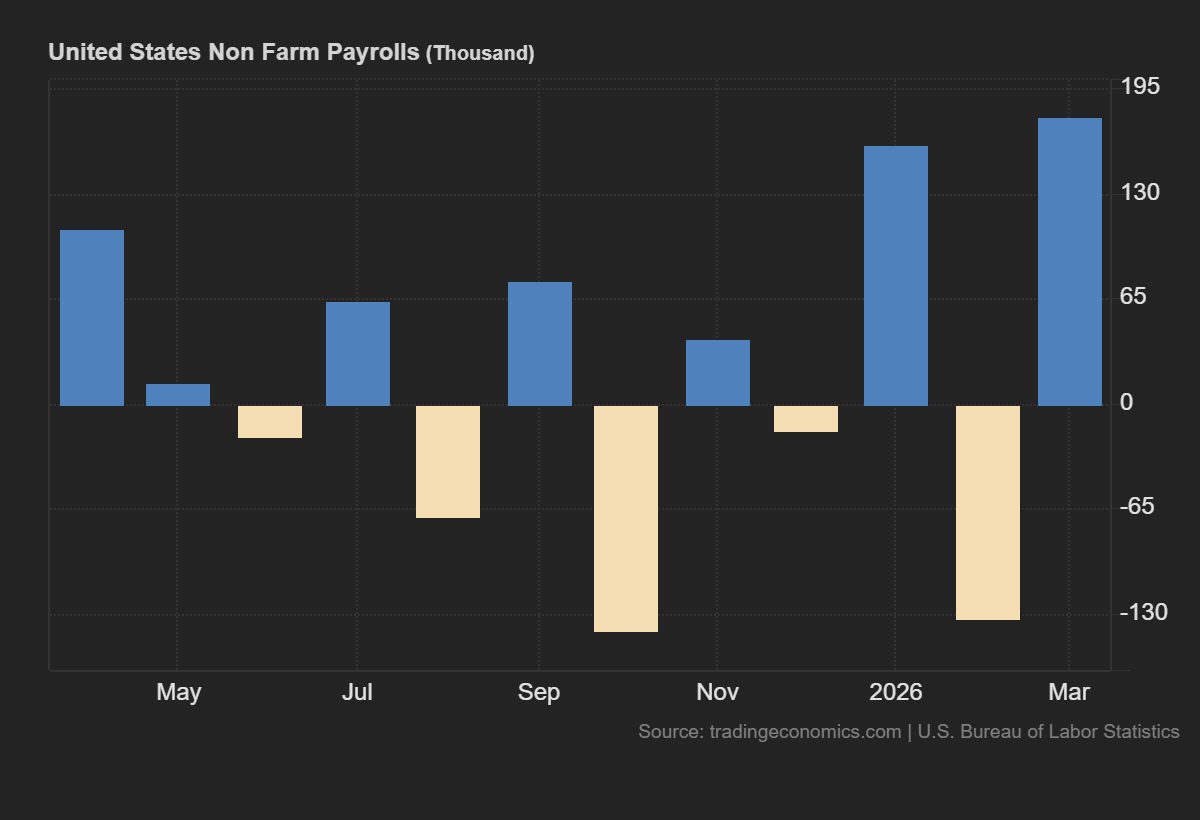
Most of the last six months’ NFPs have been revised downward at least slightly, in some cases significantly. February’s final figure was more than 40,000 lower than initially reported. The very strong figure for March released last month, 178,000, was around triple the consensus, so there’s a clear possibility that this might also be revised down.
It’s clear that the job market in the USA is overall significantly weaker compared to 2024 or early 2025, but the continuing direction is less obvious. Unemployment at 4.3% is only marginally higher than 2025’s average. That the job market isn’t strongly weaker or stronger than around this time last year gives the Fed more leeway with rates.
Current probabilities from CME FedWatch suggest around a 70% likelihood that the funds rate will stay at the current 3.5-3.75% until early 2027 with participants expecting hikes around the middle of next year. However, upcoming inflation data are also very important for determining the Fed’s next moves since the spike in inflation from the Gulf conflict hasn’t so far been as high as some had feared. 12 May is the date of the next annual headline inflation from the USA with the rate currently expected to increase to around 3.6% from 3.3%.
Euro-Dollar testing $1.18
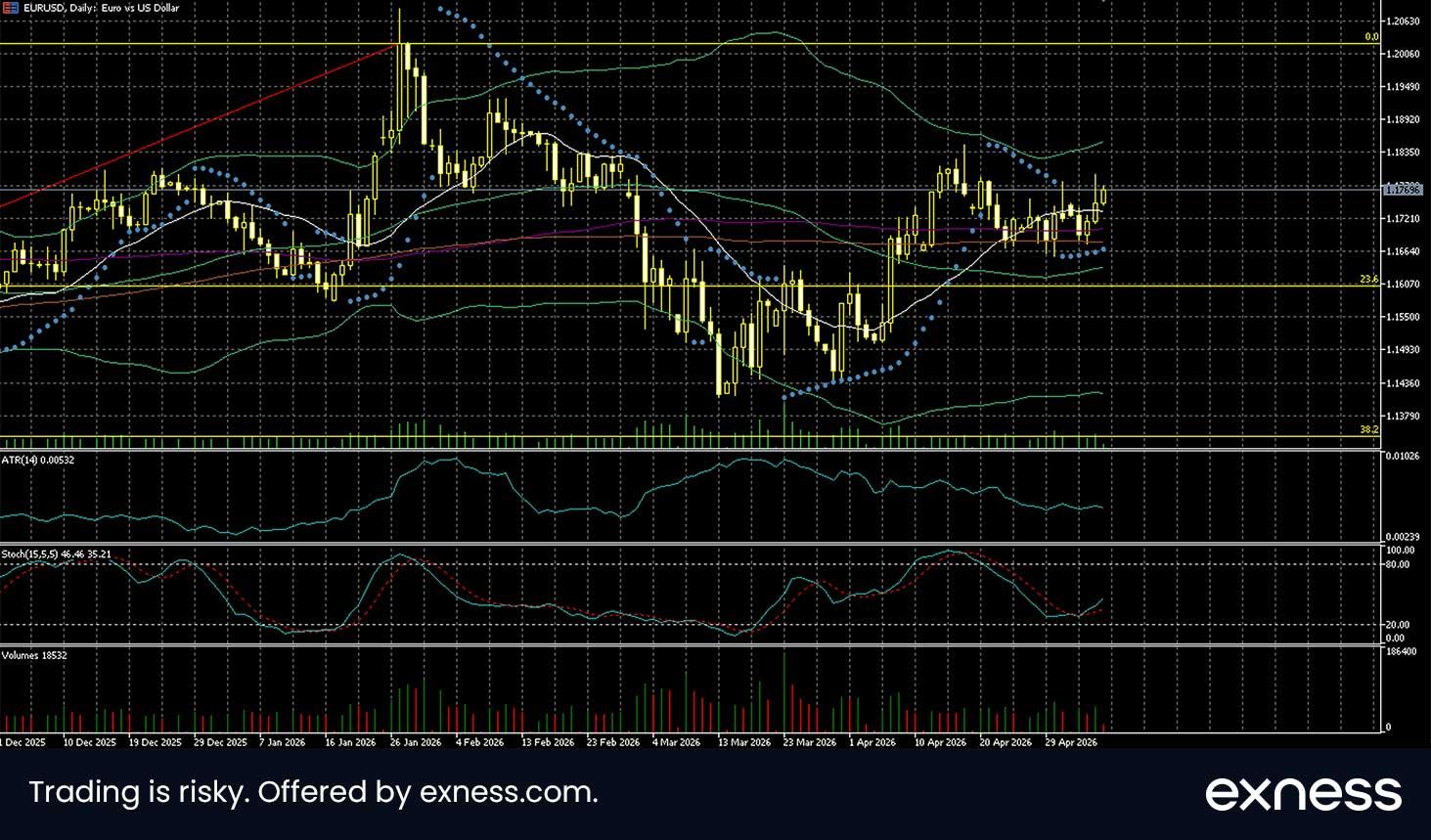
Euro-Dollar gained as hopes for an imminent peace between Iran and the USA increased around 7 May. Monetary policy is also in focus with the Fed likely to hold at 3.5-3.75% to the end of the year and probably beyond. The ECB might hike twice with a probability of around 75% that the main refinancing rate will go up to 2.4% next month.
$1.18, which was a familiar area in February before the Gulf conflict, still seems to be an important reference which the price is currently testing. Relatively low volume compared to March might make the probability of a breakout lower, but the slow stochastic is favourable being close to neutral.
For the moment, a deep retracement lower seems to be unlikely given several moving averages bunching together around $1.17. Losses around a positive NFP might be limited although the job report is unlikely to be as strong as last month’s.
Bitcoin’s gains continue but possible resistance ahead
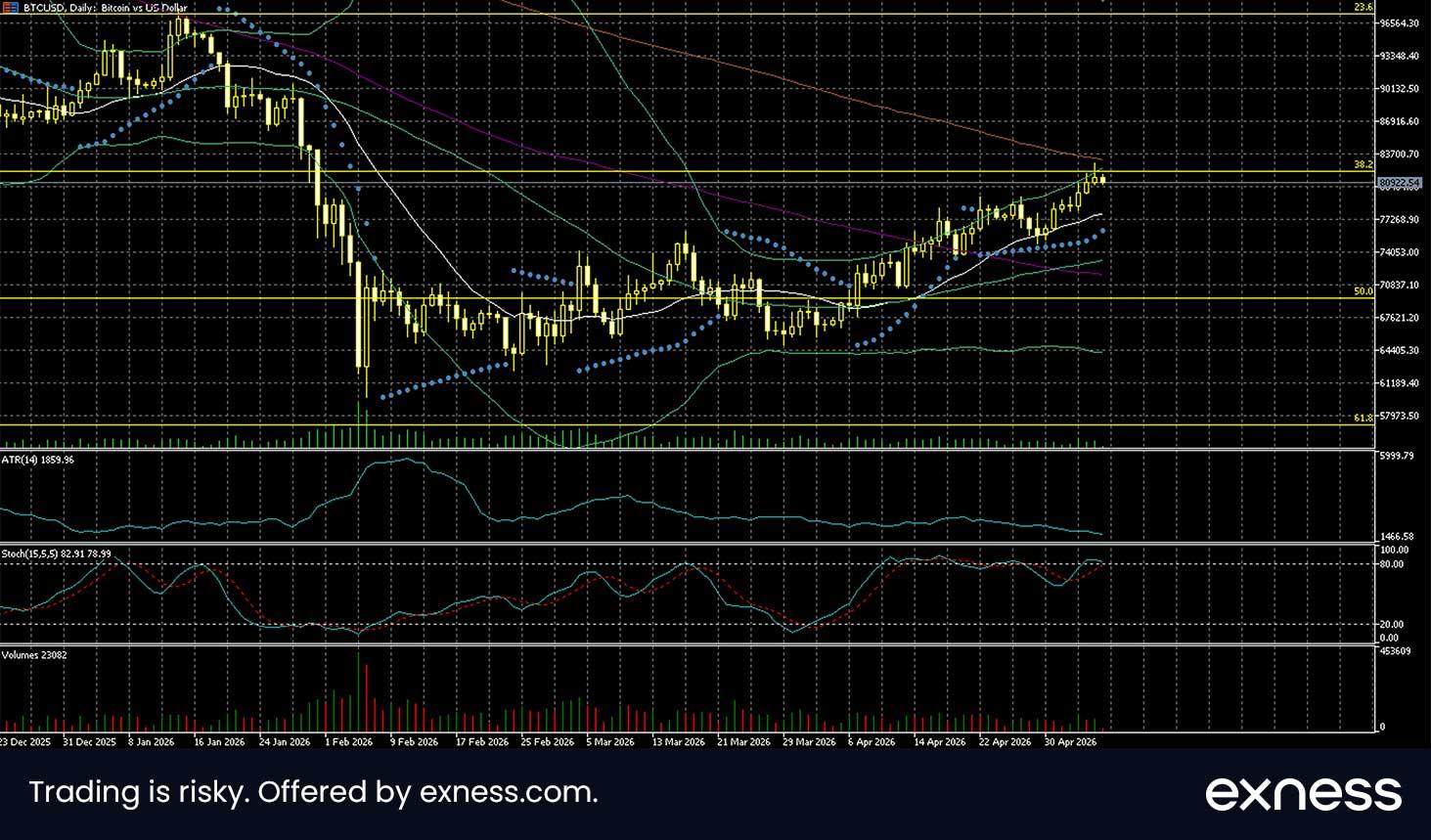
The Dollar’s recent losses and a general recovery in sentiment have helped bitcoin to continue up in May so far with the price holding around $81,000 on 7 May. Spot ETFs on bitcoin have been strongly positive since late March with last month seeing around $2.4bn net inflows. The significantly lower probability of looser monetary policy later in 2026 is a negative factor for bitcoin but this seems to be discounted for now.
$82,000 is a possible strong resistance being a round number and the area of the 38.2% monthly Fibonacci retracement. The 200 SMA is also only slightly above this zone. If there’s a break above $82,000, around $87,000 could be a further resistance as a familiar area from December 2025.
Although the slow stochastic is not normally much use for cryptocurrencies, the current very low and declining ATR might suggest in isolation a change of the trend. That’s a bit difficult to reconcile with recent fundamentals, but if the price does retrace lower there might be a pause in the value area between the 20 and 50 SMAs around $75,000. A weaker NFP might push the price higher but since this seems fairly likely the reaction might not be very strong depending on the degree of surprise from the release.
Author

Michael Stark
Exness
Michael has been investing since 2007 and trading CFDs since 2013. He favors considering both fundamental and technical analysis where possible, with a focus on swing and position trading.