|

China’s PMIs remained in contractionary territory in August

China's purchasing managers’ index data flashed mixed signals in August, with manufacturing rebounding and the non-manufacturing PMI holding steady. The data suggests that while industrial activity might stabilise in August, there will be no major turnaround amid slowing growth momentum.

Manufacturing PMI beat forecasts but remained in contractionary territory

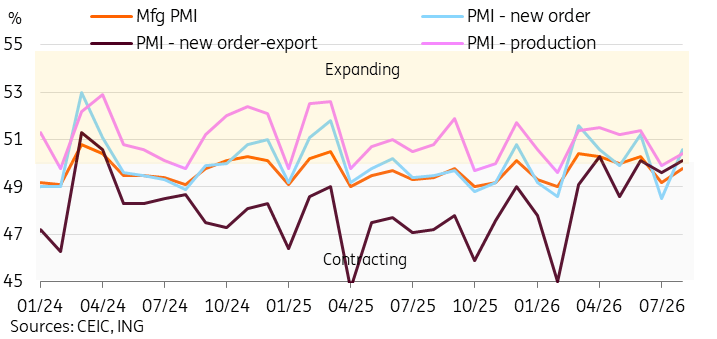
China's manufacturing PMI rose to 49.8, up from 49.2 in July. This was stronger than expectations (market: 49.5, ING: 49.5) and moved closer to the neutral level. Still, it remains in contractionary territory for a second straight month.

Encouragingly, the most important subindices recovered. Production (50.4), new orders (50.6), and new export orders (50.1) all returned to expansionary territory.

We also saw ex-factory prices rebound to 50.4, the first expansion in 3 months. Raw material prices rebounded to a 3-month high of 56.6.

After last month's softer-than-expected industrial production data, the data suggests we might see a modest uptick when the August data is released in a few weeks.

Key subindices rebounded to expansionary territory in August
Chart

Non-manufacturing PMI disappoints

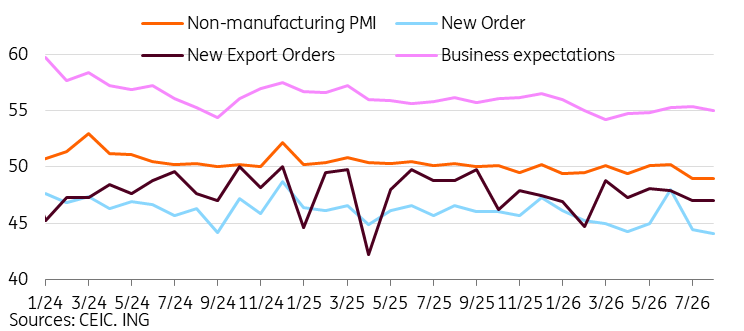
The non-manufacturing PMI remained unchanged at 49.0, disappointing market expectations (market: 49.4, ING: 49.4) for a slight recovery.

The subindex breakdown was generally unfavourable. New orders fell further to a 44-month low of 44.1, and orders on hand (42.8) fell to a 4-month low.

New export orders (47.0) and employment (45.4) remained unchanged on the month. Input prices, meanwhile, rose to 51.1, the first time above 50 in 3 months.

Because China's services sector is primarily domestically focused, this suggests domestic demand remained relatively sluggish in August. Policy support announced over the past month appears focused on interest subsidies. As positive impacts may be relatively marginal, more measures are expected in the weeks ahead.

For now, the PMI data suggests that we are due for another month of relatively sluggish domestic activity data in August, with any potential rebound likely to be limited.

Non-manufacturing PMI stagnant as new orders fell to 44-month low
Chart

Read the original analysis here

Author

ING Global Economics Team

ING Global Economics Team

ING Economic and Financial Analysis

From Trump to trade, FX to Brexit, ING’s global economists have it covered. Go to ING.com/THINK to stay a step ahead.


More from ING Global Economics Team
Share:

Editor's Picks

AUD/USD rises to 0.6950 as USD slips on Fed's Warsh

AUD/USD regains traction and extends the bounce toward 0.6950 in the Asian session on Friday. Fed Chair Warsh's comments reinforce the selling pressure on the US Dollar, allowing the pair to stretch higher. Warsh said that he remains committed to delivering price stability without giving away anything on future interest rate path.

USD/JPY falls in symc with USD, gives up 158.00 after Warsh's speech

USD/JPY has come under fresh selling pressure and gives up 158.00 in the Asian session on Friday amid the emergence of fresh US Dollar selling. Fed Chair Warsh's non-committal commentary on the future tightening path, weighs on the US Dollar and the pair.

$4,200: Back in sight for Gold after Warsh’s silence on interest rate outlook

Gold is looking to build on its recent recovery, reverting toward $4,200 in the early European hours, as traders digest US Fed Kevin Warsh’s neutral remarks delivered at the Fireside Chat with International Monetary Fund (IMF) Managing Director Kristalina Georgieva in Bangkok.

Bitcoin holds $80,500; Ethereum rebounds, Ripple weakens

Bitcoin (BTC), Ethereum (ETH) and Ripple (XRP) show mixed price action on Friday, with BTC and ETH holding above key support levels while XRP struggles below key resistance. Meanwhile, sticky inflation figures have dampened risk appetite, and momentum indicators for these top three cryptocurrencies have also weakened, signaling a risk of a deeper correction if key support fails to hold.

US midterms put fiscal policy under the spotlight, treasury sell-off raises risk
The US will hold its midterm elections - a de facto referendum on the Trump administration - on 3rd November after two years shaped by rising trade protectionism, attacks on Federal Reserve independence and, since the spring, the Iran war. Republicans are expected to take a heavy electoral hit.
Everyone's dumping Gold after hot US inflation. Here's why $4,100 could be a floor, not a cliff
Gold (XAU/USD) is recovering from a sharp sell-off triggered by hotter-than-expected United States (US) inflation data released on Wednesday. The precious metal briefly plunged toward $4,073 as investors increased their bets on further Federal Reserve (Fed) interest rate hikes before recovering as US Treasury yields and the US Dollar (USD) reversed their initial gains.















