Bullish SPY and CPI gift

S&P 500 rejected downswing twice yesterday, and closed on a bullishly leaning note – setting the stage for upswing continuation premarket today. That has been good enough to deliver very finely working long intraday calls in our channel, where I did so both in ES and DAX (European stocks are poised to do better, just remember than Europe is benefiting earlier and more from a China stimulus) – these intraday opportunities are easier to manage when market breadth isn‘t A-OK. Rotations though keep saving the day as the stock market advance is depending on fewer stocks than say in the Nov-Dec period.
But I had been clear throughout all of 2024 that the top isn‘t in, and that the grind higher in equities is to continue no matter what rate cuts expectations and actual yield path would do. Monetary policy normalization in Japan is some two months away, more China stimulus would hit before that, and Treasury is all too happy to put the foot off the pedal when it comes to long-term debt issuance – these are all bullish factors behind the stock market advance as much as earnings, good earnings… making the participants set aside the soft landing vs. no landing conundrum, and keep driving stock prices higher.
I‘ve served clients plenty of opportunities and ideas how to make the most of the advance by selecting sectors or stocks that are bound to outperform, and have proved so as well – quoting yesterday‘s article (how did you like the ARM move? Just yesterday I brought this stock up as AI results in various beneficiaries, with NVDA momemtarily struggling at $700 after I called for it in the autumn to break $500 with ease…
(…) you know already how much I had been in past weeks praising Q4 earnings as delivering positive surprises, and clients heard me plenty talking XLC (NFLX, META), XLF and XLI with of course XLK (NVDA, SMCI, ARM, MSFT) throughout already November and December – just check where all of these are now…
As an extra hint, defensives (XLU, XLP) keep acting weak while many consumer stocks (XLY and AMZN, which also belongs to the above bullish mix – talked mid Oct and early Nov) do well – these are hardly the circumstances favoring pronounced weakness. Except that there is still more yields pressure with USD up, and not complete acknowledgement of no rate cut Mar – yields aren‘t still done rising in the very near term.
Let‘s move right into the charts – today‘s full scale article contains of them, featuring S&P 500, precious metals and oil.
Tired of seeing those red boxes instead of way more valuable information? Try the premium services based on what and how you trade.
S&P 500 and Nasdaq
The next S&P 500 milestone would be Tuesday‘s CPI that are to come at worst in line with prior figures (0.3% mom headline and core), which would confirm that disinflation is long in the tooth, but not over. With Mar rate cut odds at 17.5%, it‘s a bullish sign, and I prepared you weeks ago for stocks shaking off rate cuts disappointment, and going up anyway…
This CPI revision is a gift on top, painting an even better picture going into Tuesday.
Gold, Silver and Miners
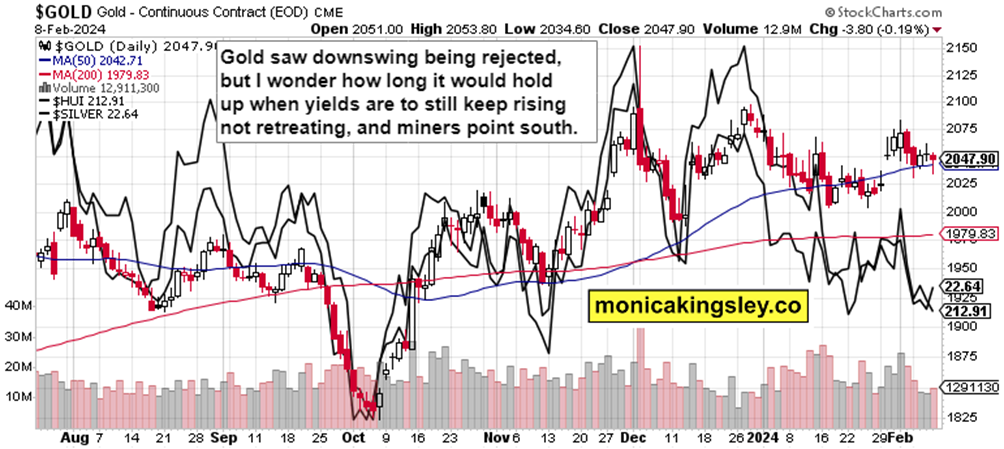
Gold prices looks likely to revisit low $2,020s approximately, and gold being unable to hold any gains following CPI revisions, clearly favors more headwinds dead ahead. Miners were right in leading lower yesterday.
Copper hesitated too much in the low $3.70, and time to buy isn‘t yet here - $3.68 is likely to be broken to the downside on a closing basing. Not even during the Asian session did some buying show up, and that‘s concerning for the buyers.
Author

Monica Kingsley
Monicakingsley
Monica Kingsley is a trader and financial analyst serving countless investors and traders since Feb 2020.