|

Brent tops $90 as US-Iran war disrupts Hormuz Oil supplies
Brent crude prices rose in early trading on Tuesday, reaching their highest level in more than three weeks and moving above $90 a barrel. The US–Iran war continues to create uncertainty in energy markets, pushing prices higher as traders factor in the threat to supplies. Both sides have adopted an increasingly belligerent tone, diminishing hopes of a negotiated settlement and a normalisation of maritime traffic through the Strait of Hormuz. This has contributed to a sharp decline in oil-tanker traffic through this crucial shipping route, which normally carries approximately one-fifth of global oil and LNG supplies. Against this backdrop, and with little realistic prospect of a short-term peace agreement allowing the Strait to reopen fully, there is scope for further price increases. The crisis threatens to continue, and the disruption is now affecting fourth-quarter orders, adding further upward pressure on prices. Investors will continue to monitor developments closely. The longer the current stand-off continues, the greater the potential for further increases in crude prices.
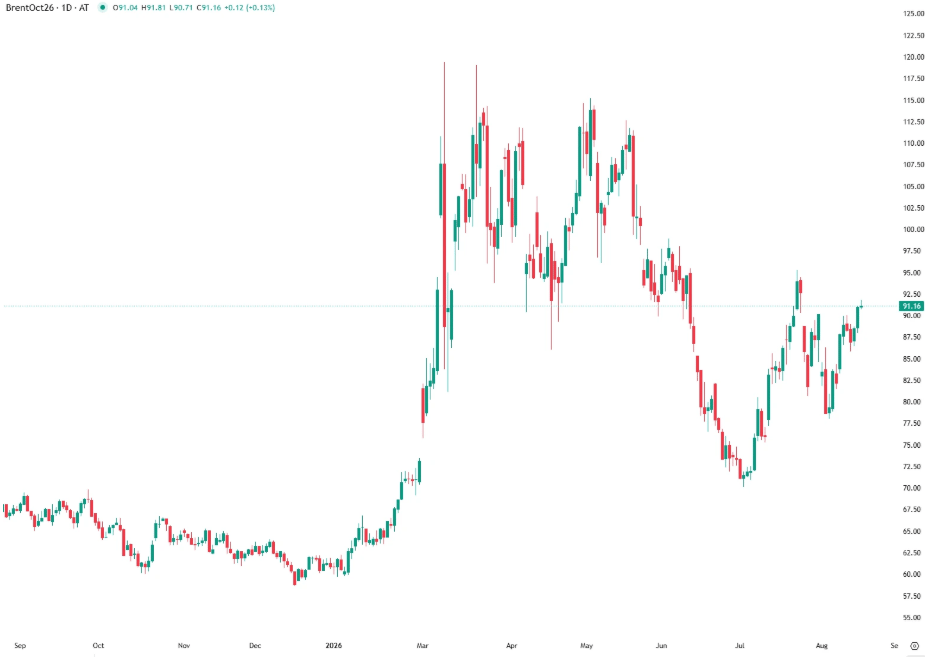
Chart
Source: ActivTrader

Stay up to date with what's moving and shaking on the world's markets and never miss another important headline again! Check ActivTrades daily news and analyses here.

Author

Ricardo Evangelista

Ricardo Evangelista is a seasoned financial markets professional with extensive experience in trading, analysis, and market strategy.


More from Ricardo Evangelista
Share:

Editor's Picks

GBP/USD holds losses below 1.3550 after weak UK jobs data

GBP/USD holds losses below 1.3550 in European trading hours on Tuesday. The UK ILO Unemployment Rate held steady at 4.9% in the three months to June, against a forecast of 4.8%, while Employment Change arrived at 83K in the same period versus 147K previous. Weak UK labor data keep the British Pound under pressure, driving the pair lower.

EUR/USD stays below 1.1600 despite upbeat sentiment data

EUR/USD struggles to gain traction and trades below 1.1600 in the European session on Tuesday, even after the data from the Eurozone and Germany highlighted improving economic sentiment in August. The US Dollar (USD) benefits from the risk-averse market atmosphere as tensions in Middle East remain high, making it difficult for the pair to turn north.

Gold sticks to losses below $4,400 as USD recovers further from two-month low

Gold remains depressed below the $4,400 mark through the first half of the European session, snapping a two-day winning streak amid a broadly firmer US Dollar. Inflation risks stemming from higher oil prices back the case for at least one interest rate hike by the US Federal Reserve in 2026.

Pi Network holds steady amid app studio costs surge to push user adoption

Pi Network extends a consolidation range capped below $0.0900 holding above the $0.0839 support level. PI token remains under pressure as the Core Team pushes for real user adoption by raising costs for AI-powered app creation, effective from August 24. Leverage-linked risk exposure eases as Open Interest declines despite an increase in social interest.

Fiscal concerns and doubts on Fed independence send US yields to long-term highs

US Treasury yields keep rising across the curve this week, with the yield for the 30-year Treasury bond reaching its highest level since 2007, during the global financial crisis, at 5.33% so far on Monday. A mix of concerns about the ballooning US fiscal deficit and growing doubts about the Federal Reserve’s Independence are increasing pressure on US Government Bonds.

Why is Crude Oil priced for a reopening the ships haven't made?
Fourteen vessels crossed the Strait of Hormuz on Tuesday. Before the war, the count ran near 120 a day. In the sessions since the waterway was publicly declared open, Brent has drifted back to $87 and West Texas Intermediate (WTI) to $81, both a little lower again on Wednesday, with daily momentum on each unwound from the top of its range in late July to the low twenties now.