Australian Dollar Price Forecast: Oversold… and still under pressure
- AUD/USD has clinched new 2026 troughs just below 0.6600 on Monday.
- A firmer US Dollar has kept the Aussie under extra downside pressure.
- Advanced data from business activity in Oz disappointed expectations.


The Australian Dollar (AUD) has remained on the back foot for yet another day on Monday, briefly sending AUD/USD just below the 0.6600 yardstick for the first time since December 2025.
Indeed, the continuation of the downward trend on the pair has come in response to the unabated rally in the US Dollar (USD), which remains underpinned by prospects of extra tightening by the Federal Reserve (Fed).
From a more local view, preliminary data for business activity in November came in below estimates in both the manufacturing and services sectors, adding to the previous month's decline and remaining in the contraction territory.
Meanwhile, spot continues to navigate the area below its critical 200-day SMA around 0.7040, leaving it vulnerable to further weakness for now. In the meantime, persistently high domestic inflation in combination with the ongoing cautious stance from the Reserve Bank of Australia (RBA) seems to be failing to put a floor to the marked depreciation of the currency in the last few weeks.
Of note is the pair’s current oversold condition, as per its daily Relative Strength Index (RSI) around 22, which could allow for a technical rebound in the immediate future.
Australia’s resilience is beginning to look less convincing
Australia’s economy continues to compare favourably with many of its G10 peers, although it has cooled somewhat recently.
Supporting the above, business activity seems to have lost further momentum after November’s flash data showed the Purchasing Managers’ Index (PMI) for Manufacturing at 48.7 (from 49.6) and 46.2 (from 48.5) when it comes to Services.
Trade data, however, remained on the positive side after the September trade surplus widened to A$2.826 billion, adding to the A$0.184 billion surplus registered in the previous month (revised from A$0.495 billion).
Growth figures were less encouraging. Indeed, the Gross Domestic Product (GDP) expanded by 0.4% QoQ in the second quarter of 2026, up from 0.3%, while annual growth came in at 2.1%, down from the previous 2.5% yearly expansion.
The labour market, once again, disappointed investors in October after the Unemployment Rate ticked higher to the highest level since October 2021 at 4.9%, while the Employment Change shrunk by 43.5K, adding to September’s 36.4K drop (revised from -39.3K).
Inflation seems to have regained some impulse after the latest data showed the most-watched Trimmed Mean CPI came in at 3.7% over the last twelve months in Q3, while the headline CPI held steady at 3.9% from a year earlier.
The Melbourne Institute’s Consumer Inflation Expectations measure reinforced that trend after holding steady at 5.3% in November.
The figures leave the RBA’s inflation task incomplete. Policymakers expect inflation to return to target only in early 2028, keeping the emphasis on patience rather than an imminent policy pivot.
China offers little support for the Aussie
China is not delivering the growth impulse that has supported the Aussie during previous expansions.
The Chinese economy expanded by 4.5% YoY in the July-September period, although that trend could have lost some momentum in Q4, according to the latest data. Indeed, Industrial Production expanded by 4.8% YoY in October (from 5.5%) and 5.3% YDT. In the same direction, the latest trade data showed a surplus of $133.53 billion in September, as both imports and exports posted strong gains. Somewhat undermining this picture, consumer spending appears to have lost momentum in October, with a meagre 0.4% annual expansion and a 1.04% increase since January.
Business surveys also raised concerns after the National Bureau of Statistics (NBS) reported that both the Manufacturing PMI and the Services PMI returned to contraction territory last month, easing to 49.3 (from 50.1) and 49.7 (from 50.2), respectively. In the opposite direction, although also showing some loss of momentum, private measures like RatingDog remained in expansionary territory, with Manufacturing at 52.0 (from 52.1) and Services at 50.8 (from 51.6).
Disinflationary pressures seem to have resumed in October, with the CPI gaining 0.7% from a year earlier (from 0.9%), while prices came in flat on a monthly basis (from a 0.2% gain). In addition, Producer Prices rose more than initially estimated by 5.7% over the previous twelve months from the 5.0% increase recorded in the previous month.
Back to the central banks’ space, the People’s Bank of China (PBoC) kept its Loan Prime Rates (LPR) unchanged at 3.00% for the one-year tenor and 3.50% for the five-year tenor at its meeting last week.
Taken together, the latest Chinese data offer a mixed enthusiasm (if any at all) for Australia and the AUD, although any recovery attempt has yet to develop the kind of momentum that could provide the currency and the country with a more lasting and convincing boost.
The RBA faces an inflation–growth bind
The RBA lifted its Official Cash Rate (OCR) by 25 basis points to 4.85% earlier this month, in a 6-3 vote, after dramatically boosting its inflation predictions. However, headline CPI is now seen peaking at 4.5% and staying above 3% until late 2027, while Trimmed-mean inflation is anticipated to reach 3.6% in Q4 2026, dropping only gradually afterward.
The RBA’s recent Minutes revealed officials remain quite worried about inflation. Members saw that inflation remained too high and was likely to be high for another year, and that excess demand was anticipated to last until at least mid-2027. All in all, policymakers continued to see upside risks for inflation.
The Minutes record that the debate focused on whether to increase the OCR by a further 25 basis points or to keep it unchanged. Hawks said the hikes provided so far in 2026 had not done enough to keep inflation concerns in check, while others were reluctant to tighten more, fearing that the economy may be heading for a steeper fall.
But the Board saw financial conditions as tight, while contradictory indications made it challenging to gauge the degree of pressure from monetary policy. Growth is anticipated to be below potential over the next several years as past rate rises flow through, but global events might drive Australia’s real neutral rate higher.
The policy message continues to be strongly data-dependent. The RBA is prepared to take the necessary steps to restore price stability. But the minutes point to a difficult trade-off: inflation still needs restraint, but the build-up of the effects of tighter policy is starting to create real concerns about growth.
So far, markets pencil in just over a basis point of easing by the RBA at its December 8 meeting.
Oversold, but still pointed lower
Baseline outlook
Further losses should not be ruled out in the short term while the pair continues to trade below the 200-day SMA around 0.7040. However, the current oversold condition of the pair could allow for a near-term technical bounce.
The resumption of the bullish bias will likely require a strong catalyst, namely a sustained improvement in risk appetite trends or renewed and persistent weakness in the Greenback.
Upside scenario (currently unlikely)
A sustained improvement in risk appetite could help AUD/USD regain, initially, the 0.7000 milestone and refocus on the 200-day SMA afterwards. Beyond that, the weekly top at 0.7140 (September 21) would emerge as the next hurdle, ahead of the 2026 peak around 0.7280 (May 6).
Downside scenario
In case bears maintain control of the sentiment, there should be initial support at the 2026 bottom of 0.6597 (November 23). A breach below this level would increase the likelihood of a retest of the November 2025 floor at 0.6421 (November 21).
Bears tighten their grip as short-building accelerates
The AUD’s non-commercial bearish stance deepened substantially in the week to November 17, according to the Commodity Futures Trading Commission (CFTC) data. Indeed, speculative net shorts rose to historic highs just past 182K contracts, extending the bearish trend that has started in mid-June. The four-week change also worsened, suggesting that the larger negative trend is increasing.
Open interest rose to around 374.3K contracts, the highest level since mid-September. The combination of much larger net shorts and increased participation suggests new short-building rather than just liquidation. So conviction in the negative AUD stance looks to be rising.
Speculative exposure dropped to -48.6%, while its percentile plunged to a scant 4.2. The Net Position Percentile was unchanged at 0.0, meaning AUD positioning is currently historically severe on an absolute basis and relative to open interest.
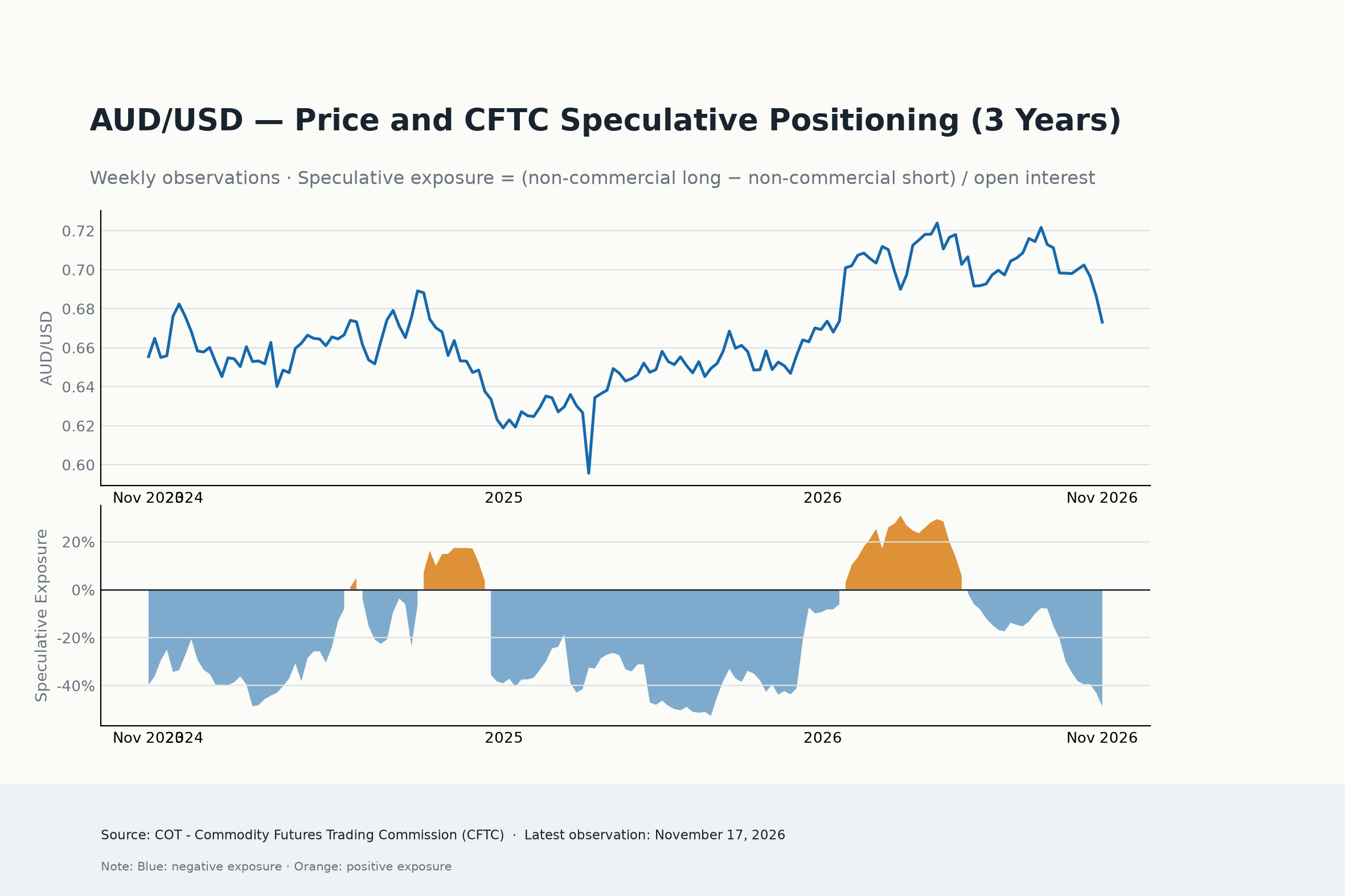
The AUD short has reached an even more crowded and aggressive overall state. Weekly and four-week readings suggest fresh negative momentum, but extreme percentile values suggest the position is more susceptible to a sudden short-covering comeback if the macro narrative shifts or bearish momentum fails.
What’s next for the Aussie
US Dollar dynamics, global risk sentiment, and geopolitical developments remain the main near-term drivers of AUD/USD.
Next on tap on the domestic docket will be the release of the crucial Inflation Rate on November 25.
Beyond that, the main risks are expected to emerge from China, a persistently cautious Fed, a deterioration in investor risk appetite or a change in the RBA’s current policy stance.
Any of these developments could quickly alter the outlook for the Australian currency.
Australian inflation is the next test
AUD/USD enters the week under pressure from several directions at once.
The dollar’s strength and fading confidence in Australia’s growth outlook have pushed the pair to a fresh low, while China has yet to provide the convincing recovery that might give the Aussie a lift.
The RBA’s inflation concerns argue against an early policy pivot, but they have not been enough to offset the market’s focus on slowing activity and rising unemployment.
With speculative shorts now near historical extremes and the daily RSI deeply oversold, a rebound would not be surprising; it would take a sustained improvement in the data or a turn in the US Dollar, however, to make that more than a corrective bounce.
For now, the bias remains lower, with Wednesday’s Australian inflation figures the next test.
RBA FAQs
The Reserve Bank of Australia (RBA) sets interest rates and manages monetary policy for Australia. Decisions are made by a board of governors at 11 meetings a year and ad hoc emergency meetings as required. The RBA’s primary mandate is to maintain price stability, which means an inflation rate of 2-3%, but also “..to contribute to the stability of the currency, full employment, and the economic prosperity and welfare of the Australian people.” Its main tool for achieving this is by raising or lowering interest rates. Relatively high interest rates will strengthen the Australian Dollar (AUD) and vice versa. Other RBA tools include quantitative easing and tightening.
While inflation had always traditionally been thought of as a negative factor for currencies since it lowers the value of money in general, the opposite has actually been the case in modern times with the relaxation of cross-border capital controls. Moderately higher inflation now tends to lead central banks to put up their interest rates, which in turn has the effect of attracting more capital inflows from global investors seeking a lucrative place to keep their money. This increases demand for the local currency, which in the case of Australia is the Aussie Dollar.
Macroeconomic data gauges the health of an economy and can have an impact on the value of its currency. Investors prefer to invest their capital in economies that are safe and growing rather than precarious and shrinking. Greater capital inflows increase the aggregate demand and value of the domestic currency. Classic indicators, such as GDP, Manufacturing and Services PMIs, employment, and consumer sentiment surveys can influence AUD. A strong economy may encourage the Reserve Bank of Australia to put up interest rates, also supporting AUD.
Quantitative Easing (QE) is a tool used in extreme situations when lowering interest rates is not enough to restore the flow of credit in the economy. QE is the process by which the Reserve Bank of Australia (RBA) prints Australian Dollars (AUD) for the purpose of buying assets – usually government or corporate bonds – from financial institutions, thereby providing them with much-needed liquidity. QE usually results in a weaker AUD.
Quantitative tightening (QT) is the reverse of QE. It is undertaken after QE when an economic recovery is underway and inflation starts rising. Whilst in QE the Reserve Bank of Australia (RBA) purchases government and corporate bonds from financial institutions to provide them with liquidity, in QT the RBA stops buying more assets, and stops reinvesting the principal maturing on the bonds it already holds. It would be positive (or bullish) for the Australian Dollar.
Author
Pablo Piovano
FXStreet
Born and bred in Argentina, Pablo has been carrying on with his passion for FX markets and trading since his first college years.