Q4 2026 market outlook: Why the Dollar holds the key for stocks, Gold and crypto

Record highs, a 5% bond yield and an oil shock: the final quarter of 2026 opens with markets pulling in different directions, and the US dollar connects them all.
The fourth quarter of 2026 opens with US stock indices at record highs, the Federal Reserve hiking for the first time since 2023, the 10-year Treasury yield above 5% and Brent crude near $100. On paper, that is a picture of strength. Underneath, it is a market in which fewer stocks are doing the lifting, bond investors are demanding more, and the dollar has turned higher again since early September.
For the quarter ahead, the key question is not simply whether markets will rise or fall, but whether the current trends can broaden and remain supported by fundamentals. According to Frank Walbaum, market analyst at NAGA, the answer runs through the key statement: the US dollar decides.
Walbaum, a former family-office fund manager who specialized in currencies, sets out that case in the Frankfurt-listed trading platform's Q4 2026 Market Outlook. In his view, the direction of the dollar this quarter will shape not only the major currency pairs but also gold, equities, and crypto.
A strong quarter built on a narrow base
The third quarter looked healthy at headline levels. The S&P 500 gained 2.6% and the Nasdaq 100 0.6%. Beneath the surface, the Russell 2000 fell 7.0%, and the Dow Jones lost 2.1%, while only 46% of S&P 500 members traded above their 200-day moving average in early October, down from about 70% at the end of July.
That divergence matters. A rising index does not necessarily mean a broadly healthy market. When fewer companies drive the gains, the market depends more heavily on a small group of highly capitalized names, most of them tied to artificial intelligence. Elsewhere, the quarter belonged to oil and crypto: Brent crude rose 33.3% as the Strait of Hormuz crisis returned, and Bitcoin rebounded 42.7%.
The Fed and the 5% question
Monetary policy is the thread that runs through every market this quarter. The Fed raised its target range to 3.75–4.00% on 16 September, with headline PCE inflation at 3.4% in August, and its median projection points to one more 25-basis-point hike before year-end. At the same time, September payrolls rose by only 29,000 and unemployment edged up to 4.2%.
That leaves the Fed caught between sticky inflation and a cooling labour market, and it makes every data release a potential market mover. "I expect the Fed to hold in October and hike again in December," Walbaum says. "The September projections point to one more hike this year, while the latest market pricing strongly favours an October hold followed by a December move." Softer jobs data, he adds, could shift that path quickly.
Bond markets have already reacted. The US 10-year yield rose 85 basis points in Q3 to 5.29%, its largest quarterly increase since 2009, and the German 10-year Bund touched 3.65% on 1 October, its highest level since 2009. Higher yields raise the discount rate applied to equity valuations, increase the opportunity cost of holding gold, and support the dollar. Whether 5% acts as a ceiling as growth cools, or as a floor for a further repricing, is one of the defining questions for Q4.
The Dollar: trend intact, rally stretched
The US Dollar Index finished Q3 almost unchanged, but it climbed from 98.79 on 8 September to 102.54 intraday on 5 October, a gain of almost 4% in less than a month. Walbaum sees the long-term trend as bullish and says a sustained break above 102.50 would confirm another leg higher. The rally is also stretched, he cautions, so a temporary correction should not be ruled out.
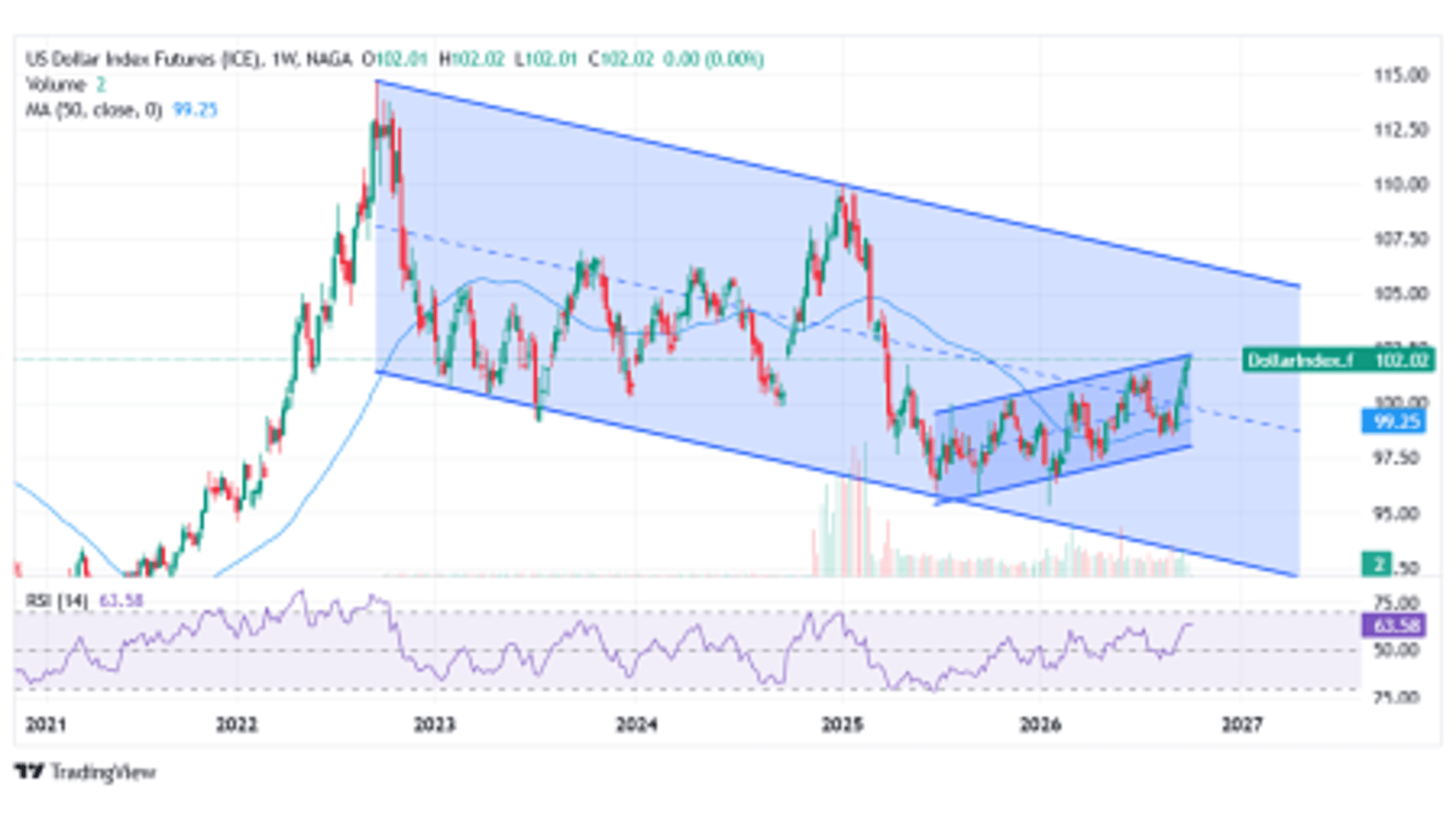
The effects are visible across currencies. EUR/USD fell to its weakest level since May 2025 in early October. "1.1150 is the line in the sand — below it, the correction could turn into a proper downslide," Walbaum says. USD/JPY trades below its July peak of 163.99, which prompted Japan to intervene, joined by the US in the first joint intervention since 1998; 160 remains the major reference point. In the UK, the 28 October Budget will decide whether sterling can hold its 2026 lows.
Gold, Oil and a fading war premium
The yellow metal set a record close near $5,600 in January and was roughly 26% below that level in early October. The $4,000 area is now the key line for the long-term uptrend. Banks' gold price forecasts have been cut since mid-year, but they still range from $4,450 to $4,800. Gold also has a less obvious trait: in a sharp sell-off, investors often cut positions across asset classes; gold included, before safe-haven demand takes over.
Oil tells a different story. The conflict involving the US, Israel and Iran has repeatedly disrupted the Strait of Hormuz, and Brent peaked near $126 earlier in the year. Yet the market's reaction is fading. "Markets get tired of wars," Walbaum says. "The second wave of the Iran conflict pushed oil higher, but the reaction was clearly smaller than the first — a sign that the geopolitical premium is fading." Forecasts for Brent range from $85 to $105, and winter adds a second source of volatility. EU gas storage was only about 72.7% full on 4 October, against a five-year average of around 87%.
Equities: why seasonality is not enough
History favours the bulls in the final quarter. Since 1950, the S&P 500 has gained 4.2% on average in Q4, and midterm-election years have been even stronger. Year-end targets from 20 major brokerages cluster around a median of 8,000, and estimates put 2026 earnings growth at roughly 24–32%.
Seasonality, however, now competes with a 5% bond yield, an energy shock and narrow breadth. The real test comes with the Big Tech results on 28–29 October and Nvidia's numbers on 17–18 November. Walbaum is watching what happens underneath the headline numbers. "I'm looking beyond the index price — if dividend-paying stocks continue to weaken while AI demand starts to fade, the rally becomes increasingly vulnerable to a larger correction," he says, putting the key S&P 500 level at 7,600. Europe looks more exposed still: the DAX gained only 2.8% in the first nine months of the year and is more sensitive to energy costs if the winter is cold.
Crypto: the clearest test of the dollar story
Crypto was the strongest asset class of Q3. Bitcoin's 42.7% gain was its best quarter in more than two years; Ether rose 71.3%, and spot Bitcoin ETFs took in $6.3 billion of net inflows. Both coins remain lower for the year after a weak first half.
After that run, most major tokens look overbought, and Walbaum would prefer a pause to a chase. "I'd rather see a correction than chase an overbought market — healthier entries could give the next leg higher room to run," he says. He puts the level that frames Bitcoin's uptrend at $81,000. Because crypto sits firmly on the risk-on side of the dollar story, it is likely to be one of the clearest signals of which scenario is unfolding.
Three scenarios for the quarter
Rather than relying on a single forecast, Walbaum maps out three scenarios for Q4, each built around the dollar, and gives the highest probability to a risk-off move:
Risk-off (50%): narrowing breadth and a fading AI narrative trigger a broader correction. Equities fall; gold may weaken at first before safe-haven demand returns, and the dollar benefits.
Dollar strength continues (25%): a break above 102.50 confirms dollar momentum, with gold, silver and risk assets under pressure and USD/JPY potentially above 160.
Dollar correction (25%): weaker US data and a more dovish Fed soften the dollar, supporting gold, stocks and crypto.
The dates that will tell them apart are US inflation, the Fed decisions on 28 October and 9 December, and the US jobs reports on 6 November and 4 December. The 9 December meeting, with new projections, is likely to be the single most important event of the quarter.
For investors, the task is less about predicting the next move than about recognizing early which of these scenarios is taking shape. In Q4 2026, the dollar is the place to look first.