From Bitcoin mining to the AI economy: How electricity powers both and how you can participate
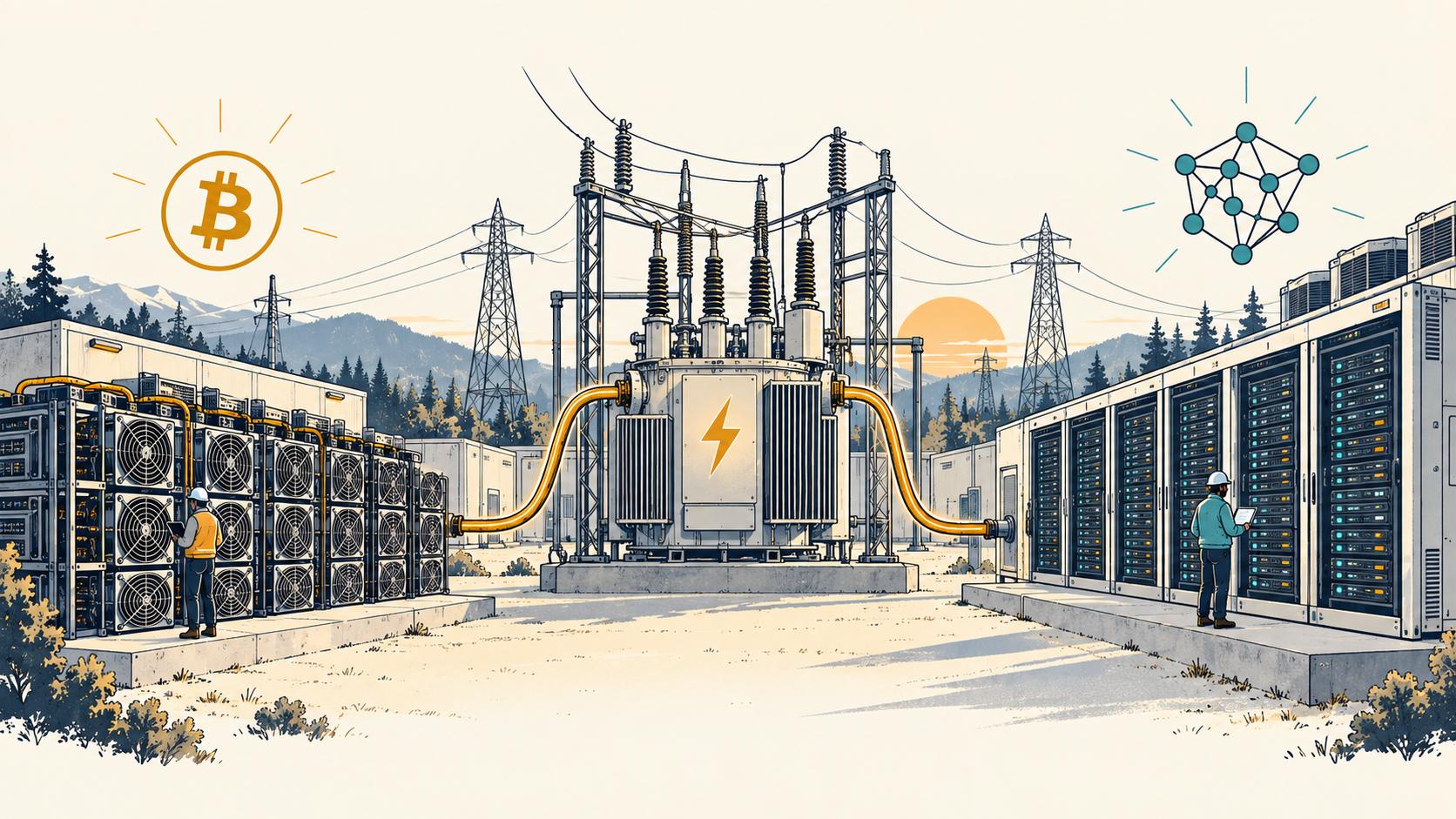

When people discuss cryptocurrency, the conversation often centers on Bitcoin prices, Bitcoin mining, and ways to participate in crypto markets. With artificial intelligence, the discussion extends to making money with AI tools, using AI for stock market analysis, and AI automated trading. Behind these topics lies an easily overlooked question: where does the computing power that keeps digital networks and intelligent tools running actually come from?
The answer depends on electricity and computing infrastructure. In the Bitcoin network, electricity powers mining equipment that helps confirm transactions and secure the network. In AI data centers, electricity supports GPUs and other hardware used to train models, process data, and deliver inference services. Whether an application generates content, assists with stock research, or provides AI analysis for automated trading, its capabilities depend on underlying computing resources. This opens up a broader question beyond how to make money using AI: how can people participate in the infrastructure that makes AI possible?
For everyday users, are there ways to participate in this infrastructure beyond buying cryptocurrency or using AI tools? 51AIpower describes one approach: users can support the electricity and computing infrastructure behind AI factories through participation plans, without owning GPUs or managing servers, and receive rewards based on actual operating performance. But how do participation models differ between Bitcoin mining and AI compute? This article explores six platforms—51AIpower, NiceHash, Braiins Pool, F2Pool, Vast.ai, and Akash Network—to explain their entry requirements, income sources, and operating models.
How Does Electricity Support the Bitcoin Economy?
Bitcoin miners use specialized hardware to perform hashing computations, competing to produce valid blocks that add transactions to the blockchain and help secure the network. Successful miners receive block subsidies and transaction fees, while pool participants receive payouts according to their pool’s rules.[1]
Electricity is a recurring operating cost. Profitability also depends on cooling, equipment efficiency and depreciation, Bitcoin’s price, network difficulty, and pool fees. Beyond trading cryptocurrency, mining pools and hashrate marketplaces offer ways to supply or access computing resources, with different participation requirements.
Three Crypto Mining Platforms Worth Understanding
These platforms illustrate hashrate trading and mining pool services through their direct links to electricity, hardware, and mining. They are not ranked by profitability, and availability varies by location.
1. NiceHash: Connecting Hashrate Sellers and Buyers
NiceHash connects mining hardware owners with buyers seeking hashing power. Sellers supply compatible mining capacity, while buyers rent hashrate and direct it to a mining pool without owning or managing equipment. Rental costs can exceed mining proceeds, so profits are not guaranteed.[2]
Platform highlights: Users can sell hashrate from their equipment or pay to rent it for mining—two roles with different costs and income sources.
2. Braiins Pool: Mining Pool Services for Bitcoin Miners
Braiins Pool lets Bitcoin miners connect equipment, submit computational work, and receive payouts under its rules. Braiins also provides firmware and management tools to improve mining operations. Efficient participation requires suitable SHA-256 ASIC hardware; ordinary computers and smartphones are not practical substitutes.[3]
Platform highlights: Combines pool services with equipment optimization tools for users with mining hardware or hosting arrangements. Participants remain responsible for hardware, electricity, and maintenance costs.
3. F2Pool: Mining Pool Services Across Proof-of-Work Networks
F2Pool serves Bitcoin and other proof-of-work networks, recording miners’ submitted work and processing payouts under each coin’s rules. Equipment must match the chosen network: support for multiple cryptocurrencies does not mean one machine can mine them all.[4]
Platform highlights: Offers pool services across multiple networks. Miners should check equipment compatibility, regional availability, fees, and payout requirements.
From Crypto Hashrate to AI Compute: How Electricity Creates Value in Different Ways
Bitcoin mining supports proof of work, while AI computing trains models and runs inference—the processing behind AI answers, code generation, and document analysis.
In large language models, tokens are basic data units used to measure input and output usage. Depending on tokenization, a token may represent a word, part of a word, or another data fragment. An AI inference token is not a cryptocurrency traded on an exchange.[5]
The AI Token Economy encompasses model usage, token processing and generation, and supporting compute services. Unlike blockchain-based token economies, the focus here is AI service delivery and consumption rather than digital asset issuance or prices.
Electricity powers the GPUs delivering these services, while providers balance speed, cost, and quality. NVIDIA identifies token processing efficiency relative to power consumption as an important AI infrastructure consideration.[6]
Despite their shared reliance on electricity, Bitcoin mining and AI computing require different infrastructure. Bitcoin ASICs perform specialized hashing and cannot replace GPU servers running large language models; networking, software, and operational requirements also differ.
Three Platforms Connected to Participation in the AI Token Economy
The AI Token Economy depends on computing resources and the services that organize and operate them. The following platforms represent infrastructure participation plans, GPU rental marketplaces, and decentralized computing networks. Each connects to the supply of AI services, but they do not all calculate participant income on a per-token basis.
1. 51AIpower: Supporting AI Infrastructure Through Participation Plans
For everyday users who do not own GPUs or want to manage servers, 51AIpower presents a different participation model. According to the platform’s business description, users can support the electricity and computing infrastructure required by AI factories through participation plans, without supplying their own electricity or purchasing hardware.
Under this model, the platform relates plan payments to the electricity costs associated with supporting AI token production. It describes rewards as being calculated according to users’ electricity support contributions, associated token output, and actual operating performance. Users participate in infrastructure plans organized by the platform rather than deploying models or operating a GPU rental business themselves.
The practical details should be clear in each plan’s terms: what the payment supports, how reward calculations are recorded, how long the plan runs, and when withdrawals are permitted. These operating descriptions come from 51AIpower and do not constitute an independent audit of its underlying facilities, customer revenue, or actual returns. Estimated returns are not guaranteed earnings.
Platform highlights: 51AIpower connects users with electricity and AI computing infrastructure through participation plans, without requiring them to operate mining equipment or GPU servers. New users receive 200 free Starter Plan purchase credits, limited to one use per day. Earnings generated through the Starter Plan are real and credited to the account. Users can experience the process before deciding whether to purchase paid plans. Visit 51AIpower to explore the Starter Plan.
2. Vast.ai: Bringing GPU Owners Into AI Compute Supply
Vast.ai operates a GPU rental marketplace connecting computing resource providers with users who need GPUs. Its resources can support machine learning, AI inference, and other computing workloads. Hardware owners can list their equipment as hosts and set rental prices.[7]
This gives participants a more direct role in providing compute services, but also requires equipment deployment, network connectivity, and maintenance. Listing hardware does not ensure that it will be rented. Revenue depends on demand, pricing, hardware specifications, and service reliability, while profit must account for electricity and other operating costs.
Platform highlights: Vast.ai connects hardware supply with computing demand through GPU rentals. It is more relevant to participants with compatible equipment and operational expertise. Revenue primarily comes from rented resources, rather than buying an AI-themed token and waiting for its price to rise.
3. Akash Network: Connecting Decentralized Compute With AI Applications
Akash Network operates a decentralized computing marketplace. Providers can make server and GPU resources available, while customers rent capacity to deploy applications. Its website also provides access to AI inference services, illustrating the connection between distributed computing resources and AI applications.[8]
For providers with server resources and technical expertise, participation means delivering services through the compute marketplace. The Akash ecosystem also involves the AKT cryptocurrency, but AKT and the inference tokens processed by language models are different concepts. Holding a token, providing computing resources, and consuming AI services are separate activities with different risks.
Platform highlights: Akash connects a decentralized resource marketplace with AI workloads. It is relevant to participants familiar with server deployment and network operations. Compute demand, resource operating costs, and cryptocurrency price exposure should be evaluated separately.
What Do These Six Participation Models Mean for Everyday Users?
All six platforms relate to computing resources, but participants contribute different things. With Braiins Pool and F2Pool, miners contribute computational work from mining equipment. On NiceHash, users can sell or purchase mining hashrate. On Vast.ai and Akash Network, providers supply computing resources that customers can rent.
51AIpower describes a model in which users support infrastructure operations through plans, while the platform organizes the associated services. This may be easier to approach for people without hardware or technical expertise, but fewer operational tasks do not eliminate business or platform risk.
Three questions help clarify whether a model fits a user’s needs: What exactly am I paying for or supplying? What activity generates the income? Which costs and restrictions affect the final outcome? Hardware providers need to consider utilization and maintenance costs, while plan participants need to understand contract duration, reward calculations, exit restrictions, and withdrawal conditions.
In every model, electricity is one input into delivering a service. The financial outcome depends on whether electricity and hardware can consistently support services customers are willing to pay for—and whether the resulting revenue covers the full cost of delivery.
Looking Beyond Digital Assets to Digital Infrastructure
Bitcoin has helped more people recognize that digital networks depend on physical energy and computing equipment. Artificial intelligence brings that relationship into everyday life: every model request requires computing systems to perform real work.
This does not mean AI will replace Bitcoin or that AI infrastructure necessarily offers higher returns. It provides a broader perspective: understanding the digital economy requires looking at electricity, equipment, and service demand alongside consumer products and assets.
Frequently Asked Questions
1. What Is the Difference Between Bitcoin Mining and AI Computing?
Bitcoin mining uses proof of work to help produce blocks and secure the network, while AI computing supports model training and inference for services such as answering questions and generating content. Both require electricity and hardware, but their tasks, equipment requirements, and income sources differ. Bitcoin ASICs cannot directly replace AI servers.
2. Are AI Tokens Cryptocurrencies?
In the context of large language models, AI tokens are basic units of data processed or generated by a model and are commonly used to measure inference usage. They are not cryptocurrencies. Some blockchain projects issue AI-themed digital assets, but those assets are distinct from the tokens consumed in model requests.
3. Can I Participate Without Owning Mining Hardware or GPUs?
Some services and participation plans do not require users to own hardware. Examples include purchasing mining hashrate or exploring the AI infrastructure participation model described by 51AIpower. These approaches still involve costs, operating uncertainty, and platform performance risk; not owning equipment does not make the income risk-free.
4. How Can Everyday Users Participate in the AI Token Economy Through 51AIpower?
According to 51AIpower, users register on the platform and select participation plans supporting the electricity and computing infrastructure behind AI factories, without managing GPUs themselves. Rewards are calculated according to the platform’s stated rules and plan terms.Users should review the duration, calculation basis, withdrawal conditions, and applicable restrictions before participating.
5. Can AI Infrastructure Participation Generate Stable Passive Income?
Some models reduce day-to-day work for participants, but that does not establish that income is stable or guaranteed. Results remain affected by computing demand, equipment utilization, electricity prices, service pricing, and the platform’s ability to meet its obligations. Estimated revenue, amounts actually received, and profit after costs should be assessed separately.