DailyForex tests whether the same Forex broker offers the same protections in every country
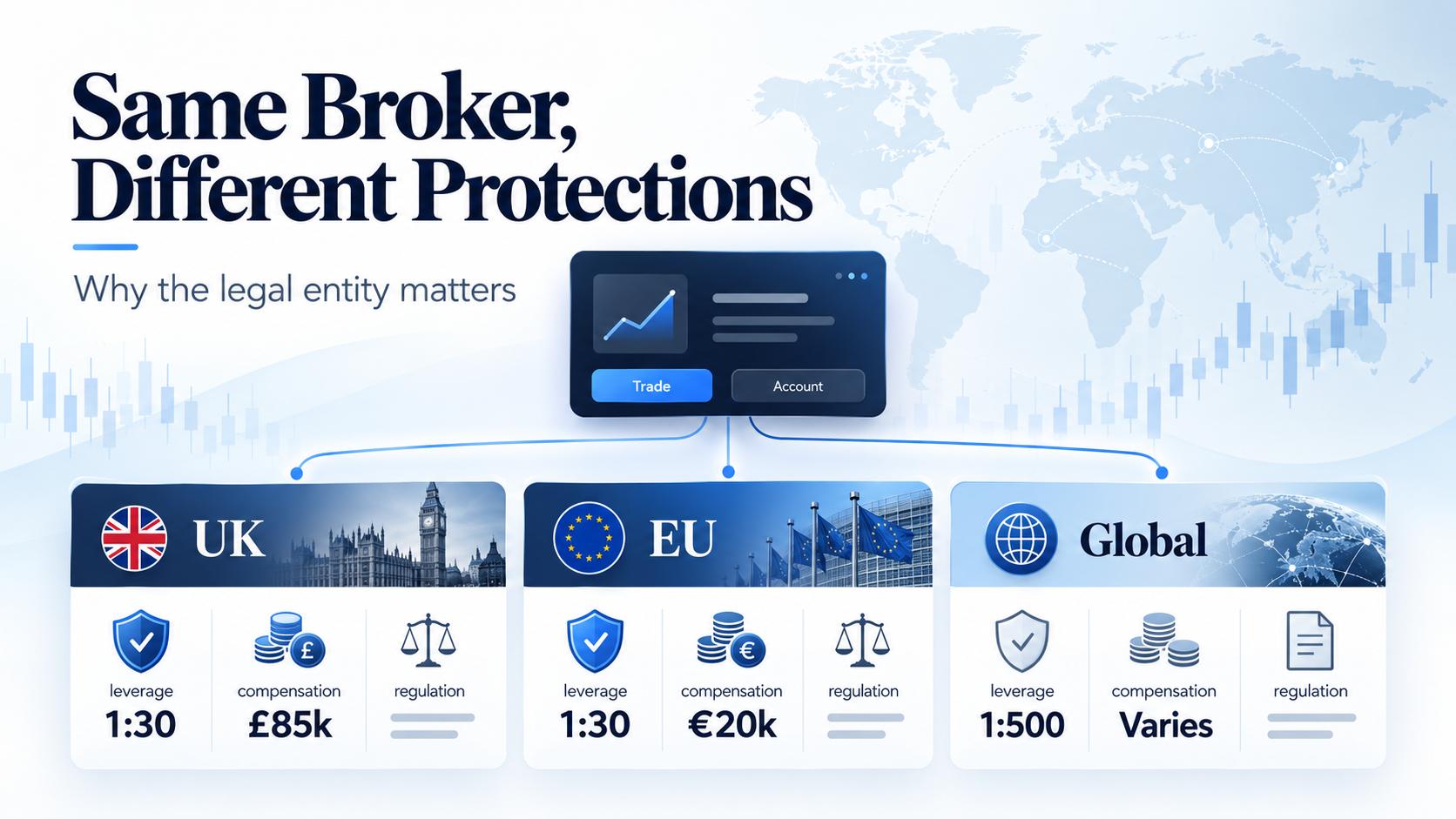

DailyForex analyzed brokers included in its Forex Brokers Directory to examine whether traders using the same global broker brand receive the same regulatory protections in different countries.
The finding is straightforward: the name displayed on a broker’s website does not necessarily identify the legal company that will hold a trader’s account. Large international brokers often operate through multiple subsidiaries, each regulated in a different jurisdiction. As a result, two people opening accounts with the same brand may face different leverage limits, negative-balance protections, investor-compensation arrangements and complaint routes.
For traders, the practical question is not only “Is this broker regulated?” It is: “Which legal entity am I contracting with, and what protections apply to that entity?”
Same Broker, Different Protections
DailyForex reviewed examples from three international broker brands—IG, Pepperstone and XM—to compare how their account arrangements can differ by client location.
IG’s own international comparison illustrates the point clearly. A UK client may contract with IG Index Ltd or IG Markets Ltd, regulated by the Financial Conduct Authority (FCA). The account is eligible for Financial Services Compensation Scheme protection of up to £85,000, and retail clients receive negative-balance protection. A client in continental Europe may instead contract with IG Europe GmbH, which is authorised by BaFin and Deutsche Bundesbank; the published compensation arrangement is 90% of a claim, capped at €20,000. Meanwhile, an Australian IG trading account has segregated client money but no statutory compensation scheme listed, and IG states that a client can lose more than their deposit on a standard trading account.
Pepperstone provides another example of how the same trading brand can carry different insolvency protections. In the UK, Pepperstone Limited is FCA-regulated, and its published client-funds information says eligible shortfalls of up to £85,000 may be compensated under the FSCS. The company’s Cyprus subsidiary, Pepperstone EU Limited, is regulated by CySEC and participates in Cyprus’s Investor Compensation Fund. The maximum cover is the lower of 90% of eligible cumulative claims or €20,000.
The legal entity also matters outside Europe. Pepperstone is licensed across multiple jurisdictions, including the UK, Australia, Cyprus, Dubai, Kenya, Germany and The Bahamas. The protections, available products and applicable local rules can therefore depend on where the customer resides, and which group company accepts the application.
XM highlights a further difference between an EU-regulated entity and an offshore group company. Trading Point of Financial Instruments Ltd, operating under the XM brand in Cyprus, is licensed by CySEC under licence number 120/10. Its published risk disclosure specifies retail leverage of up to 30:1 on major currency pairs. In contrast, XM Global Limited is registered with Belize’s Financial Services Commission. XM also advertises leverage of up to 1,000:1 on its global website—an example of how product conditions can vary substantially between jurisdictions.
These comparisons do not mean that one entity is automatically suitable for every trader. They do show, however, that regulation is not a single, brand-wide feature. It is tied to the particular company named in the account agreement.
Why Traders Should Check the Broker Entity
A broker’s overall regulatory footprint can be reassuring, but traders should avoid assuming that every licence held by a global group applies to their account. A UK trader, an EU trader, an Australian trader and a client accepted by an international or offshore entity may all see the same logo, platforms and market list while operating under different rules.
Before depositing funds, traders should check:
- The full legal name of the account provider in the client agreement.
- The regulator and licence number associated with that company.
- Whether retail negative-balance protection applies.
- The maximum leverage permitted for their account and product.
- Whether client money is segregated and how this is described in the broker’s legal documents.
- Whether a statutory investor-compensation scheme applies, including its eligibility rules and cap.
- The relevant complaints authority and dispute-resolution process.
Compensation protection is particularly important to interpret carefully. It is not a guarantee against trading losses. It generally concerns eligible claims if a regulated firm cannot meet its obligations, subject to the terms, limits and exclusions of the applicable scheme.
“A broker may operate under several regulated entities worldwide, so two traders opening an account with the same brand may not receive exactly the same protections,” said a Anat Ben Dror, CEO of GlobalOnMedia, the owner of DailyForex. “Checking the legal entity behind the account is an important part of broker research.”
About DailyForex
Founded in 2008, DailyForex provides independent Forex broker reviews, comparisons, market analysis, trading education and financial market research to traders worldwide, establishing itself as one of the most trusted independent review and market analysis brands.