Yen gains for a third session as Tokyo's warnings hold 160.00
- USD/JPY is on track for a third lower close after stalling at 160.00.
- US stocks fell and the Yen gained, with a December BoJ hike still expected.
- Japan's trade data is due Tuesday, and national inflation on Thursday.


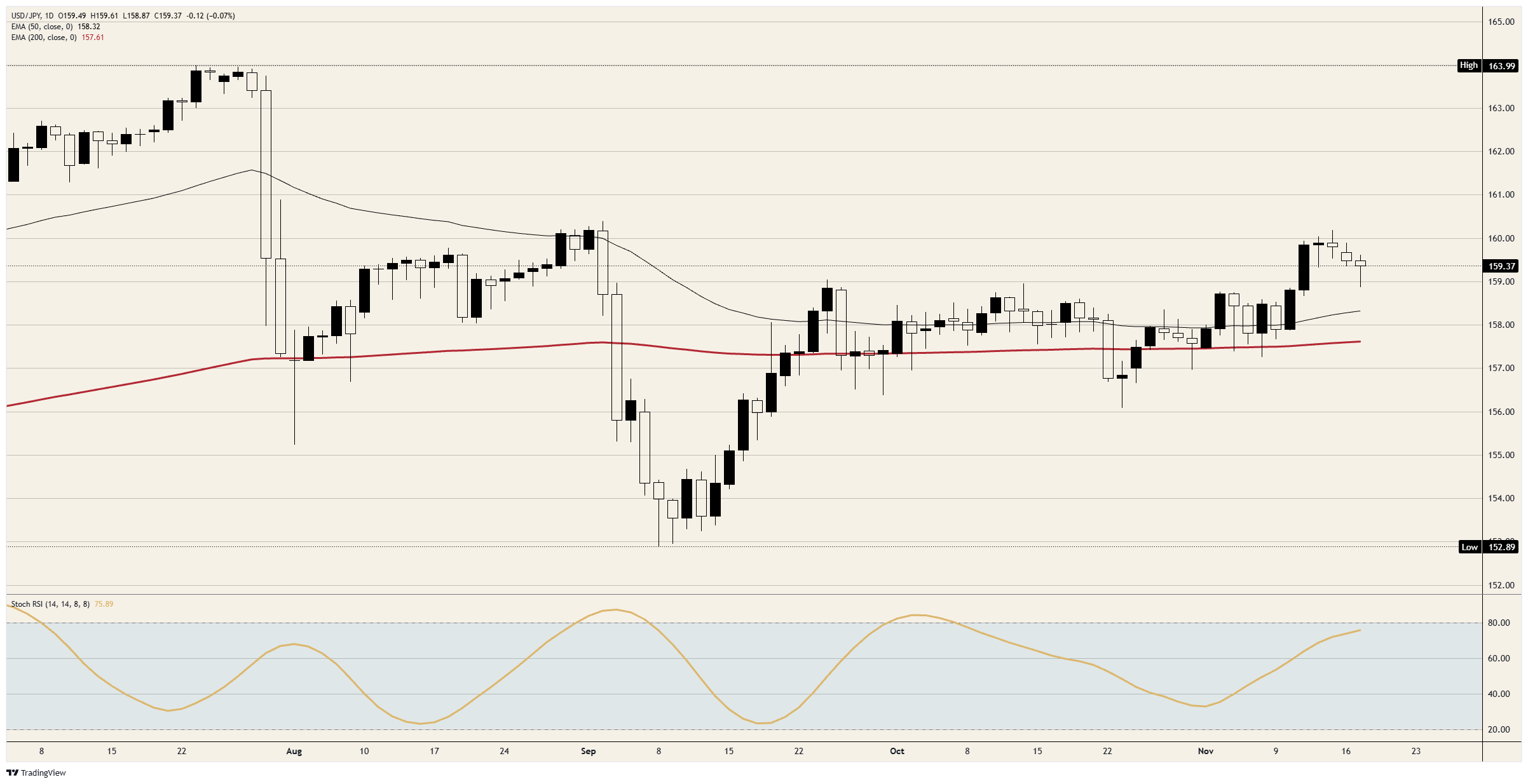
The Yen is gaining on the Dollar for a third session, and the first two came while the Dollar was rising against almost everything else. USD/JPY stalled at 160.00 on November 12 and 13, fell to just under 159.00 on Tuesday, and is trading just under 159.50.
Tokyo has warned against Yen selling since the pair reached 160.00, and Japan's finance ministry said it is watching one-sided moves and talking to the US Treasury. Tokyo bought Yen in late July, when the pair was near 164.00, and this time statements alone have kept every daily close under 160.00.
US stocks fell for a second session on Tuesday, and analysts at Brown Brothers Harriman said risk aversion was keeping USD/JPY below 160.00 and bringing haven buying to the Yen. Japan's economy shrank in the third quarter, and most economists still expect the Bank of Japan (BoJ) to raise its 1.25% rate on December 17-18. The Fed is priced to raise its 3.75%-4.00% rate nine days earlier, so a quarter-point from each leaves the gap at 2.50-2.75 percentage points.
On the calendar
Japan's October trade figures are due at 23:50 GMT on Tuesday, with exports forecast up 20% from a year earlier, after 16.7%, and imports up 25.8%, after 18.9%. National inflation for October follows at 23:30 GMT on Thursday, with the rate excluding fresh food forecast at 2.3% after 2.1%. Both feed into the BoJ's December 17-18 meeting.
The Fed publishes its October minutes at 19:00 GMT on Wednesday, and Fed Governor Waller speaks on Friday at 13:25 GMT. A December Fed hike is priced near 96%, so both bear mostly on whether traders add a second.
On the charts
USD/JPY rose from just under 158.00 on November 10 to its November 13 high, then gave back about a third of that. Tuesday's low was the lowest since November 11, and the pair has recovered most of the session's drop. The 50-day Exponential Moving Average (EMA) has risen to just under 158.50, above the 200-day just above 157.50.
USD/JPY daily chart
Japanese Yen FAQs
The Japanese Yen (JPY) is one of the world’s most traded currencies. Its value is broadly determined by the performance of the Japanese economy, but more specifically by the Bank of Japan’s policy, the differential between Japanese and US bond yields, or risk sentiment among traders, among other factors.
One of the Bank of Japan’s mandates is currency control, so its moves are key for the Yen. The BoJ has directly intervened in currency markets sometimes, generally to lower the value of the Yen, although it refrains from doing it often due to political concerns of its main trading partners. The BoJ ultra-loose monetary policy between 2013 and 2024 caused the Yen to depreciate against its main currency peers due to an increasing policy divergence between the Bank of Japan and other main central banks. More recently, the gradually unwinding of this ultra-loose policy has given some support to the Yen.
Over the last decade, the BoJ’s stance of sticking to ultra-loose monetary policy has led to a widening policy divergence with other central banks, particularly with the US Federal Reserve. This supported a widening of the differential between the 10-year US and Japanese bonds, which favored the US Dollar against the Japanese Yen. The BoJ decision in 2024 to gradually abandon the ultra-loose policy, coupled with interest-rate cuts in other major central banks, is narrowing this differential.
The Japanese Yen is often seen as a safe-haven investment. This means that in times of market stress, investors are more likely to put their money in the Japanese currency due to its supposed reliability and stability. Turbulent times are likely to strengthen the Yen’s value against other currencies seen as more risky to invest in.
Author
Joshua Gibson
FXStreet
Joshua joins the FXStreet team as an Economics and Finance double major from Vancouver Island University with twelve years' experience as an independent trader focusing on technical analysis.

















