XAU/USD slips back as the post-Powell bounce fades
- The Fed held the federal funds rate at 3.50% to 3.75% in the most divided FOMC vote since October 1992.
- Powell said the energy surge had not yet peaked and wanted to see energy and tariffs end before cuts.
- Powell flagged that the easing bias could be removed as early as the next meeting, lifting the US Dollar.
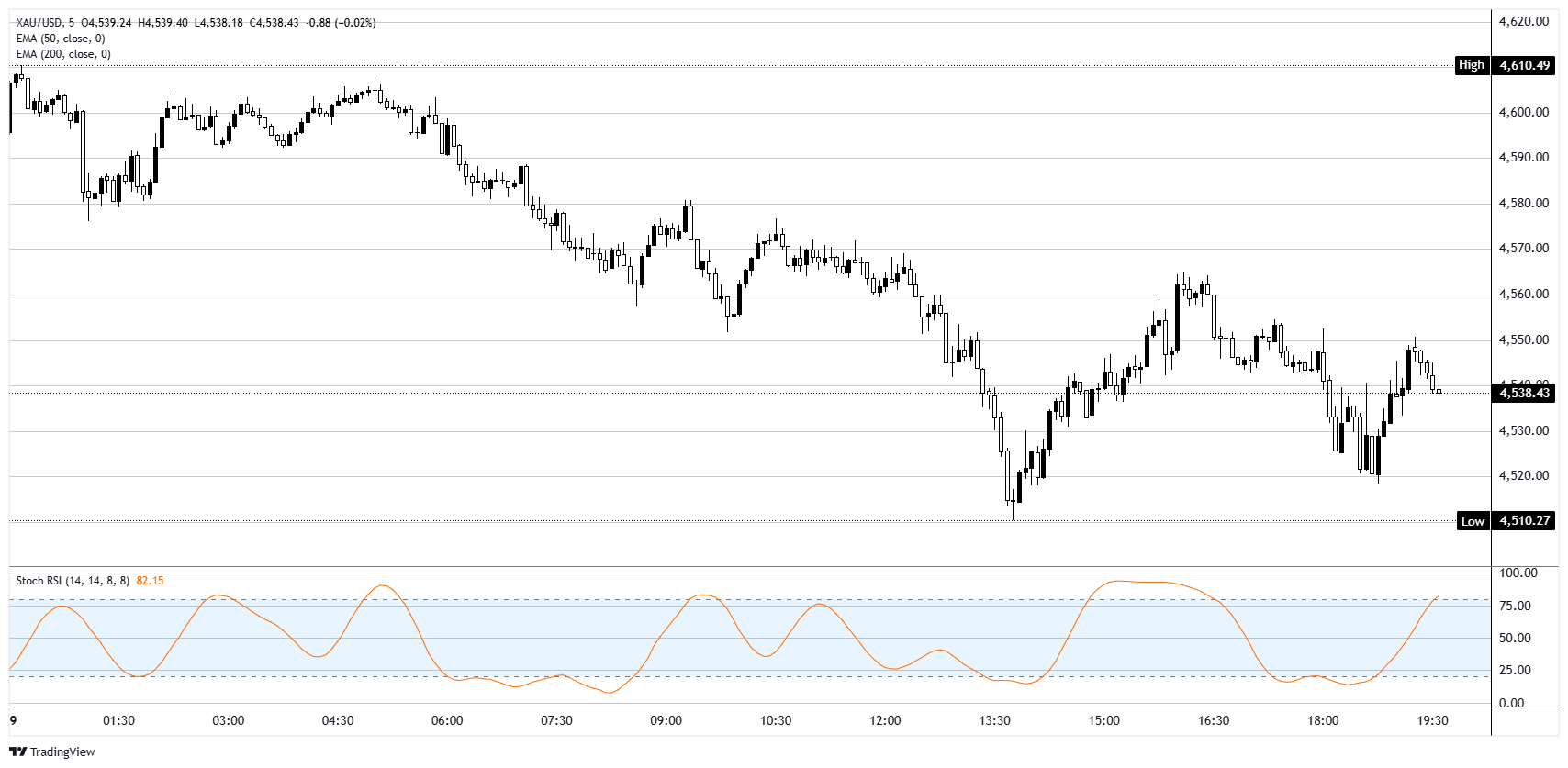
XAU/USD declined around 1.6% on Wednesday, falling from a session high near $4,610 to a session low of about $4,510 around the FOMC decision, then recovering to roughly $4,565 during Jerome Powell's press conference before slipping back to retest the $4,520 area and currently trading close to $4,534. The session showed a steady series of lower highs and lower lows into the rate decision, with the late-session price action carving a tentative basing pattern in a $4,520 to $4,560 corridor as the post-Powell bounce gave way to a second leg of selling.
The Federal Reserve (Fed) held the federal funds rate at 3.50% to 3.75% for a third consecutive meeting, sharpening its inflation language to "elevated" from "somewhat elevated" while citing higher global energy prices and a high level of uncertainty around Middle East developments. The 8-4 Federal Open Market Committee (FOMC) vote drew the most dissents since October 1992: Stephen Miran preferred a 25 basis points cut, while Beth Hammack, Neel Kashkari, and Lorie Logan voted to hold but opposed the easing bias added to the statement. Chair Powell described the decision as "a closer call than in March," said the energy price surge had not yet peaked, and noted that the number of officials seeing a hike as likely as a cut had moved up. Powell added that a shift away from the easing bias could come as early as the next meeting and that he wanted to see energy and tariff pressures end before any rate cuts, hawkish-tilted comments that lifted the US Dollar broadly and capped gold's intraday recovery into the close.
XAU/USD 5-minute chart
Gold FAQs
Gold has played a key role in human’s history as it has been widely used as a store of value and medium of exchange. Currently, apart from its shine and usage for jewelry, the precious metal is widely seen as a safe-haven asset, meaning that it is considered a good investment during turbulent times. Gold is also widely seen as a hedge against inflation and against depreciating currencies as it doesn’t rely on any specific issuer or government.
Central banks are the biggest Gold holders. In their aim to support their currencies in turbulent times, central banks tend to diversify their reserves and buy Gold to improve the perceived strength of the economy and the currency. High Gold reserves can be a source of trust for a country’s solvency. Central banks added 1,136 tonnes of Gold worth around $70 billion to their reserves in 2022, according to data from the World Gold Council. This is the highest yearly purchase since records began. Central banks from emerging economies such as China, India and Turkey are quickly increasing their Gold reserves.
Gold has an inverse correlation with the US Dollar and US Treasuries, which are both major reserve and safe-haven assets. When the Dollar depreciates, Gold tends to rise, enabling investors and central banks to diversify their assets in turbulent times. Gold is also inversely correlated with risk assets. A rally in the stock market tends to weaken Gold price, while sell-offs in riskier markets tend to favor the precious metal.
The price can move due to a wide range of factors. Geopolitical instability or fears of a deep recession can quickly make Gold price escalate due to its safe-haven status. As a yield-less asset, Gold tends to rise with lower interest rates, while higher cost of money usually weighs down on the yellow metal. Still, most moves depend on how the US Dollar (USD) behaves as the asset is priced in dollars (XAU/USD). A strong Dollar tends to keep the price of Gold controlled, whereas a weaker Dollar is likely to push Gold prices up.
Author

Joshua Gibson
FXStreet
Joshua joins the FXStreet team as an Economics and Finance double major from Vancouver Island University with twelve years' experience as an independent trader focusing on technical analysis.