Gold Price Forecast: XAU/USD pulls back amid cooling safe-haven demand
- Spot Gold flattened on Monday as easing Hormuz tensions moderate the fear premium.
- Gold has retreated from the spike high near 5,600, reached at the peak of the Strait of Hormuz supply shock, and is now consolidating close to the psychologically significant 5,000 level.
- The Fed's rate decision on Wednesday, alongside updated SEP projections, is the week's key event for Gold, with the rate path outlook directly influencing US Dollar strength and real yield dynamics.
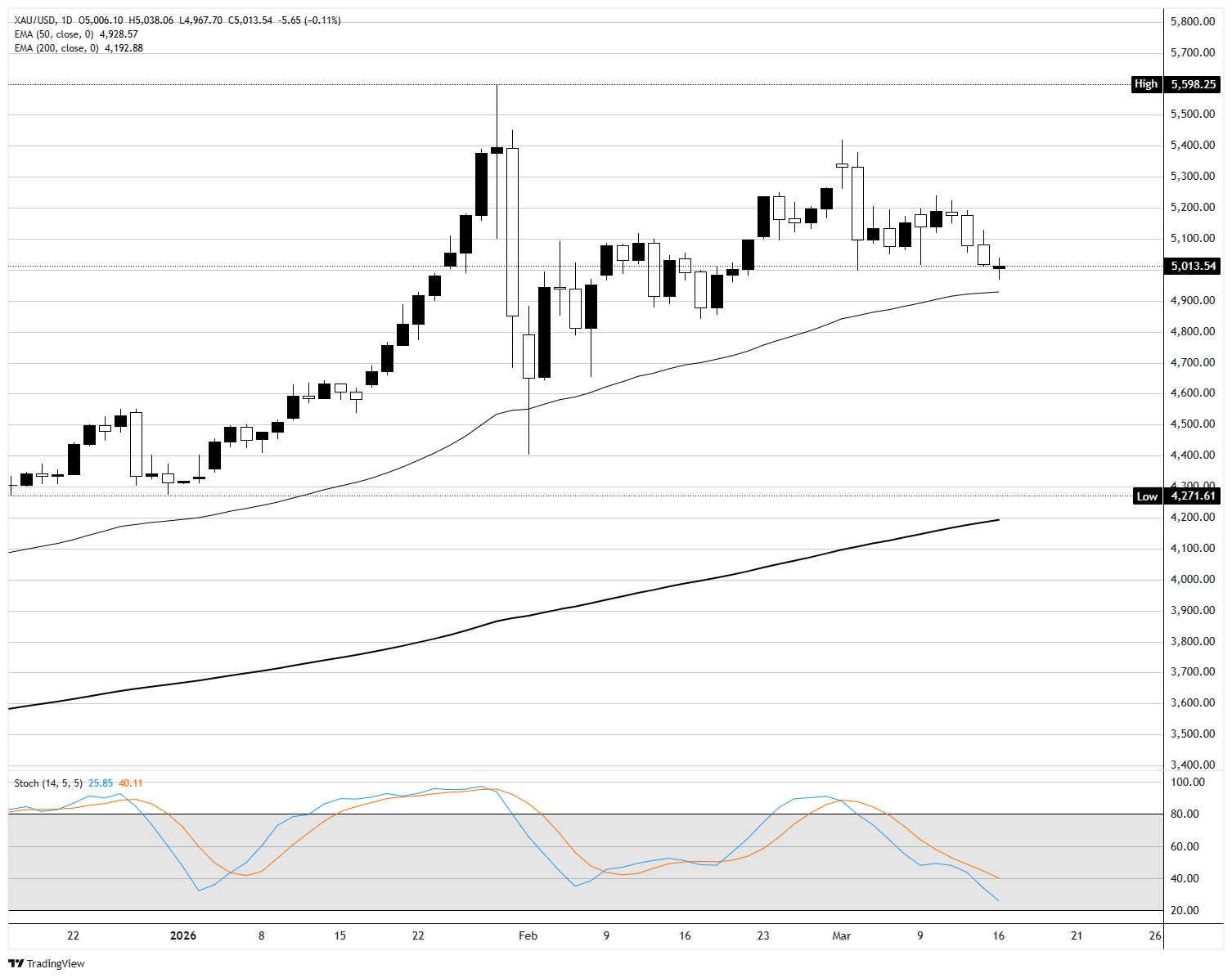
XAU/USD spun in a flat circle on Monday, settling close to 5,000 in a relatively contained session following last week's sharp decline from the highs. Gold has pulled back meaningfully from its spike high near 5,600, reached at the height of the Strait of Hormuz disruption, with the 5,000 round number now acting as the immediate psychological support. Monday's small-bodied candle at this level suggests the market is in a wait-and-see mode rather than committing to further selling.
Spot Gold's retreat from the 5,600 spike high reflects a gradual cooling of the fear premium that drove prices to record levels when the Strait of Hormuz closure removed a significant portion of global seaborne oil supply from the market. With diplomatic channels showing early signs of progress and the initial shock fading, safe-haven flows have moderated, applying downward pressure on Gold alongside falling crude prices. Central bank reserve buying and structural demand from Asian institutions continue to provide a floor, though the pace of inflows has slowed since the panic peak.
The Federal Reserve (Fed) rate decision on Wednesday is the key near-term catalyst, with markets expecting a hold at 3.75%. The accompanying SEP update and Chair Powell's press conference will be closely watched for any shift in the rate path, given the inflationary risk posed by elevated energy prices from the supply disruption. Higher-for-longer rate expectations would pressure Gold by lifting real yields and the US Dollar (USD), while any dovish signal could reignite the rally.
XAU/USD daily chart
Gold FAQs
Gold has played a key role in human’s history as it has been widely used as a store of value and medium of exchange. Currently, apart from its shine and usage for jewelry, the precious metal is widely seen as a safe-haven asset, meaning that it is considered a good investment during turbulent times. Gold is also widely seen as a hedge against inflation and against depreciating currencies as it doesn’t rely on any specific issuer or government.
Central banks are the biggest Gold holders. In their aim to support their currencies in turbulent times, central banks tend to diversify their reserves and buy Gold to improve the perceived strength of the economy and the currency. High Gold reserves can be a source of trust for a country’s solvency. Central banks added 1,136 tonnes of Gold worth around $70 billion to their reserves in 2022, according to data from the World Gold Council. This is the highest yearly purchase since records began. Central banks from emerging economies such as China, India and Turkey are quickly increasing their Gold reserves.
Gold has an inverse correlation with the US Dollar and US Treasuries, which are both major reserve and safe-haven assets. When the Dollar depreciates, Gold tends to rise, enabling investors and central banks to diversify their assets in turbulent times. Gold is also inversely correlated with risk assets. A rally in the stock market tends to weaken Gold price, while sell-offs in riskier markets tend to favor the precious metal.
The price can move due to a wide range of factors. Geopolitical instability or fears of a deep recession can quickly make Gold price escalate due to its safe-haven status. As a yield-less asset, Gold tends to rise with lower interest rates, while higher cost of money usually weighs down on the yellow metal. Still, most moves depend on how the US Dollar (USD) behaves as the asset is priced in dollars (XAU/USD). A strong Dollar tends to keep the price of Gold controlled, whereas a weaker Dollar is likely to push Gold prices up.
Author

Joshua Gibson
FXStreet
Joshua joins the FXStreet team as an Economics and Finance double major from Vancouver Island University with twelve years' experience as an independent trader focusing on technical analysis.