Why is the British Pound holding steady when the United Kingdom is facing a political transition?
The British Pound (GBP) is showing resilience against a backdrop of local political shifts and brewing fiscal questions. Back by steady economic growth and an attractive carry profile that continues to draw foreign inflows into UK Gilts, Sterling appears to have shrugged off domestic political noise.
While the Bank of England (BoE) maintains a cautious, restrictive posture despite ongoing disinflation, market participants are focusing on incoming political leadership and upcoming budget execution. Meanwhile, technical indicators suggest a modest near-term upward rebound, though broader dynamics point to a cap on extended gains.
Gilt inflows and steady BoE policy anchor the British Pound
Foreign exchange strategists at OCBC emphasize that the fundamental pillars supporting the British Pound remain intact. Despite a shifting political landscape – highlighted by prime ministerial candidate Andy Burnham’s pledges toward re-industrialisation and devolution – the currency is insulated by structural advantages.
The combination of supportive yield differentials and a central bank that is slow to ease monetary policy means that investors are prioritizing structural factors over near-term political headlines.
The GBP has proven resilient to local political developments and associated fiscal risks. Carry support from foreign inflows into gilts should be in place for longer, as the BoE remains reluctant to ease policy amid resilient growth – even with ongoing disinflation.
Short-term momentum picks up but faces heavy overhead resistance
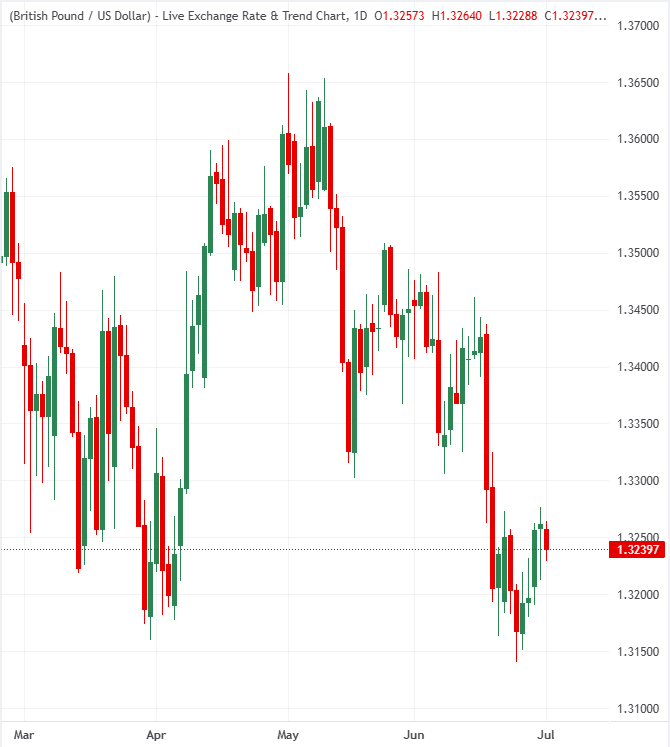
UOB highlights a subtle positive shift in short-term momentum for GBP/USD. While the pair has managed to reverse its previous downward bias over a multi-week horizon, technical structures indicate that the currency is approaching major overhead ceilings that will likely contain a rally.
We revised our view from negative to positive yesterday (...) We indicated that ‘there has been a build-up in momentum, but while GBP could rebound further, it is currently unclear whether any advance can reach 1.3355.’
Banks anticipate a range-bound trajectory for the Pound
The banks project a steady yet capped near-term trajectory for the British Pound, expecting the currency to consolidate its recent resilience. OCBC maintains a structurally neutral outlook, predicting a flat, range-bound path for crosses like EUR/GBP until concrete fiscal clarity emerges from the Autumn Budget. UOB expects the GBP/USD pair to experience a modest, technically driven rebound in the coming weeks, concluding that while minor tests of the 1.3275 level are likely, the broader advance will remain constrained below 1.3355 as long as critical support at 1.3180 holds.
(This article was created with the help of an Artificial Intelligence tool and reviewed by an editor.)
Author

FXStreet Insights Team
FXStreet
The FXStreet Insights Team is a group of journalists that handpicks selected market observations published by renowned experts. The content includes notes by commercial as well as additional insights by internal and external analysts.
















