USD/MXN dips as Mexican inflation moderates, as investors eye US inflation data
- Mexico’s inflation slows for the third consecutive month, prompting expectations of a pause in rate hikes.
- US debt ceiling issues and Federal Reserve speakers take the spotlight, impacting market sentiment.
- USD/MXN’s future direction may hinge on upcoming US inflation data, with a breach of key levels possible.

USD/MXN slides towards the 17.7000 area after a better-than-expected inflation report in Mexico could open the door for a pause on Mexico’s central bank. Although it’s usually a sign that should weaken the currency, falling US bond yields underpinned the USD/MXN pair, albeit the overall US Dollar (USD) strength. The USD/MXN is trading at 17.7687, down 0.17%.
Mexican Peso stays resilient despite inflation decline, warranting a pause for Mexico’s central bank
USD/MXN resumed its downtrend after INEGI reported that inflation in Mexico slowed for the third straight month in April to 6.25% from 6.85% YoY. The Consumer Price Index (CPI) in Mexico plunged 0.02% MoM, while the core CPI rose 0.39% MoM, while annually based stood at 7.67%.
The Bank of Mexico (Banxico’s) hiked rates 25 bps in the March meeting to 11.25% while opening the door for a pause. Today’s inflation report could pave the way for a pause in the May 18 meeting, as shown by a poll by Citibanmes, which showed that most market participants estimate Banxico to keep rates unchanged.
Aside from this, the US debt ceiling theme in the United States (US) is taking all the headlines. On Monday, the US Secretary of Treasury Janet Yellen said that the government would run out of cash by June 1, adding that it would be a “huge hit” adding that a default would have “tremendously adverse effects” on the financial markets.
Meanwhile, Federal Reserve speakers Jefferson and the New York (NY) Fed President Williams crossed newswires. Jefferson commented about the banking system and added that inflation is slowing down in an “orderly fashion” but omitted to speak regarding his posture for the next meeting. Contrarily, John Williams of the NY Fed said, “We haven’t said we are done,” increasing interest rates, emphasizing that the only change is that the US central bank would be data dependent.
Given the backdrop, further upside in the USD/MXN was warranted, but the release of inflation data in the United States (US) would determine the fate of the USD/MXN. If April’s US CPI exceeds estimates to the upside, the USD/MXN would be bolstered by expectations for further tightening by the Fed. Otherwise, the USD/MXN could print another leg down and challenge the current year-to-date (YTD) low of 17.7392, on its way toward the July 2017 low of 17.45.
USD/MXN Technical Analysis
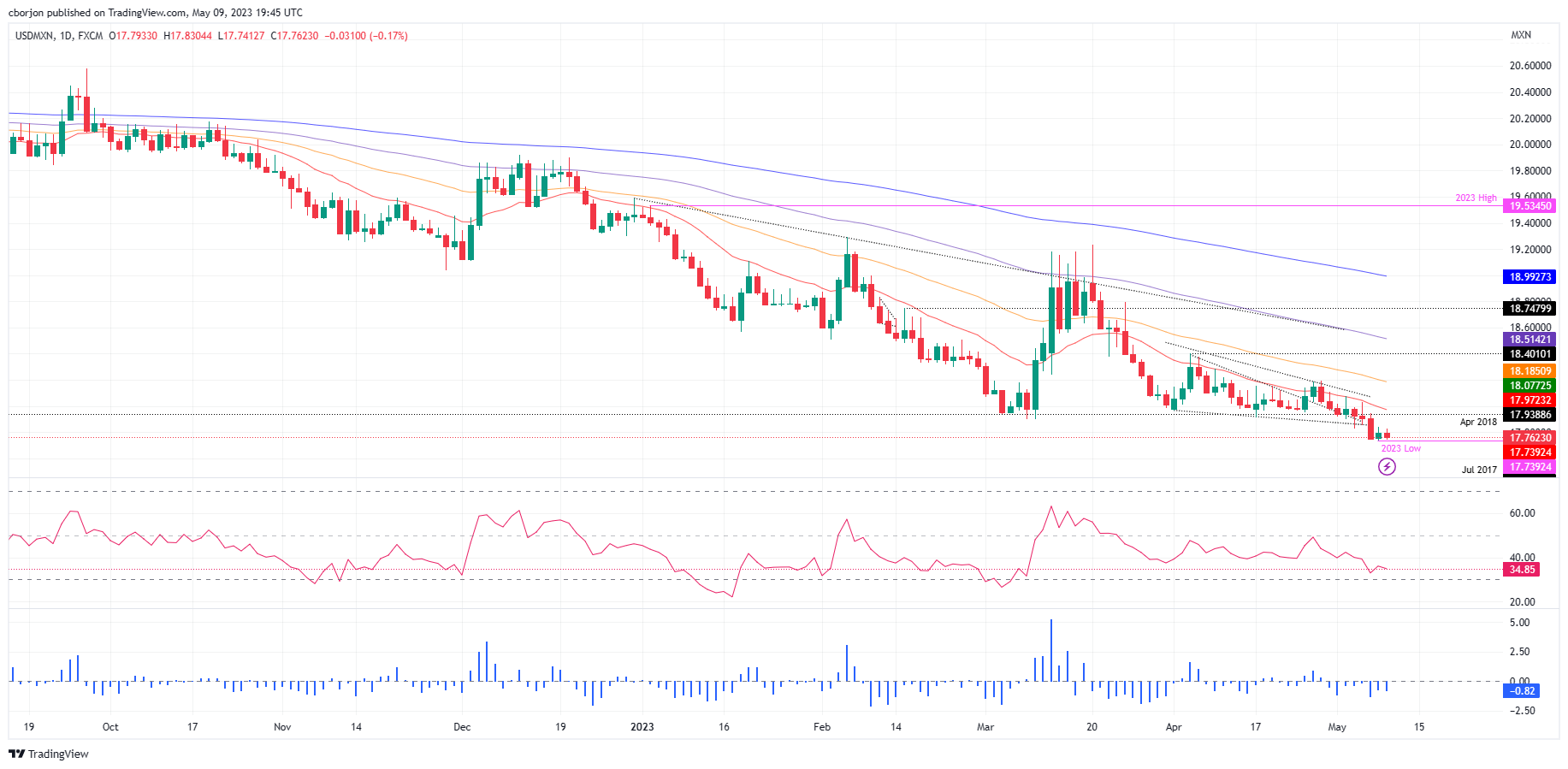
USD/MXN bounced off the YTD lows, printing a weekly high of 17.8404 before reversing its course. If USD/MXN buyers want to reclaim control, they must crack the 20-day EMA at 17.9722. A breach of the latter will expose the 18.00 handle, followed by the 50-day EMA at 18.1850, before posing a threat of the 100-day EMA At 18.5142. Conversely, USD/MXN could print a new six-year low beneath 17.7392, at around 17.50, followed by the July 2017 low.
Author

Christian Borjon Valencia
FXStreet
Markets analyst, news editor, and trading instructor with over 14 years of experience across FX, commodities, US equity indices, and global macro markets.
















