USD/JPY Price Forecast: Tests breakout region around 159.20 at the start of BoJ-Fed policy week
- USD/JPY falls back to near 159.20 as the US Dollar turns upside down.
- The US called off peace talks with Iran, which were expected over the weekend.
- The BoJ and the Fed are expected to leave interest rates unchanged this week.
The USD/JPY pair gives back its opening gains and trades marginally lower around 159.20 during the late Asian trading session on Monday. The pair surrenders early gains as the US Dollar (USD) turns upside down despite the United States (US)-Iran diplomacy remaining at a stalemate.
As of writing, the US Dollar Index (DXY), which tracks the Greenback’s value against six major currencies, is marginally lower to near 98.45.
The US-Iran peace talks, which were expected to resume in Islamabad over the weekend, were called off as Washington canceled the US envoys' visit, citing that it would be a waste of time as the counteroffer by Iran, received through Pakistan, is not good enough, Axios reported.
US President Donald Trump also confirmed that Iran has offered a new proposal, which is better than what it was going to present in peace talks, and “is much better, but still not good enough”.
On domestic fronts, investors await monetary policy announcements by both the Bank of Japan (BoJ) and the Federal Reserve (Fed) on Tuesday and Wednesday, respectively. Both central banks are expected to hold interest rates steady and warn of upside inflation risks and downside economic risks in the wake of higher energy prices.
USD/JPY technical analysis
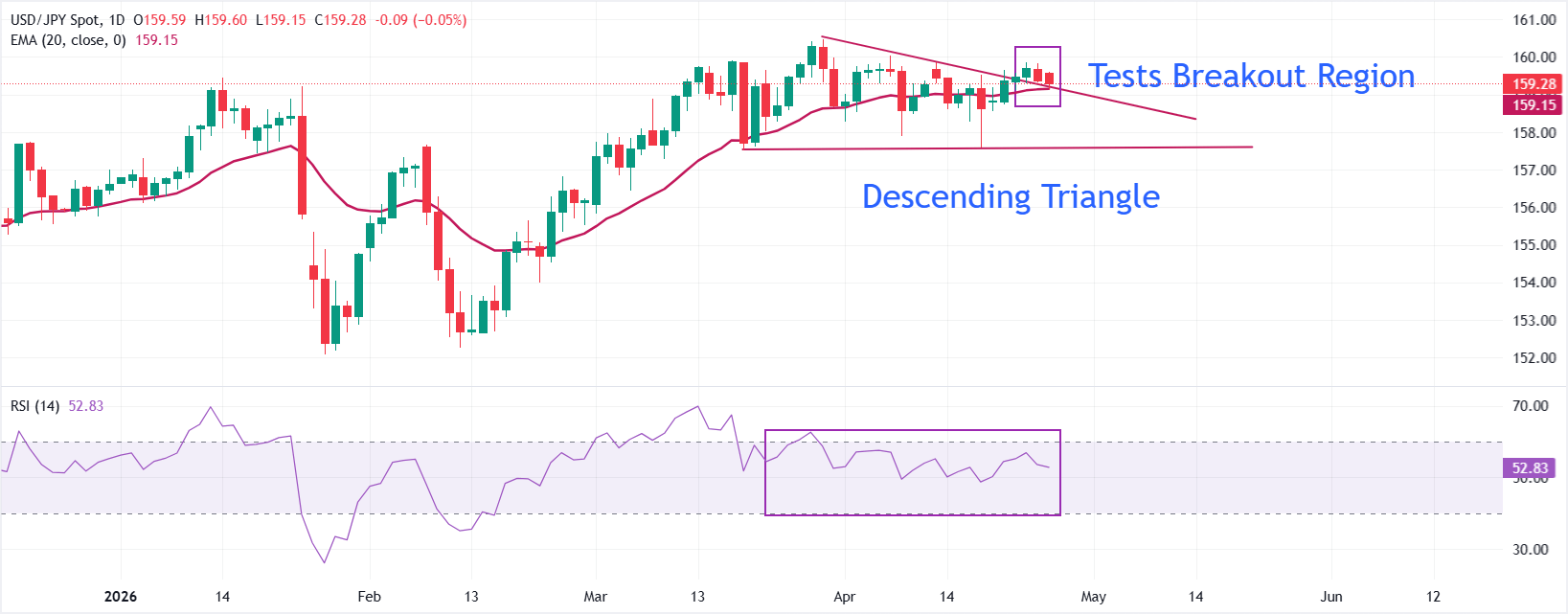
USD/JPY ticks down to near 159.20 in the Asian trade; however, the pair holds a constructive bullish bias as spot remains above the 20-day exponential moving average (EMA) at 159.14. The pair tests the breakout of the Descending Triangle formation on a daily timeframe near the downward-sloping border at around 159.20, which usually results in a fresh rally on the upside.
The Relative Strength Index (RSI) near 52 hints at neutral-to-slightly positive momentum rather than an overstretched rally.
On the downside, the reclaimed downward-sloping border around 159.17, aligning closely with the 20-day EMA at 159.14 is the immediate support; a break below that level would expose the horizontal support border of the above-mentioned chart pattern near 157.60.
Looking up, the pair could advance towards 160.00 if it manages to hold the above-mentioned downward-sloping border. A break above 160.00 would open the scope of further upside towards the March 30 high at 160.46.
(The technical analysis of this story was written with the help of an AI tool.)
Central banks FAQs
Central Banks have a key mandate which is making sure that there is price stability in a country or region. Economies are constantly facing inflation or deflation when prices for certain goods and services are fluctuating. Constant rising prices for the same goods means inflation, constant lowered prices for the same goods means deflation. It is the task of the central bank to keep the demand in line by tweaking its policy rate. For the biggest central banks like the US Federal Reserve (Fed), the European Central Bank (ECB) or the Bank of England (BoE), the mandate is to keep inflation close to 2%.
A central bank has one important tool at its disposal to get inflation higher or lower, and that is by tweaking its benchmark policy rate, commonly known as interest rate. On pre-communicated moments, the central bank will issue a statement with its policy rate and provide additional reasoning on why it is either remaining or changing (cutting or hiking) it. Local banks will adjust their savings and lending rates accordingly, which in turn will make it either harder or easier for people to earn on their savings or for companies to take out loans and make investments in their businesses. When the central bank hikes interest rates substantially, this is called monetary tightening. When it is cutting its benchmark rate, it is called monetary easing.
A central bank is often politically independent. Members of the central bank policy board are passing through a series of panels and hearings before being appointed to a policy board seat. Each member in that board often has a certain conviction on how the central bank should control inflation and the subsequent monetary policy. Members that want a very loose monetary policy, with low rates and cheap lending, to boost the economy substantially while being content to see inflation slightly above 2%, are called ‘doves’. Members that rather want to see higher rates to reward savings and want to keep a lit on inflation at all time are called ‘hawks’ and will not rest until inflation is at or just below 2%.
Normally, there is a chairman or president who leads each meeting, needs to create a consensus between the hawks or doves and has his or her final say when it would come down to a vote split to avoid a 50-50 tie on whether the current policy should be adjusted. The chairman will deliver speeches which often can be followed live, where the current monetary stance and outlook is being communicated. A central bank will try to push forward its monetary policy without triggering violent swings in rates, equities, or its currency. All members of the central bank will channel their stance toward the markets in advance of a policy meeting event. A few days before a policy meeting takes place until the new policy has been communicated, members are forbidden to talk publicly. This is called the blackout period.
Author

Sagar Dua
FXStreet
Sagar Dua is associated with the financial markets from his college days. Along with pursuing post-graduation in Commerce in 2014, he started his markets training with chart analysis.