USD/CAD Price Forecast: Downside bias holds as BoC interest rate decision looms
- USD/CAD trades with a mild downside bias ahead of the BoC interest rate decision.
- Technically, USD/CAD holds a bearish near-term bias below key moving averages.
- Momentum indicators remain weak, with RSI in the low-40s and MACD in negative territory.


USD/CAD trades with a mild downside bias on Wednesday ahead of the Bank of Canada’s (BoC) interest rate decision due at 13:45 GMT. At the time of writing, the pair is trading around 1.3672, with the Canadian Dollar (CAD) modestly outperforming its US counterpart as rising Oil prices offer support to the commodity-linked Loonie.
Meanwhile, the US Dollar (USD) is consolidating minor gains as traders also await the Federal Reserve’s (Fed) monetary policy announcement due later in the American session at 18:00 GMT. The US Dollar Index (DXY), which tracks the Greenback’s value against a basket of six major currencies, is trading around 98.70.
Both the Fed and the BoC are widely expected to keep interest rates unchanged as policymakers assess the impact of rising energy prices on inflation expectations. The focus will be on forward guidance. Any signal that the BoC remains open to rate hikes could support the Canadian Dollar, while the Fed’s stance will influence the US Dollar’s direction.
Against this backdrop, the upcoming policy decisions are likely to drive volatility and near-term moves in USD/CAD, with markets also closely monitoring developments in US-Iran tensions.
Technical Analysis:
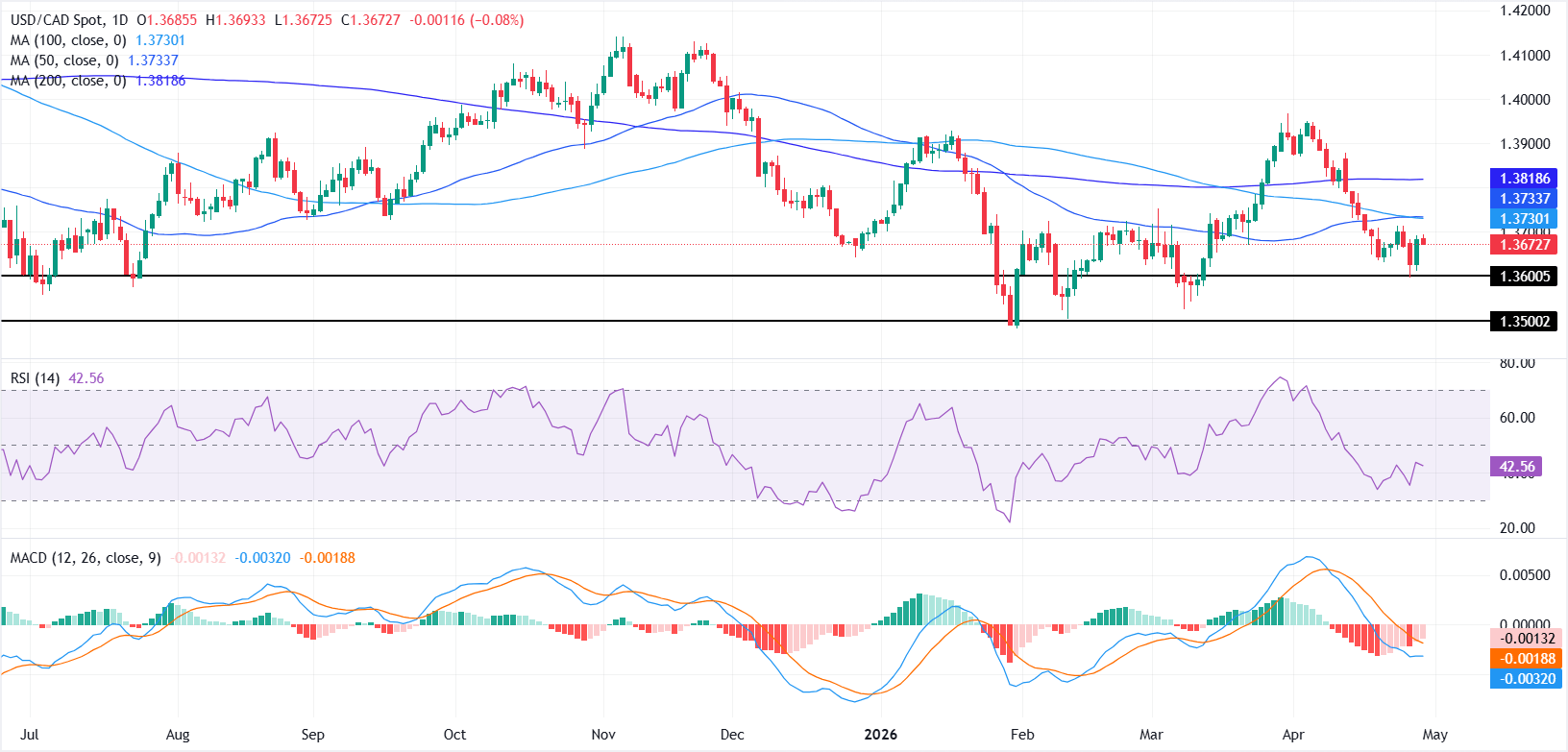
In the daily chart, USD/CAD maintains a bearish near-term tone as it holds beneath a cluster of moving averages. The 100-day and 50-day Simple Moving Averages (SMAs) around 1.3730-1.3733 sit overhead as immediate resistance, while the 200-day SMA near 1.3818 further reinforces the topside cap. Momentum indicators align with this soft structure, with the Relative Strength Index (RSI) hovering in the low-40s and the Moving Average Convergence Divergence (MACD) remaining in negative territory, suggesting lingering downside pressure despite the pair stabilizing above recent lows.
On the downside, initial support emerges at the horizontal level near 1.3600, ahead of a deeper floor around 1.3500, which would come into focus if sellers regain control. On the topside, bulls would need to reclaim the 100-day SMA at 1.3730 first, followed closely by the 50-day SMA at 1.3733, to ease the current bearish bias; a sustained break above these levels could then expose the 200-day SMA near 1.3820 as the next resistance hurdle.
(The technical analysis of this story was written with the help of an AI tool.)
Economic Indicator
BoC Interest Rate Decision
The Bank of Canada (BoC) announces its interest rate decision at the end of its eight scheduled meetings per year. If the BoC believes inflation will be above target (hawkish), it will raise interest rates in order to bring it down. This is bullish for the CAD since higher interest rates attract greater inflows of foreign capital. Likewise, if the BoC sees inflation falling below target (dovish) it will lower interest rates in order to give the Canadian economy a boost in the hope inflation will rise back up. This is bearish for CAD since it detracts from foreign capital flowing into the country.
Read more.Next release: Wed Apr 29, 2026 13:45
Frequency: Irregular
Consensus: 2.25%
Previous: 2.25%
Source: Bank of Canada
Author
Vishal Chaturvedi
FXStreet
I am a macro-focused research analyst with over four years of experience covering forex and commodities market. I enjoy breaking down complex economic trends and turning them into clear, actionable insights that help traders stay ahead of the curve.