USD/CAD edged lower as inflation cools down in Canada, US Retail Sales softened
- Canadian inflation drops to a 27-month low, relieving pressure on the Bank of Canada following last week’s rate hike.
- US data releases show weaker-than-expected retail sales and a significant drop in industrial production.
- Lower inflation in Canada may open the path for USD/CAD upside, with a 20% chance of a BoC rate hike in September.

USD/CAD edges lower after data from Canada and the United States (US) put buyers and sellers in a tug-of-war, with the latter getting the upper hand, as the major prints modest losses of 0.05%. The USD/CAD is trading at 1.3192 at the time of writing., after hitting a daily high at 1.3243.
Underwhelming US Retail Sales and Industrial Production pressures the US Dollar
Statistics Canada revealed that inflation fell to a 27-month low, with the Consumer Price Index (CPI) for June jumped to 2.8% YoY, below estimates of 3%, less than May’s 3.4%. Regarding core CPI, figures came at 3.2%, less than estimates and May’s figures, of 3.2% and 3.7%, each, respectively, easing off pressure on the Bank of Canada (BoC), which lifted rates last week to 5% threshold, which stressed that if incoming data suggested further tightening, they could hike rates further.
In data across the border, US Retail Sales in the past month were more modest than expected, with a 0.2% increment rather than the projected 0.5%. The Core Retail Sales, excluding auto sales, also missed estimates, showing the same slight growth of 0.2%, failing to meet the benchmark of 0.3%.
Other data from the US Federal Reserve showed a noteworthy drop in Industrial Production. The monthly figures highlighted a decrease of -0.5% relative to the preceding month, a disappointing result compared to the predicted 0% growth. Year-over-year predictions had forecasted an increase of 1.1%, yet June’s data presented a shrinkage of -0.4%.
Following the data release, the USD/CAD rallied to a daily high at 1.3243 before making a U-turn that benefited the Canadian Dollar (CAD) bulls. They dragged the USD/CAD pair towards a daily low of 1.3167 before settling around current exchange rates.
The greenback has continued to recover some ground, as shown by the US Dollar Index (DXY). The DXY, which tracks the buck’s performance against a basket of six currencies, advances 0.13%, up at 100.017. Meanwhile, bond yields in the US and Canada are dropping, with the 10-year benchmark note rate sitting at 3.781%, down three bps in the US, while the Canadian 10-year bond yield sits at 3.360%, down four bps.
Given the fundamental backdrop, softer inflation data in Canada could pave the way for USD/CAD upside, as odds stand at a 20% chance the Bank of Canada (BoC) would raise rates 25 bps at the September 6 meeting. Contrarily, the Federal Reserve would hike 25 bps at the upcoming July meeting, with officials reiterating that an additional increase would be needed.
USD/CAD Price Analysis: Technical outlook
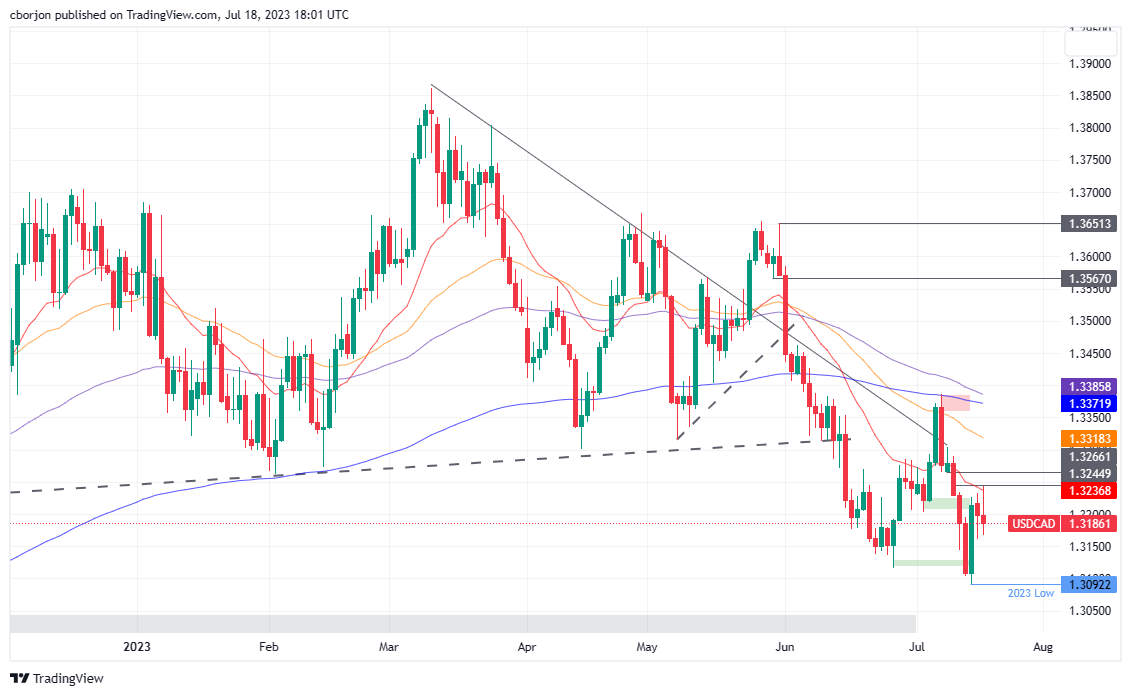
From a technical standpoint, the USD/CAD remains tilted to the downside, set to test initially the June 27 daily low of 1.3116 after USD/CAD sellers claimed the 1.3200 figure. IF USD/CAD drops below 1.3150, the next stop would be the June 27 low, followed by the YTD low of 1.3092. Conversely, if USD/CAD buyers reclaim 1.3200, that will expose the 20-day Exponential Moving Average (EMA) at 1.3237, followed by the 1.3250 psychological level.
Author

Christian Borjon Valencia
FXStreet
Markets analyst, news editor, and trading instructor with over 14 years of experience across FX, commodities, US equity indices, and global macro markets.

















