US inflation data comes next for a Pound back above 1.31
- GBP/USD is back above 1.3100 after Monday's fall to its November 2025 low.
- UK services growth slows to a five-month low while Dollar buying eases.
- US PCE inflation is due Wednesday, with no BoE decision until December 17.


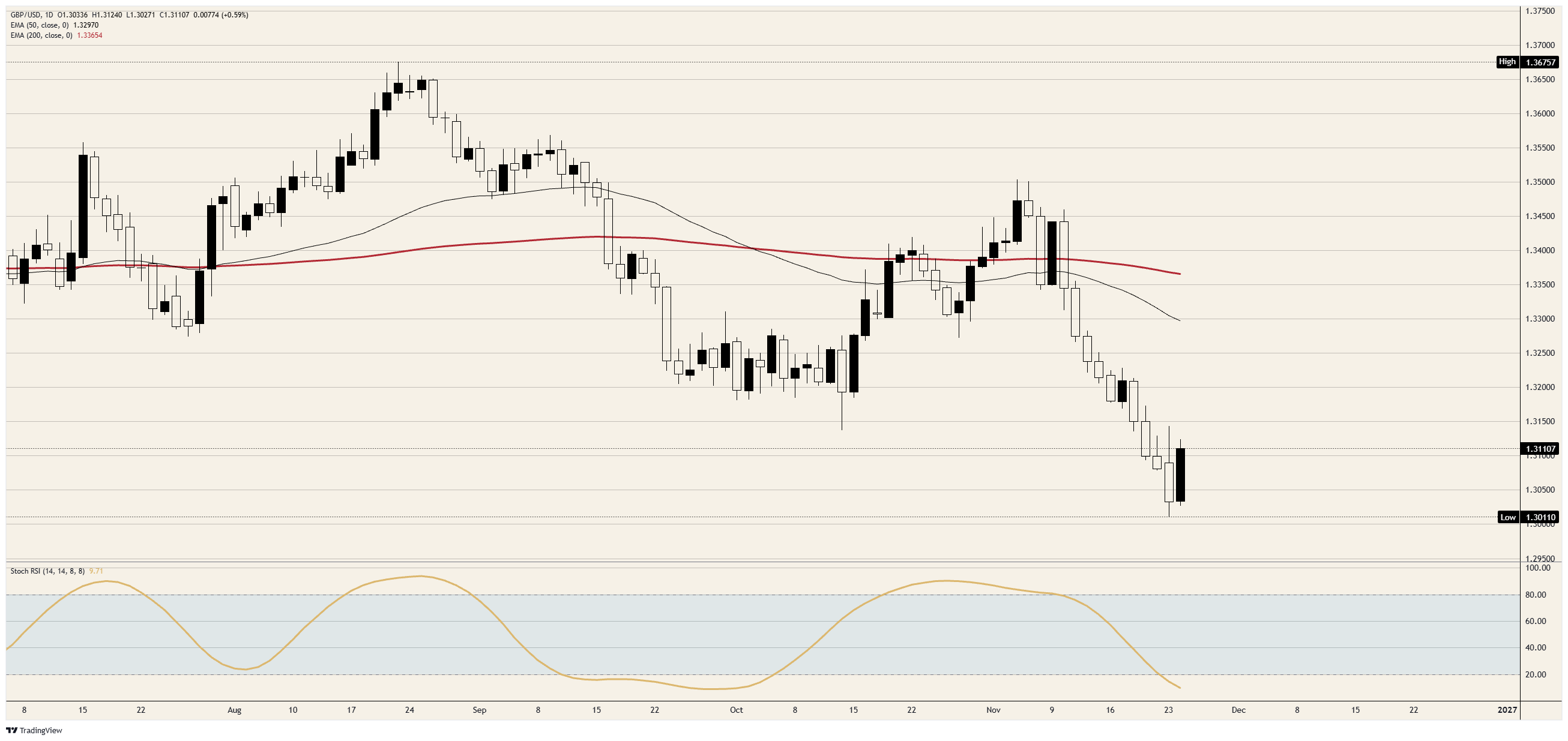
A three-week fall of about 500 pips stopped at the Pound's November 2025 low, and the bounce from it is back above 1.3100. The fall started from the November 4 high near 1.3500. GBP/USD dropped to just above 1.3000 on Monday, turned, and is now trading just above 1.3100.
The Dollar rose on Monday with US stocks after Nvidia (NVDA) brought back its chief executive, and it gave that back when artificial intelligence (AI) stocks sold off. Treasury Secretary Bessent also warned against excessive monetary tightening, and the Pound's move back above 1.3100 followed. A December 9 Fed hike is still priced above 95%, and New York Fed President Williams said on Monday that policy would need to adjust to bring inflation back to 2%.
UK flash surveys for November showed services growing at the slowest pace in five months and manufacturing output at its highest since August 2024. October retail sales rose 0.7%, and markets price at least two more Bank of England (BoE) hikes from the UK's Bank Rate of 4.00%. The Pound has followed the Dollar more closely than any of it.
On the calendar
Wednesday at 13:30 GMT brings October's Personal Consumption Expenditures Price Index (PCE), revised third-quarter Gross Domestic Product (GDP) and weekly jobless claims in one slot, and Thursday is the Thanksgiving holiday in the US. With a December Fed hike priced above 95%, the figures bear mostly on whether another follows in January. The BoE's next decision is on December 17, eight days after the Fed's, and UBS expects the next BoE hike in February.
On the charts
Monday's low and the November 2025 low are within a few pips of each other, and they're the two lowest points on a chart that starts in September 2025. The 50-day Exponential Moving Average (EMA) has dropped under 1.3300 and the 200-day is just under 1.3400. Daily momentum is oversold for the first time since early October.
GBP/USD daily chart
Pound Sterling FAQs
The Pound Sterling (GBP) is the oldest currency in the world (886 AD) and the official currency of the United Kingdom. It is the fourth most traded unit for foreign exchange (FX) in the world, accounting for 12% of all transactions, averaging $630 billion a day, according to 2022 data. Its key trading pairs are GBP/USD, also known as ‘Cable’, which accounts for 11% of FX, GBP/JPY, or the ‘Dragon’ as it is known by traders (3%), and EUR/GBP (2%). The Pound Sterling is issued by the Bank of England (BoE).
The single most important factor influencing the value of the Pound Sterling is monetary policy decided by the Bank of England. The BoE bases its decisions on whether it has achieved its primary goal of “price stability” – a steady inflation rate of around 2%. Its primary tool for achieving this is the adjustment of interest rates. When inflation is too high, the BoE will try to rein it in by raising interest rates, making it more expensive for people and businesses to access credit. This is generally positive for GBP, as higher interest rates make the UK a more attractive place for global investors to park their money. When inflation falls too low it is a sign economic growth is slowing. In this scenario, the BoE will consider lowering interest rates to cheapen credit so businesses will borrow more to invest in growth-generating projects.
Data releases gauge the health of the economy and can impact the value of the Pound Sterling. Indicators such as GDP, Manufacturing and Services PMIs, and employment can all influence the direction of the GBP. A strong economy is good for Sterling. Not only does it attract more foreign investment but it may encourage the BoE to put up interest rates, which will directly strengthen GBP. Otherwise, if economic data is weak, the Pound Sterling is likely to fall.
Another significant data release for the Pound Sterling is the Trade Balance. This indicator measures the difference between what a country earns from its exports and what it spends on imports over a given period. If a country produces highly sought-after exports, its currency will benefit purely from the extra demand created from foreign buyers seeking to purchase these goods. Therefore, a positive net Trade Balance strengthens a currency and vice versa for a negative balance.
Author
Joshua Gibson
FXStreet
Joshua joins the FXStreet team as an Economics and Finance double major from Vancouver Island University with twelve years' experience as an independent trader focusing on technical analysis.