Australia CPI seems likely to pose a headache for the RBA
- Australian Consumer Price Index is expected to have accelerated at the fastest annual pace in the last three years in October.
- Hot inflation pressures coupled with growing signs of economic slowdown are likely to pose a challenge for the Reserve Bank of Australia.
- The Australian Dollar is set for its sharpest monthly decline in years in November.


The Australian Bureau of Statistics (ABS) will publish October’s Consumer Price Index (CPI) on Wednesday at 00:30 GMT. The market consensus anticipates a sharp acceleration in consumer prices to a 4.8% year-over-year rate, which is the fastest level since the 4.9% seen in October 2023.
The report comes with the Australian Dollar (AUD) immersed in a sharp sell-off against the US Dollar (USD). The AUD/USD pair has depreciated nearly 6% in November, as investors ramp up bets on a steeper monetary tightening cycle by the US Federal Reserve (Fed), while the Reserve Bank of Australia (RBA) is seen done with hikes and set to cut rates at least once in 2027.
What to expect from Australia’s inflation rate data?
Against this background, Wednesday’s CPI report might pose a headache for RBA policymakers. The central bank’s main goal is to keep inflation steady in the 2% to 3% range, and the expected 4.8% CPI would add pressure to tighten borrowing costs further, as the economic consequences of the five rate hikes delivered in 2026 start to arise.
Macroeconomic data released in previous weeks revealed that the Unemployment Rate rose to 4.9% in October, and that net employment fell by nearly 80K over the last two months, highlighting a fast deterioration of the labour market.
Beyond that, services and manufacturing activity contracted at their fastest pace in years in November, according to preliminary S&P Global Purchasing Managers' Index (PMI) data released earlier this week, altogether pointing out to weak Gross Domestic Product (GDP) growth in the last quarter of the year
Strategists at Rabobank argue that Australia now offers a “salient case study” of the risks associated with delayed action on inflation. They note that the RBA’s policy rate is “now 50bps above its peak during the Covid-19 inflation wave,” which they suggest may vindicate Fed Governor Lisa Cook’s warning that “failure to do enough to tackle inflation in the short term may necessitate a harsher response in the future.”
That said, Rabobank experts warn that the jobless rate is “now above the RBA’s estimate of the non-accelerating inflation rate of unemployment (NAIRU) and perilously close to triggering the Sahm Rule recession indicator,” underscoring mounting concerns that policy may be tipping from restrictive into overtight territory.
The RBA anticipated in its last monetary policy statement that inflation risks will remain skewed to the upside in the coming months, while “tighter monetary policy is expected to keep GDP growth below potential”. With this in mind, a strong inflation reading would only raise concerns about stagflation – an economic environment characterized by high consumer prices, declining growth, and rising unemployment – potentially putting additional pressure on the Aussie.
How could Australia’s Consumer Price Index report affect AUD/USD?
As previously mentioned, high inflation figures are likely to pose a serious challenge for RBA policymakers while, in this case, softer-than-expected CPI figures might be welcomed as a relief and provide limited support to the Aussie. And it will be limited because the reasons for the Australian Dollar’s sharp decline are not exclusively domestic.
The US Dollar has surged across the board over the last few weeks, boosted by bets of Fed monetary tightening, a trend that looks unlikely to reverse as long as US macroeconomic data keeps fuelling economic exceptionalism rhetoric.
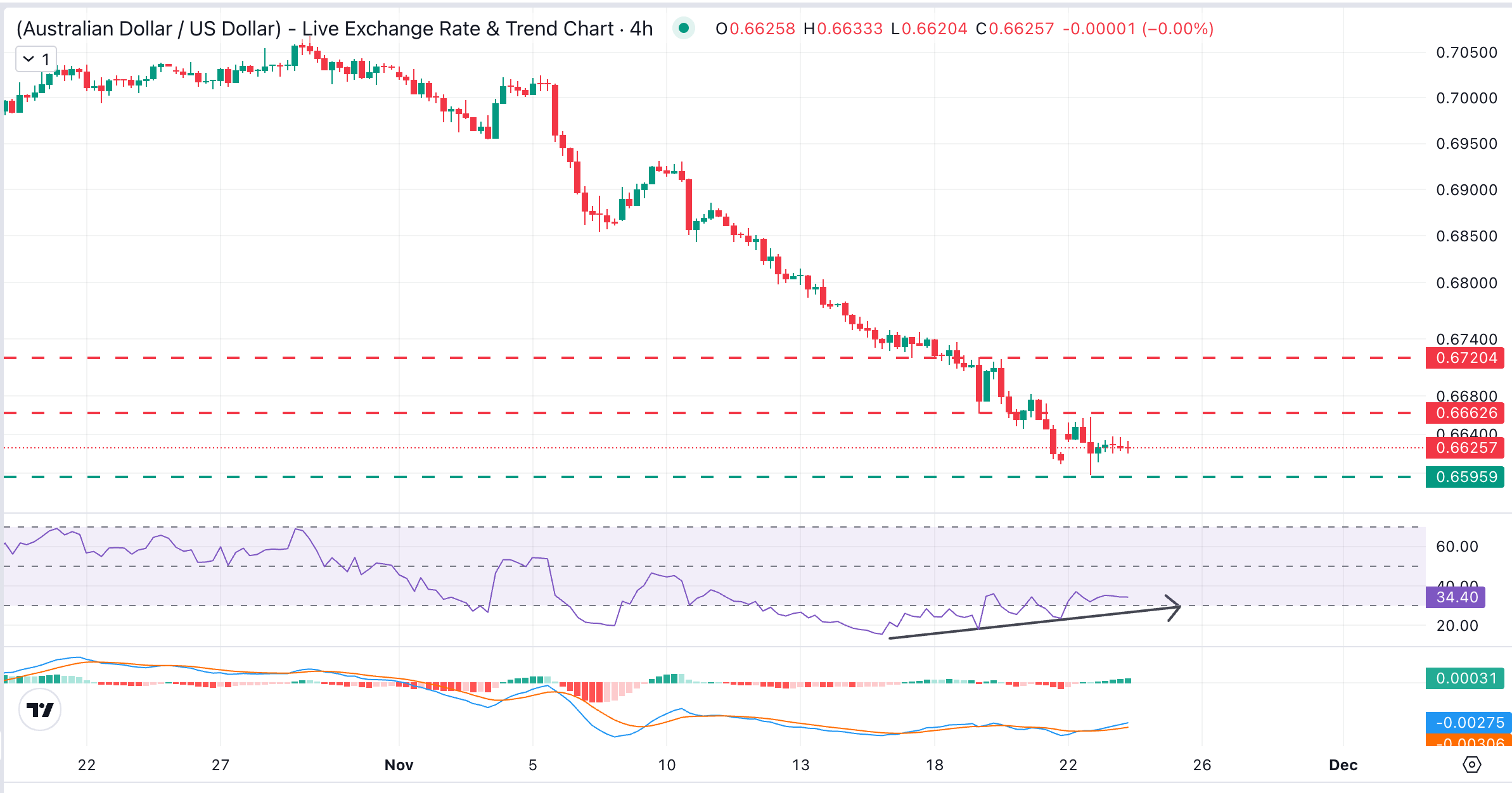
From a technical perspective, the AUD/USD shows an intense bearish trend, says Guillermo Alcalá, Forex analyst at FXStreet. “The pair has lost nearly 6% in November and 8.5% from September’s highs and is not showing any sign of an immediate trend reversal, except for the bullish divergence in the 4-hour Relative Strength Index (RSI)”, according to Alcalá.
Momentum indicators are mixed, with the RSI just above the oversold area, while the Moving Average Convergence Divergence (MACD) histogram has popped up above zero. Alcalá, however, observes that bulls “need solid reasons to gain the necessary confidence to break resistances at Monday’s high near 0.6560 and the November 19 high at 0.6720 before raising expectations of any significant recovery.
On the downside, the area below 0.6600 is holding bears for now. If this level finally gives way, Alcalá points out to the 0.6500 psychological level and the November 2025 lows near 0.6420 as the next bearish targets.
Inflation FAQs
Inflation measures the rise in the price of a representative basket of goods and services. Headline inflation is usually expressed as a percentage change on a month-on-month (MoM) and year-on-year (YoY) basis. Core inflation excludes more volatile elements such as food and fuel which can fluctuate because of geopolitical and seasonal factors. Core inflation is the figure economists focus on and is the level targeted by central banks, which are mandated to keep inflation at a manageable level, usually around 2%.
The Consumer Price Index (CPI) measures the change in prices of a basket of goods and services over a period of time. It is usually expressed as a percentage change on a month-on-month (MoM) and year-on-year (YoY) basis. Core CPI is the figure targeted by central banks as it excludes volatile food and fuel inputs. When Core CPI rises above 2% it usually results in higher interest rates and vice versa when it falls below 2%. Since higher interest rates are positive for a currency, higher inflation usually results in a stronger currency. The opposite is true when inflation falls.
Although it may seem counter-intuitive, high inflation in a country pushes up the value of its currency and vice versa for lower inflation. This is because the central bank will normally raise interest rates to combat the higher inflation, which attract more global capital inflows from investors looking for a lucrative place to park their money.
Formerly, Gold was the asset investors turned to in times of high inflation because it preserved its value, and whilst investors will often still buy Gold for its safe-haven properties in times of extreme market turmoil, this is not the case most of the time. This is because when inflation is high, central banks will put up interest rates to combat it. Higher interest rates are negative for Gold because they increase the opportunity-cost of holding Gold vis-a-vis an interest-bearing asset or placing the money in a cash deposit account. On the flipside, lower inflation tends to be positive for Gold as it brings interest rates down, making the bright metal a more viable investment alternative.
Economic Indicator
Consumer Price Index (YoY)
The Consumer Price Index (CPI), released by the Australian Bureau of Statistics on a monthly basis, measures the changes in the price of a comprehensive basket of goods and services acquired by household consumers. The indicator is the primary measure of headline inflation after a new methodology was applied to transition from quarterly to monthly readings, applying to data from April 2024 onwards. The YoY reading compares prices in the reference month to the same month a year earlier. A high reading is seen as bullish for the Australian Dollar (AUD), while a low reading is seen as bearish.
Read more.Next release: Wed Nov 25, 2026 00:30
Frequency: Monthly
Consensus: 4.8%
Previous: 4.3%
Source: Australian Bureau of Statistics
Author
FXStreet Team
FXStreet
Composed of a group of economic journalists and FX experts, the FXStreet content team produces and oversees all content published on FXStreet. It provides a purely journalistic approach to the Forex market.