US Dollar Index storms higher as Warsh's Fed trades cuts for hikes
- DXY rallied to a fresh session high after the June Federal Reserve decision.
- New projections flipped the 2026 rate path from a cut to a hike.
- Rate traders now price a possible Fed hike as soon as September.

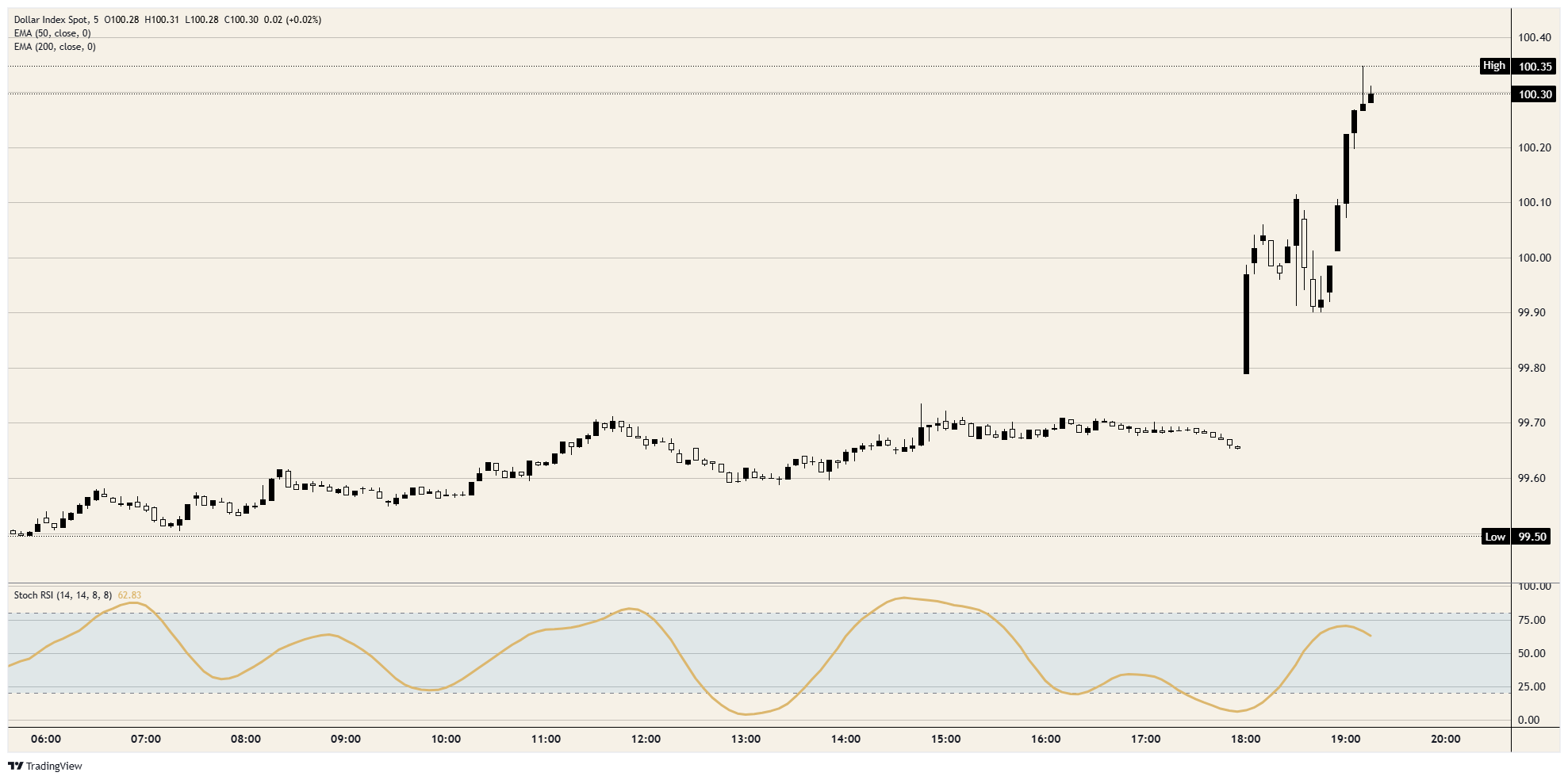
Kevin Warsh's first meeting as Federal Reserve (Fed) Chair held rates steady, exactly as expected, and then handed the Dollar one of its cleaner catalysts of the year. The US Dollar Index (DXY) had been grinding in the high 99.60s into the announcement and ripped through the 100.00 handle within minutes, printing a session high just above it and holding the breakout as the hawkish details landed.
A statement with the hedges removed
The Federal Open Market Committee (FOMC) kept the target range at 3.50% to 3.75%, but the vote and the language did the talking. The decision was unanimous at 12 to 0, a stark contrast to the four-way 8 to 4 split in April, and the easing bias was stripped out entirely. The reference to the timing of future adjustments vanished, replaced by a flat pledge to deliver price stability, while job gains were upgraded and policymakers flagged strong productivity and capital investment.
A dot plot that reversed
The Summary of Economic Projections (SEP) supplied the firepower. The median 2026 federal funds projection climbed to roughly 3.8% from 3.4% in March, lifting it a quarter point above the current rate and turning the next move from a cut into a hike. Behind it sat a startling inflation revision, with the median 2026 Personal Consumption Expenditures (PCE) projection vaulting to 3.6% from 2.7% and core marked up to 3.3%. That the forecast rose even as oil retreated on the new Iran deal told markets the Committee sees price pressure as broader than energy, and nearly half of policymakers now expect a hike this year.
Warsh sets his own terms
In his debut press conference Warsh moved quickly to stamp his authority, launching five task forces to review how the central bank conducts key operations, including the balance sheet. He pressed hardest on communication, saying he would not be surprised if the Fed adopts a new communications framework and reworks the SEP by year-end, a clear signal he wants the institution to step back from forward guidance. Having apparently left his own dot off the chart, Warsh underlined that the dot plot which just powered this Dollar move may not survive in its current form.
The hike clock starts ticking
Rate pricing repriced fast. According to the CME FedWatch tool, a hike by September is now roughly a coin flip, the probability climbs toward 60% by October, and about three quarters of traders see higher rates by December. With the nearest meetings treated as near-certain holds, the debate has shifted entirely to the timing of the first hike, a profound tailwind for a Dollar that spent much of the year braced for cuts.
Resistance: Having reclaimed 100.00, the index meets 100.50 next, with the 101.00 handle the broader objective should momentum carry the breakout further.
Support: The 100.00 handle now flips to first support, and only a slip back beneath it would throw the breakout into doubt and reopen the path toward 99.50.
Bias: Bullish. The Fed has swung firmly behind the Dollar, and pullbacks toward 100.00 look like buying opportunities while the projected rate path points higher rather than lower.
DXY 5-minute chart
US Dollar FAQs
The US Dollar (USD) is the official currency of the United States of America, and the ‘de facto’ currency of a significant number of other countries where it is found in circulation alongside local notes. It is the most heavily traded currency in the world, accounting for over 88% of all global foreign exchange turnover, or an average of $6.6 trillion in transactions per day, according to data from 2022. Following the second world war, the USD took over from the British Pound as the world’s reserve currency. For most of its history, the US Dollar was backed by Gold, until the Bretton Woods Agreement in 1971 when the Gold Standard went away.
The most important single factor impacting on the value of the US Dollar is monetary policy, which is shaped by the Federal Reserve (Fed). The Fed has two mandates: to achieve price stability (control inflation) and foster full employment. Its primary tool to achieve these two goals is by adjusting interest rates. When prices are rising too quickly and inflation is above the Fed’s 2% target, the Fed will raise rates, which helps the USD value. When inflation falls below 2% or the Unemployment Rate is too high, the Fed may lower interest rates, which weighs on the Greenback.
In extreme situations, the Federal Reserve can also print more Dollars and enact quantitative easing (QE). QE is the process by which the Fed substantially increases the flow of credit in a stuck financial system. It is a non-standard policy measure used when credit has dried up because banks will not lend to each other (out of the fear of counterparty default). It is a last resort when simply lowering interest rates is unlikely to achieve the necessary result. It was the Fed’s weapon of choice to combat the credit crunch that occurred during the Great Financial Crisis in 2008. It involves the Fed printing more Dollars and using them to buy US government bonds predominantly from financial institutions. QE usually leads to a weaker US Dollar.
Quantitative tightening (QT) is the reverse process whereby the Federal Reserve stops buying bonds from financial institutions and does not reinvest the principal from the bonds it holds maturing in new purchases. It is usually positive for the US Dollar.
Author

Joshua Gibson
FXStreet
Joshua joins the FXStreet team as an Economics and Finance double major from Vancouver Island University with twelve years' experience as an independent trader focusing on technical analysis.