United States Dollar Index rebounds following Israeli airstrikes, Jobless Claims eyed
- US Dollar Index gains support after an Israeli airstrike in Lebanon raised geopolitical concerns.
- Headwinds from an Iran-Oman shipping deal and weak ADP payrolls limit further Dollar upside.
- Fed’s Cook signaled hawkish concern over entrenched inflation, scoring 7.2/10 on the FXS Speechtracker versus a 6.5 average.

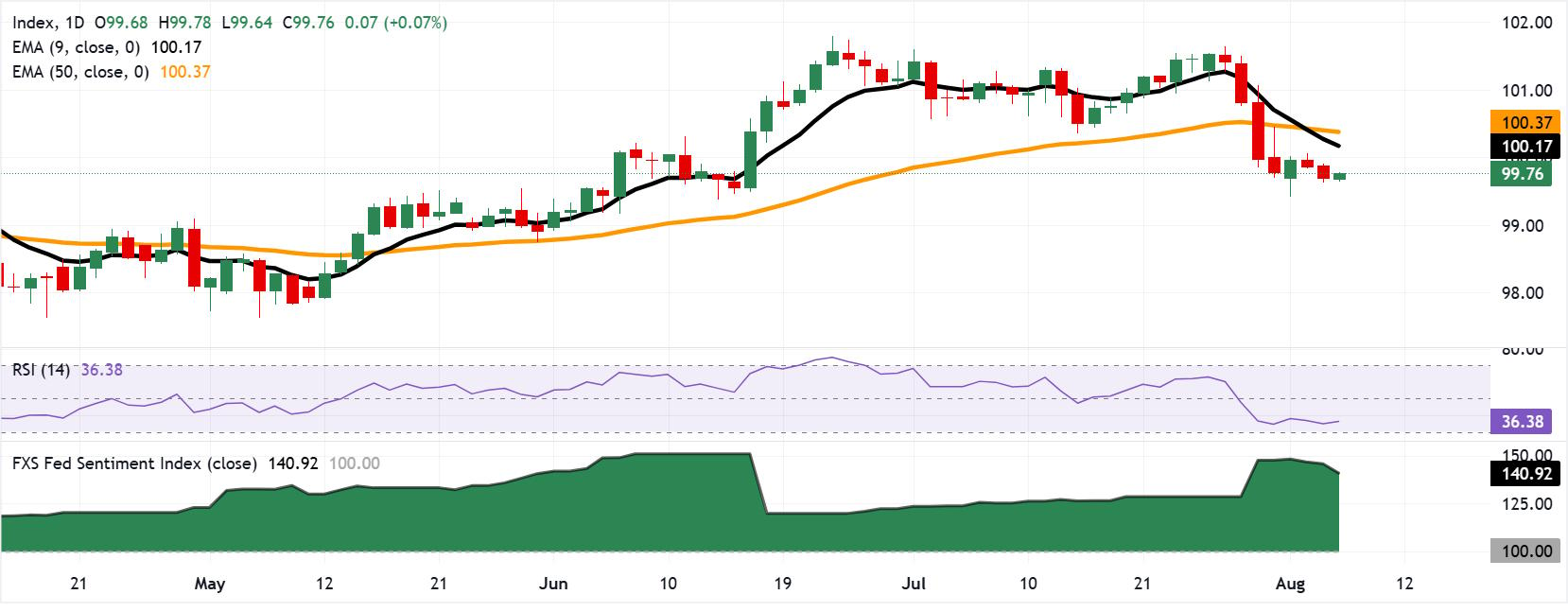
The US Dollar Index (DXY), which measures the value of the US Dollar (USD) against six major currencies, is holding gains after two days of losses and trading around 99.80 during the European session on Thursday.
The Greenback found renewed support from safe-haven demand following an Israeli airstrike in southern Lebanon. Marking one of Israel's deadliest bombings since the June ceasefire took effect, the attack killed one person and injured 11. However, the US Dollar could face potential headwinds as markets digest news of a pending maritime agreement between Iran and Oman. The two nations are finalizing a joint statement establishing a temporary two-to-four-month shipping route through the Strait of Hormuz, aimed at increasing Middle Eastern energy flows.
On the economic front, US macro indicators delivered mixed results. ADP private-sector payrolls expanded by just 44,000 in July, a steep slowdown from June's revised 95,000 and well below the 70,000-consensus forecast. Conversely, the ISM Services PMI pointed to steady momentum, rising slightly to 54.1 from June's 54.0, though it fell just short of the expected 54.5. Investor attention now turns toward upcoming risk drivers, including Thursday's Initial Jobless Claims and Friday's key Nonfarm Payrolls (NFP) report.
Cook flags inflation risks but keeps rate hike option conditional
Fed Governor Lisa Cook delivers a moderately more forceful tone than the established baseline, with a 7.2/10 FXS Speechtracker score versus a 6.5/10 historical average, underscoring heightened concern that excessive inflation could become entrenched. The emphasis on inflation threats surpassing job market concerns, combined with a firm commitment to restoring price stability and readiness to hike rates if disinflation fails to reappear, tilts the speech hawkish even as Cook notes a resilient economy, sturdy labor market, and the possibility that further hikes may prove unnecessary. Overall, the message balances recognition of solid economic expansion with a clear warning that the Fed’s tolerance for renewed inflation pressures is limited.
The FXS Fed Sentiment Index fell by 1.93 points to 140.92, signaling a modest pullback in perceived hawkishness despite remaining firmly above the neutral 100 mark. This indicates that, while the latest remarks are still clearly in hawkish territory, the incremental tone relative to recent communications is slightly less aggressive, even as the FXS Speechtracker score shows Cook leaning more hawkish than the established baseline.
(This story was corrected on August 6 at 10:30 GMT to remove a paragraph containing strategists' quotes due to inconsistency.)
US Dollar FAQs
The US Dollar (USD) is the official currency of the United States of America, and the ‘de facto’ currency of a significant number of other countries where it is found in circulation alongside local notes. It is the most heavily traded currency in the world, accounting for over 88% of all global foreign exchange turnover, or an average of $6.6 trillion in transactions per day, according to data from 2022. Following the second world war, the USD took over from the British Pound as the world’s reserve currency. For most of its history, the US Dollar was backed by Gold, until the Bretton Woods Agreement in 1971 when the Gold Standard went away.
The most important single factor impacting on the value of the US Dollar is monetary policy, which is shaped by the Federal Reserve (Fed). The Fed has two mandates: to achieve price stability (control inflation) and foster full employment. Its primary tool to achieve these two goals is by adjusting interest rates. When prices are rising too quickly and inflation is above the Fed’s 2% target, the Fed will raise rates, which helps the USD value. When inflation falls below 2% or the Unemployment Rate is too high, the Fed may lower interest rates, which weighs on the Greenback.
In extreme situations, the Federal Reserve can also print more Dollars and enact quantitative easing (QE). QE is the process by which the Fed substantially increases the flow of credit in a stuck financial system. It is a non-standard policy measure used when credit has dried up because banks will not lend to each other (out of the fear of counterparty default). It is a last resort when simply lowering interest rates is unlikely to achieve the necessary result. It was the Fed’s weapon of choice to combat the credit crunch that occurred during the Great Financial Crisis in 2008. It involves the Fed printing more Dollars and using them to buy US government bonds predominantly from financial institutions. QE usually leads to a weaker US Dollar.
Quantitative tightening (QT) is the reverse process whereby the Federal Reserve stops buying bonds from financial institutions and does not reinvest the principal from the bonds it holds maturing in new purchases. It is usually positive for the US Dollar.
Author

Akhtar Faruqui
FXStreet
Akhtar Faruqui is a Forex Analyst based in New Delhi, India. With a keen eye for market trends and a passion for dissecting complex financial dynamics, he is dedicated to delivering accurate and insightful Forex news and analysis.














