United Kingdom CPI inflation cools to 2.8% YoY in April vs. 3.0% forecast

The United Kingdom (UK) headline Consumer Price Index (CPI) rose 2.8% over the year in April, compared to a rise of 3.3% in March, the data released by the Office for National Statistics (ONS) showed on Wednesday.
Markets predicted a 3.0% growth in the reported period. The UK inflation reading was well above the Bank of England’s (BoE) 2% inflation target.
The core CPI (excluding volatile food and energy items) climbed 2.5% year-over-year (YoY) in the same period, compared to March’s 3.1% print and came in softer than the forecast of 2.6%.
Meanwhile, the monthly UK CPI arrived at 0.7% in April versus a rise of 0.7% reported in March, below the market consensus of 0.9%.
GBP/USD reaction to the UK CPI inflation data
At the time of writing, the GBP/USD pair is trading 0.10% lower on the day to trade at 1.3381.
Pound Sterling Price Today
The table below shows the percentage change of British Pound (GBP) against listed major currencies today. British Pound was the weakest against the Japanese Yen.
| USD | EUR | GBP | JPY | CAD | AUD | NZD | CHF | |
|---|---|---|---|---|---|---|---|---|
| USD | 0.09% | 0.08% | -0.06% | 0.12% | 0.09% | 0.07% | 0.17% | |
| EUR | -0.09% | -0.02% | -0.17% | 0.02% | -0.01% | -0.01% | 0.07% | |
| GBP | -0.08% | 0.02% | -0.15% | 0.02% | -0.01% | 0.00% | 0.09% | |
| JPY | 0.06% | 0.17% | 0.15% | 0.18% | 0.14% | 0.14% | 0.23% | |
| CAD | -0.12% | -0.02% | -0.02% | -0.18% | -0.04% | -0.00% | 0.05% | |
| AUD | -0.09% | 0.01% | 0.01% | -0.14% | 0.04% | 0.00% | 0.11% | |
| NZD | -0.07% | 0.01% | -0.00% | -0.14% | 0.00% | -0.01% | 0.08% | |
| CHF | -0.17% | -0.07% | -0.09% | -0.23% | -0.05% | -0.11% | -0.08% |
The heat map shows percentage changes of major currencies against each other. The base currency is picked from the left column, while the quote currency is picked from the top row. For example, if you pick the British Pound from the left column and move along the horizontal line to the US Dollar, the percentage change displayed in the box will represent GBP (base)/USD (quote).
This section below was published at 05:25 GMT as a preview of the UK Consumer Price Index (CPI) inflation data.
- The annual UK headline inflation is seen easing in April despite an uptick in monthly inflation.
- The UK CPI data might provide some leeway for the BoE to keep interest rates unchanged in June.
- Bearish pressure on the Pound Sterling persists, and a higher-than-expected inflation reading could intensify it.
The United Kingdom (UK) Office for National Statistics (ONS) will publish the high-impact Consumer Price Index (CPI) data for March at 06:00 GMT.
With inflation pressure high on the agenda of the central banks, April’s CPI will be analysed by the market from a monetary policy perspective, providing further insight about the Bank of England’s (BoE) next steps. In that sense, any relevant deviation from the market consensus is likely to boost near-term volatility for the British Pound (GBP).
What to expect from the next UK inflation report?
The UK Consumer Price Index is expected to show that inflation softened to 3% year-over-year (YoY) in April, from the 3.3% level seen in March, although the monthly CPI growth is seen ticking up to 0.9% from 0.7% in the previous month.
The Ofgem energy price cap, which was lowered ahead of the Iran war, seems to have cushioned the impact of the energy shock, while the unwinding of the Easter effect in prices has contributed to taming inflationary pressures.
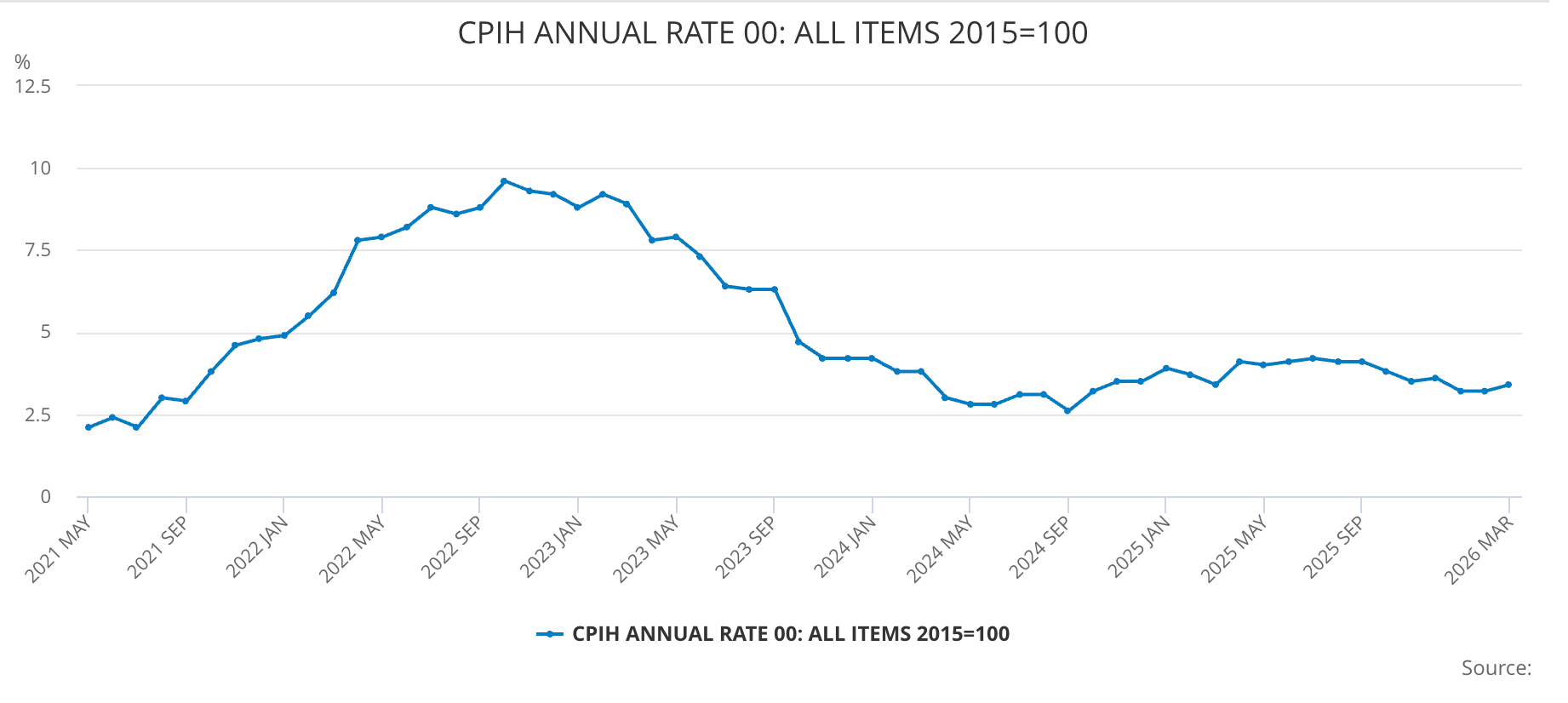
The Core CPI, which excludes energy, food, alcohol, and tobacco prices, is expected to show that price growth from all other goods slowed down to 2.6% YoY in April, the coolest rate since July 2021, contributing to the softer CPI numbers.
Together with consumer Inflation, the Office for National Statistics will also release April’s Producer Price Index (PPI) figures, which are expected to follow suit. The PPI Input is forecast to slow down to 1% from 4.4% in March, while the PPI Output is seen ticking up to a 1% yearly rate, from 0.9% in March.
The cooling inflation, if confirmed, is likely to ease pressures on the BoE to hike interest rates immediately, which will be good news considering the increasing unemployment figures released on Tuesday. The trend, however, is unlikely to be long-lasting. Ofgem will revise the energy price cap in July, triggering a significant increase in energy bills, which is likely to be reflected in the headline CPI. The Bank of England expects consumer inflation to peak at 4% later this year.
“Though temporarily comforting, the brunt of the energy price shock will then be felt in Q3 with a potential for second-round effects in the latter half of the year,” said analysts at TD Securities.
How will the UK Consumer Price Index report affect GBP/USD?
Inflation is a key issue for the BoE’s monetary policy and, in that sense, tends to have a significant impact on the British Pound. The GBP, however, is suffering from weaknesses of its own in May, amid the growing political uncertainty after the Labour Party’s debacle in the local elections, and is likely to act as a headwind for bulls.
Bearing that in mind, a soft inflation reading might provide some support to the Pound, as it would give the BoE more time to await domestic developments and to better assess the impact of the Middle East conflict before taking any decision on interest rates. BoE Deputy Governor for Financial Stability, Sarah Breeden, warned on Monday that “political uncertainty is hitting the business environment” and advised the bank against being “trigger happy” on rates.
An upside surprise on inflation, on the contrary, would put the BoE in a challenging situation, and might increase bearish pressure on the Pound in this case.
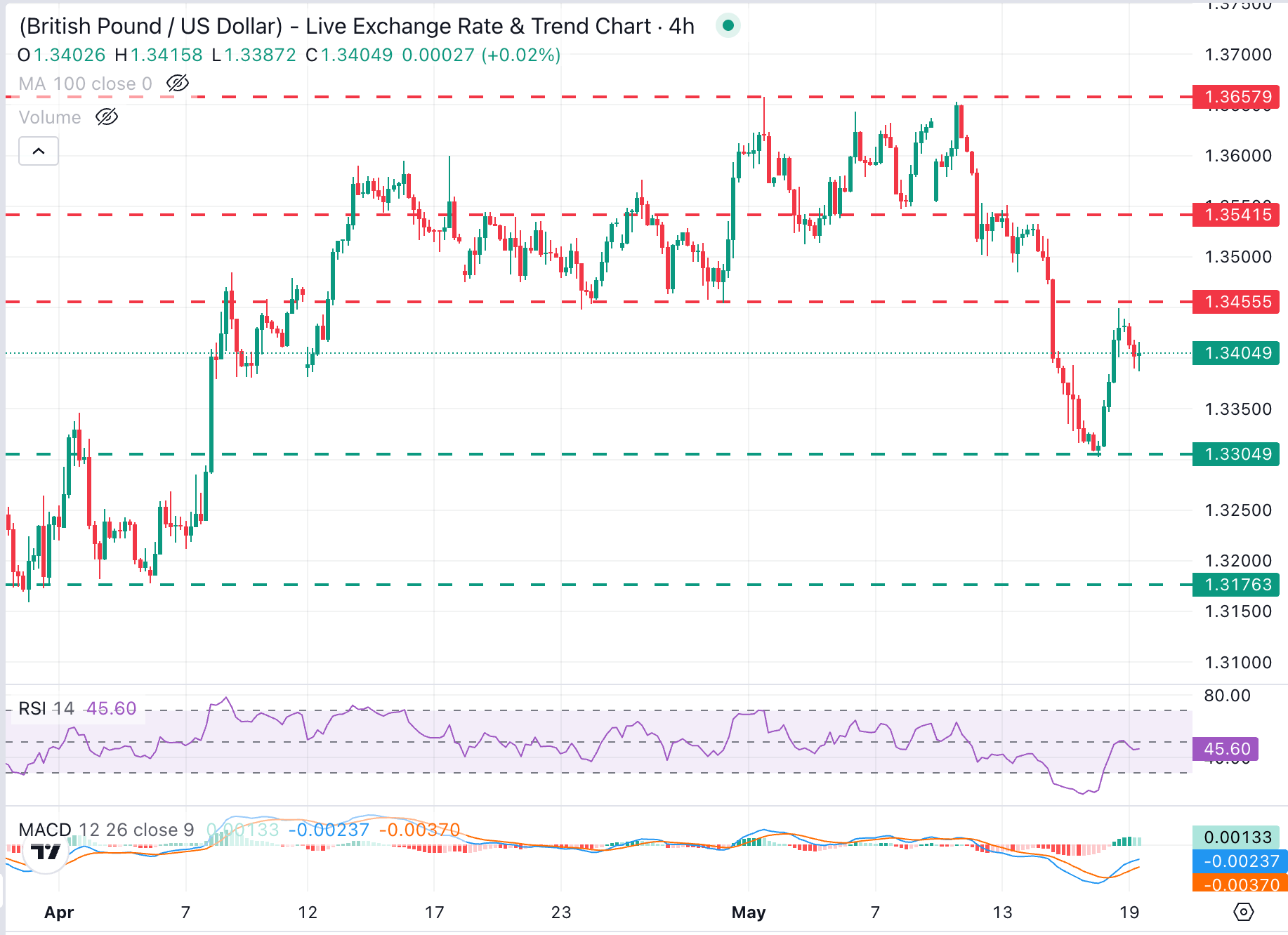
From a technical perspective, Guillermo Alcala, FX Analyst at FXStreet, sees the Pound on the defensive after last week’s sell-off: “The GBP’s near-term bias remains bearish even after Monday’s bullish engulfing candle in the daily chart has eased negative pressure. Bulls, however, seem to need additional impulse to break a previous support level at 1.3450 and shift the focus towards the mid-May highs in the 1.3530-1.3540 area.”
“On the downside, key support is at Monday’s lows at around 1.3305. A confirmation below that level would expose late March and early April highs in the area of 1.3175,” adds Alcalá.
BoE FAQs
The Bank of England (BoE) decides monetary policy for the United Kingdom. Its primary goal is to achieve ‘price stability’, or a steady inflation rate of 2%. Its tool for achieving this is via the adjustment of base lending rates. The BoE sets the rate at which it lends to commercial banks and banks lend to each other, determining the level of interest rates in the economy overall. This also impacts the value of the Pound Sterling (GBP).
When inflation is above the Bank of England’s target it responds by raising interest rates, making it more expensive for people and businesses to access credit. This is positive for the Pound Sterling because higher interest rates make the UK a more attractive place for global investors to park their money. When inflation falls below target, it is a sign economic growth is slowing, and the BoE will consider lowering interest rates to cheapen credit in the hope businesses will borrow to invest in growth-generating projects – a negative for the Pound Sterling.
In extreme situations, the Bank of England can enact a policy called Quantitative Easing (QE). QE is the process by which the BoE substantially increases the flow of credit in a stuck financial system. QE is a last resort policy when lowering interest rates will not achieve the necessary result. The process of QE involves the BoE printing money to buy assets – usually government or AAA-rated corporate bonds – from banks and other financial institutions. QE usually results in a weaker Pound Sterling.
Quantitative tightening (QT) is the reverse of QE, enacted when the economy is strengthening and inflation starts rising. Whilst in QE the Bank of England (BoE) purchases government and corporate bonds from financial institutions to encourage them to lend; in QT, the BoE stops buying more bonds, and stops reinvesting the principal maturing on the bonds it already holds. It is usually positive for the Pound Sterling.
Author

FXStreet Team
FXStreet
Composed of a group of economic journalists and FX experts, the FXStreet content team produces and oversees all content published on FXStreet. It provides a purely journalistic approach to the Forex market.

















