Pound has only the Fed's quiet period ahead after a flat BoE report
- GBP/USD stays inside Wednesday's range near 1.3100, a cent above Monday's low.
- BoE stability report keeps bank buffers unchanged and flags AI financing risk.
- Fed officials go quiet from Saturday before the December 9 rate decision.


A US holiday left the Pound's session to the Bank of England (BoE), and its Financial Stability Report didn't move the currency. GBP/USD is trading near 1.3100 and hasn't left Wednesday's range. It has recovered for two sessions from Monday's low just above 1.3000, its lowest since at least early August.
The report kept the countercyclical capital buffer for UK banks at 2% and warned that the borrowing behind artificial intelligence (AI) investment has become harder to trace. BoE Deputy Governor Breeden said UK households can absorb higher interest rates, a day after BoE Governor Bailey said rates are more likely than not to rise further if energy stays expensive. The report puts no financial-stability obstacle in the way of those rises, which is what matters for the Pound.
The UK's Bank Rate rose to 4% on November 5, which puts it above the middle of the Fed's 3.75%-4.00%. The Pound fell about five cents from its November 4 high to Monday's low anyway, because the Fed raised in September and is expected to raise again before the BoE next meets. That BoE decision is on December 17.
On the calendar
Neither side of the pair has a data release scheduled before the weekend. US markets reopen on Friday for a shortened session, and Fed officials stop commenting publicly from Saturday ahead of the December 9 decision. Traders put a quarter-point Fed rise there above 90%, so the open question for the rate gap is whether the BoE follows eight days later.
On the charts
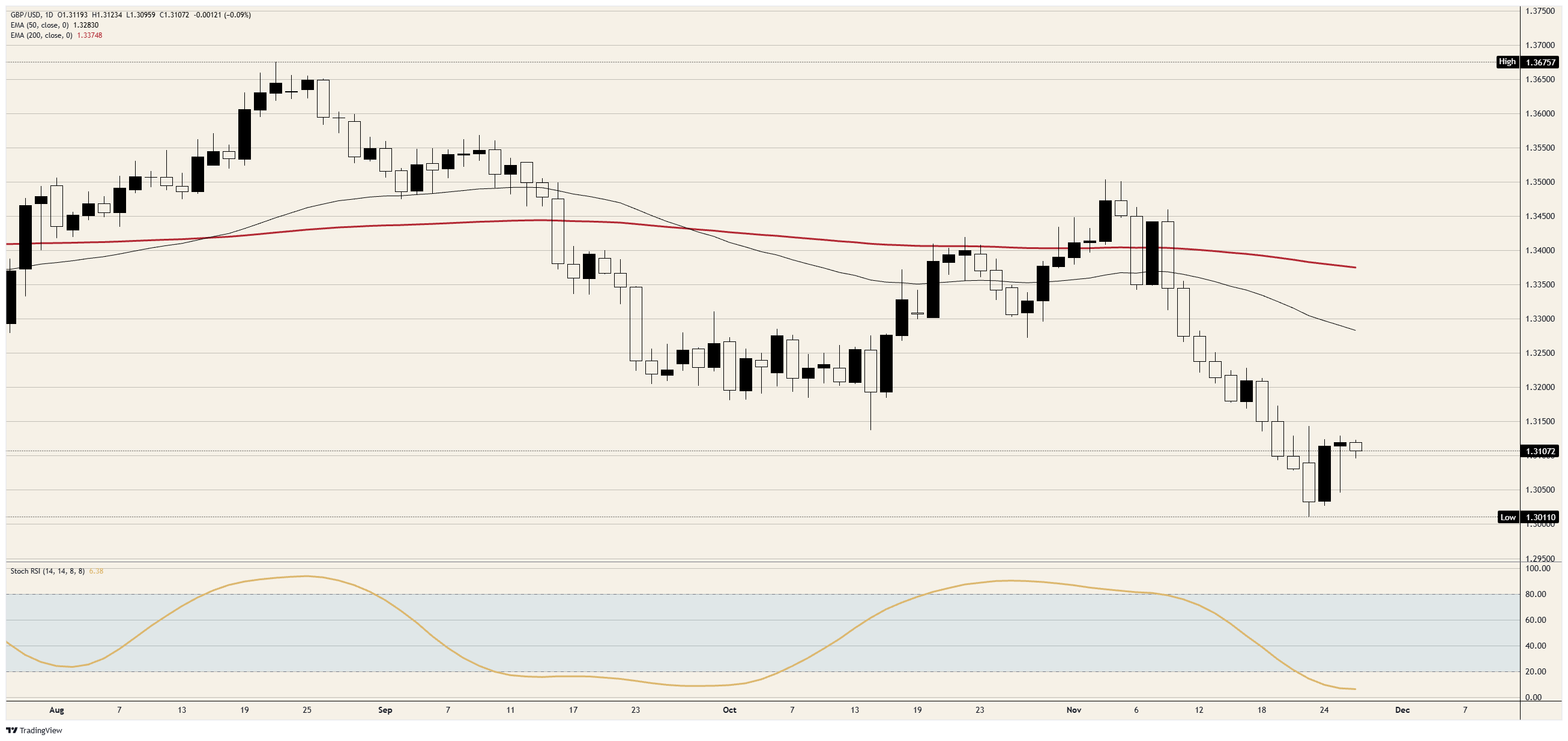
The two-session recovery has retraced about a fifth of the slide from the November 4 high near 1.3500. GBP/USD is below both its 50-day Exponential Moving Average (EMA), just under 1.3300, and its 200-day, just under 1.3400, and the late-August high, just under 1.3700, is the top of the chart's range. Daily momentum is oversold and is still falling.
GBP/USD daily chart
Pound Sterling FAQs
The Pound Sterling (GBP) is the oldest currency in the world (886 AD) and the official currency of the United Kingdom. It is the fourth most traded unit for foreign exchange (FX) in the world, accounting for 12% of all transactions, averaging $630 billion a day, according to 2022 data. Its key trading pairs are GBP/USD, also known as ‘Cable’, which accounts for 11% of FX, GBP/JPY, or the ‘Dragon’ as it is known by traders (3%), and EUR/GBP (2%). The Pound Sterling is issued by the Bank of England (BoE).
The single most important factor influencing the value of the Pound Sterling is monetary policy decided by the Bank of England. The BoE bases its decisions on whether it has achieved its primary goal of “price stability” – a steady inflation rate of around 2%. Its primary tool for achieving this is the adjustment of interest rates. When inflation is too high, the BoE will try to rein it in by raising interest rates, making it more expensive for people and businesses to access credit. This is generally positive for GBP, as higher interest rates make the UK a more attractive place for global investors to park their money. When inflation falls too low it is a sign economic growth is slowing. In this scenario, the BoE will consider lowering interest rates to cheapen credit so businesses will borrow more to invest in growth-generating projects.
Data releases gauge the health of the economy and can impact the value of the Pound Sterling. Indicators such as GDP, Manufacturing and Services PMIs, and employment can all influence the direction of the GBP. A strong economy is good for Sterling. Not only does it attract more foreign investment but it may encourage the BoE to put up interest rates, which will directly strengthen GBP. Otherwise, if economic data is weak, the Pound Sterling is likely to fall.
Another significant data release for the Pound Sterling is the Trade Balance. This indicator measures the difference between what a country earns from its exports and what it spends on imports over a given period. If a country produces highly sought-after exports, its currency will benefit purely from the extra demand created from foreign buyers seeking to purchase these goods. Therefore, a positive net Trade Balance strengthens a currency and vice versa for a negative balance.
Author
Joshua Gibson
FXStreet
Joshua joins the FXStreet team as an Economics and Finance double major from Vancouver Island University with twelve years' experience as an independent trader focusing on technical analysis.