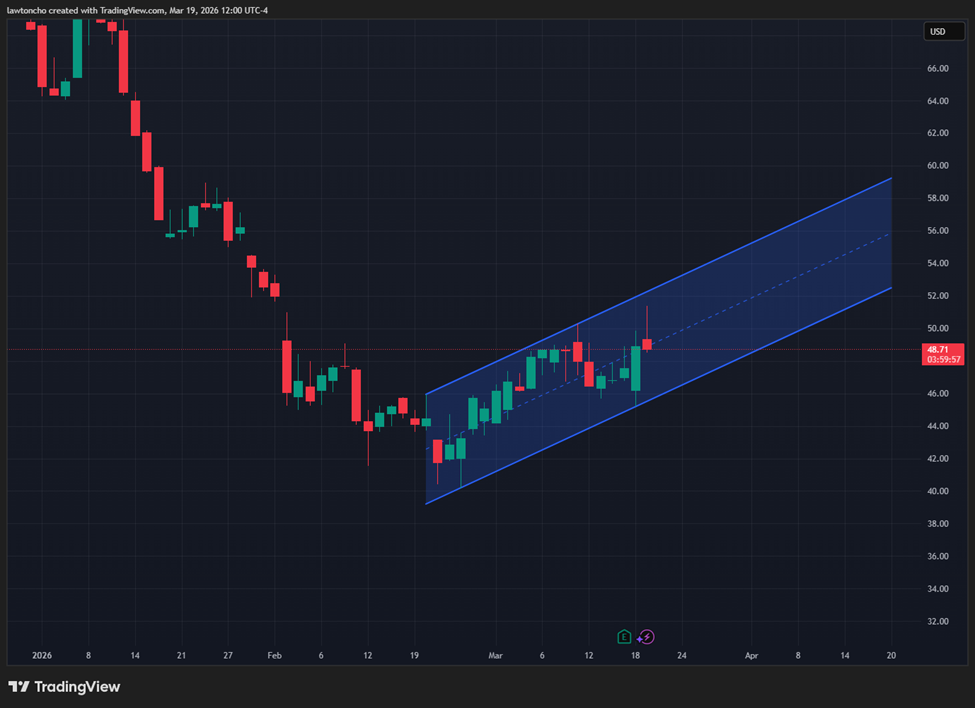
The parallel channel DocuSign is trading in

DocuSign (DOCU) is trading flat today, but the price action over the last couple of sessions has been anything but uneventful. After reporting earnings following the bell on Tuesday, the stock initially reacted negatively, opening roughly 3% below its pre-earnings price.
That kind of reaction typically sets a tone, but what stood out to me here is what happened next. Instead of continuing lower, buyers stepped in, and the stock managed to push higher throughout the session, ultimately closing in positive territory yesterday. That shift in momentum is something I always pay close attention to, especially when it comes right after an earnings reaction.
When I step back and look at the technicals on the daily chart, what I see is DocuSign trading within an upward sloping parallel channel. While upward movement can often look constructive at first glance, this specific structure is generally considered a bearish pattern. It’s one of those setups where price continues to grind higher, but within a defined range that can eventually break down if support fails. The structure itself becomes the key focus rather than just the direction of price.
From a trading perspective, there are a couple of ways I would approach a setup like this. The first is waiting for a confirmed breakdown—specifically, a break below the bottom of the channel. That’s where the structure fails, and where I would look for potential downside continuation. The second approach is more anticipatory, which would involve watching for a retrace back toward the lower boundary of the channel and using that area as a potential short entry. Both approaches rely heavily on respecting the structure that the stock is currently trading within.
For those who may not be as familiar with the company itself, DocuSign is a digital agreement platform that allows individuals and businesses to electronically sign, send, and manage documents. It became widely adopted as companies shifted toward more efficient, remote-friendly workflows, making it a recognizable name across both corporate and individual use cases. Because of this, its earnings and price movements tend to draw attention from both investors and traders.
As always, regardless of how clean a setup may look on the technicals, risk management remains the priority. No pattern is guaranteed to play out, and protecting capital is what allows you to stay in the game long enough to capitalize when they do.
Author

Lawton Ho
Verified Investing
A marketing expert sharing his journey to mastering the charts.