Tesla’s 15% earnings surprise hit by weak outlook for 2026

Tesla’s latest earnings came in stronger than expected, with the company reporting a 15.87% earnings surprise. On paper, that should have been enough to support the stock. Instead, the market looked past the headline beat.
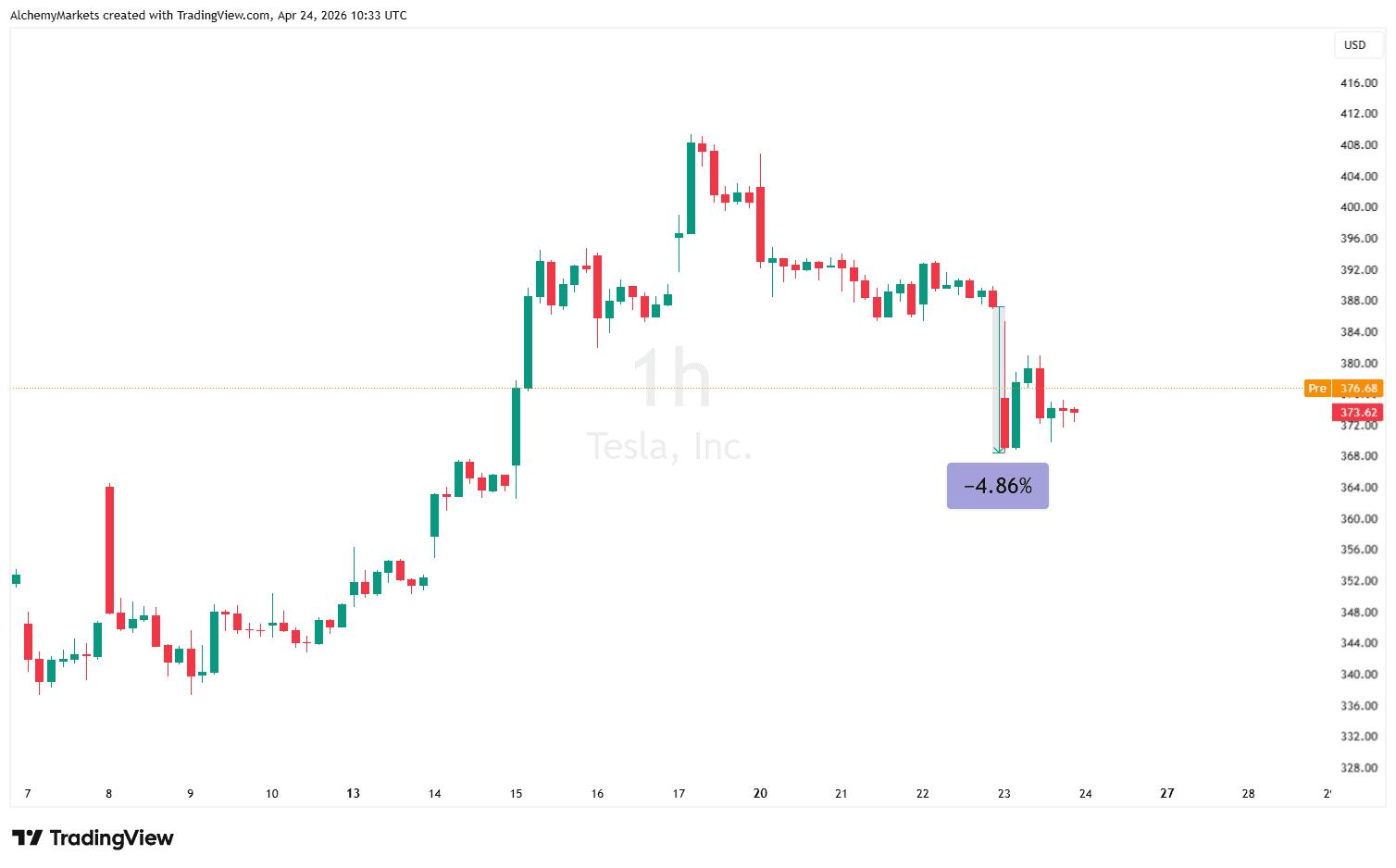
From Wednesday’s close to Thursday’s open, Tesla opened sharply lower, with the first hourly candle dropping by around 4.86%.
The stock later closed the session down roughly 3.4% to 3.7%, near $373 per share.
For investors who only saw the earnings beat, the reaction may have looked confusing. Usually, a positive earnings surprise gives a stock at least some breathing room… So what happened?
Was the good news already priced in?
Or did Tesla’s forward guidance disappoint?
The cleaner answer is probably both. But the bigger issue was the market’s reaction to Tesla’s 2026 spending outlook.
Tesla’s earnings beat was overshadowed by spending fears
The main concern was not Tesla’s latest quarter. It was what comes next.
Elon Musk guided for a sharp increase in capital expenditure, with Tesla now expecting to spend around $25 billion this year. That is roughly $5 billion higher than the previous guidance.
The spending is mainly aimed at scaling Tesla’s next major growth bets, including:
- Cybercab production.
- Robotaxi development.
- Optimus humanoid robots.
- AI and robotics infrastructure.
That sounds exciting from a long-term growth perspective, but the market had a more immediate concern: cash flow.
According to the latest guidance, these projects are expected to weigh on Tesla’s free cash flow for the rest of 2026. In simple terms, Tesla may need to spend heavily now before these businesses generate meaningful revenue later. That is where the market got nervous.
Guidance told investors that the next few quarters could be more expensive, more uncertain, and less cash-generative.
Why investors are not fully buying the AI story yet
Tesla’s long-term bull case is increasingly tied to AI, robotaxis, and Optimus. The problem is that these projects still require a lot of investment before they can prove themselves at scale.
Cybercab and robotaxis have also not fully won over retail investors yet. The idea is ambitious, but the market still wants proof that Tesla can turn it into a reliable commercial business.
Optimus has faced a similar reaction. Some investors see it as a major future opportunity. Others still view it as speculative, expensive, and difficult to monetise in the near term.
That mixed perception matters because Tesla is no longer being judged purely as an electric vehicle company. A large part of its valuation now depends on whether investors believe these AI and robotics projects can eventually justify the spending.
Right now, the market seems to be saying: show us the results first.
Tesla one-hour timeframe technical analysis
On the 1H timeframe, Tesla remains under pressure.
A useful way to view the current structure is through the 1H 50 EMA band, visually drawn using a Bollinger Bands indicator set to 1 standard deviation.
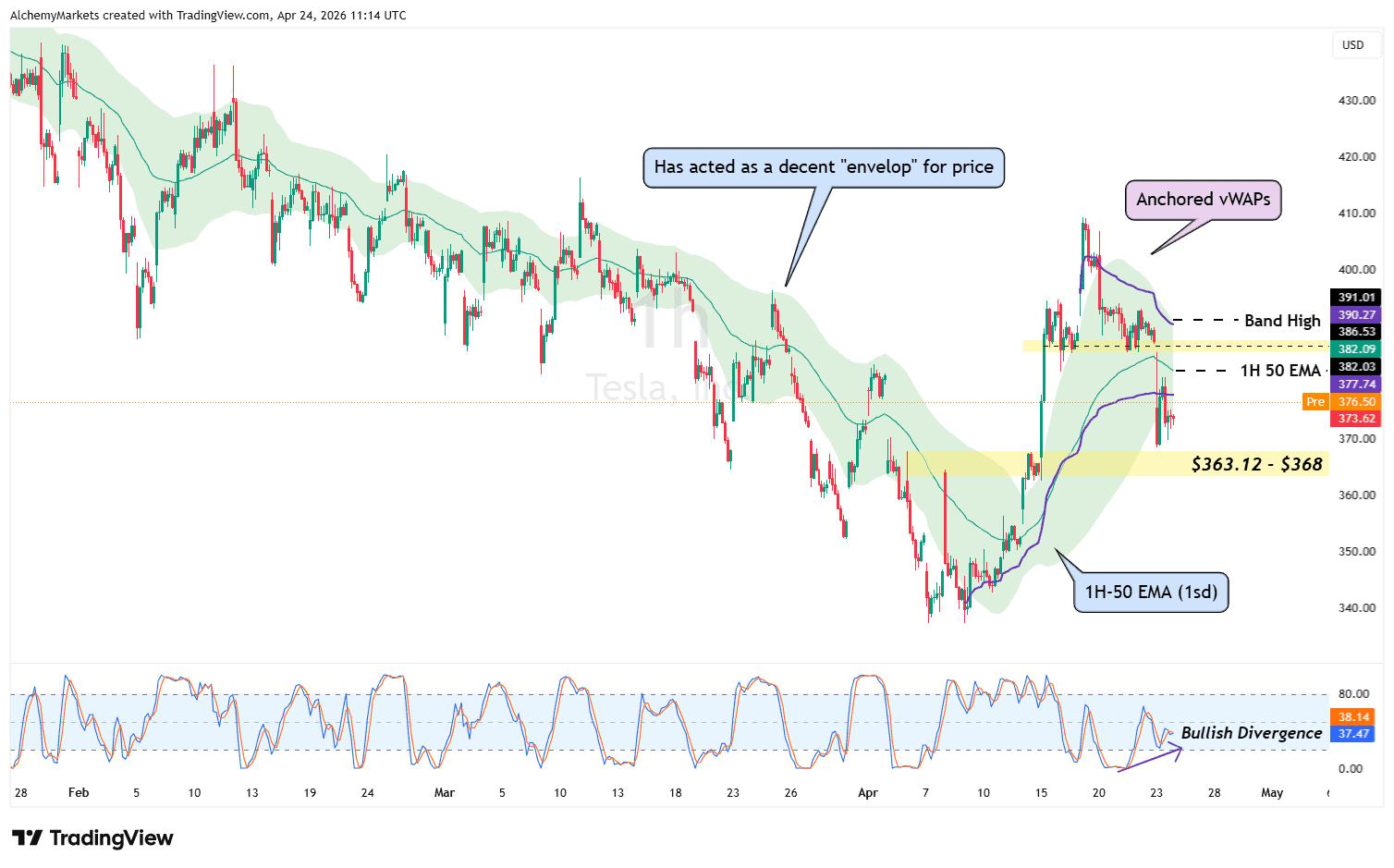
In recent sessions, this band has worked well as both a trend filter and a resistance zone. As long as price remains below the upper side of the band, the short-term bias remains weak.
Anchored VWAPs also help frame the current structure. A VWAP anchored from the recent high around $410 and another from the recent low around $338 both line up closely with the current band structure.
Technically, Tesla remains bearish until it can clear the band high and anchored VWAP resistance around $391.
Resistance levels to watch
The first resistance level sits near the anchored VWAP from the recent low at $377.74.
Above that, Tesla faces the 1H 50 EMA near $382.
The next key zone is the previous gap and prior low area around $385 to $387. If Tesla cannot reclaim this region, the bounce may struggle to gain momentum.
The bigger level remains around $391. A clean move above this zone would start to weaken the bearish short-term structure.
Support levels to watch
The main support and possible take-profit zone sits around $363.12 to $368.
If Tesla holds this region, the stock may attempt to stabilise and form a short-term rebound.
But if this zone breaks, the chart opens the door for a deeper move back toward the recent lows near $338.
Bottom line
Tesla’s earnings surprise was strong, but the market did not treat it as enough.
The stock fell because investors were more focused on the company’s higher spending plans, weaker free cash flow outlook, and the still-uncertain timeline for robotaxis and Optimus.
For now, the technical picture matches the fundamental concern. Tesla remains under short-term pressure unless it can reclaim the $385 to $391 resistance region. Until then, rallies may still be treated as corrective bounces rather than a full bullish reversal.
Author

Zorrays Junaid
Alchemy Markets
Zorrays Junaid has extensive combined experience in the financial markets as a portfolio manager and trading coach. More recently, he is an Analyst with Alchemy Markets, and has contributed to DailyFX and Elliott Wave Forecast in the past.